

Trusted by








.webp)

.webp)

.webp)
Adverse media screening is the systematic review of public information sources to identify negative news, legal actions, regulatory enforcement, or reputational risks associated with a merchant, its beneficial owners, or key management personnel. This process searches news archives, legal databases, enforcement actions, sanctions lists, and digital media to surface material risks before onboarding or during ongoing monitoring.
Payment providers face three critical challenges when relying on traditional screening approaches:
The False Positive Problem Most screening tools generate high volumes of irrelevant matches. Common names, similar entity names, or broad keyword searches produce hundreds of results that require manual review. We see compliance teams spending substantial time dismissing false positives rather than investigating genuine risk signals.
The Coverage Gap No single data source captures all relevant adverse media. Regional news outlets, court filings in secondary jurisdictions, and non-English sources contain material risk information that aggregated databases can miss. Acquirers operating in multiple geographies typically need to search multiple different source types to achieve adequate coverage.
The Decay Problem Adverse media is time-sensitive. A merchant flagged for fraud six months ago may have resolved the issue, changed ownership, or ceased operations. Conversely, a clean screening result becomes outdated within weeks as new litigation, enforcement actions, or news stories emerge. Screening at onboarding without periodic refresh leaves significant blind spots.
Not all merchants require the same screening intensity. We recommend tiering your approach based on:
Most adverse media databases prioritize English-language content, creating coverage gaps in regions where merchants operate. For merchants with UBOs or operations in non-English-speaking jurisdictions:
In our experience, a meaningful proportion of material adverse findings for European merchants appear exclusively in local-language sources.
Not all adverse media findings require rejection. Teams need documented criteria for when to:
Clear escalation workflows prevent bottlenecks and ensure consistent decision-making across reviewers.
Adverse media screening is not a one-time check. We recommend continuous monitoring with alert triggers for:
Automated monitoring reduces the need for manual periodic reviews while surfacing risks as they emerge.
Auditors and regulators expect evidence of screening diligence. For each adverse media review, document:
This creates an audit trail and supports consistent policy application across your portfolio.
An acquirer onboards a UK-based e-commerce merchant selling electronics. During adverse media screening, the compliance team identifies:
Analysis:
Decision: The compliance team approves onboarding with enhanced monitoring: transaction velocity limits for 90 days, weekly review of chargeback rates, and re-screening in six months. This approach balances risk mitigation with avoiding false rejection of a potentially legitimate merchant.
Adverse media screening directly affects three business outcomes:
Regulatory Compliance and Audit Readiness Payment facilitators and acquirers must demonstrate compliance with Anti-Money Laundering (AML) and Know Your Customer (KYC) regulations. Regulators expect documented adverse media screening as part of customer due diligence, consistent with Financial Action Task Force (FATF) guidance on risk-based approaches (FATF Recommendations). Inadequate screening can result in enforcement actions, fines, or restrictions on acquiring licenses.
Portfolio Risk Management Merchants with undisclosed adverse media pose elevated chargeback risk, fraud exposure, and potential association with financial crime. Early detection through screening allows acquirers to decline high-risk applications, apply appropriate monitoring, or structure pricing to reflect true risk levels.
Operational Efficiency Manual adverse media reviews consume compliance resources. Acquirers using automated screening with tuned false positive filters can reduce review time per merchant. This efficiency gain supports faster onboarding cycles without compromising diligence quality.
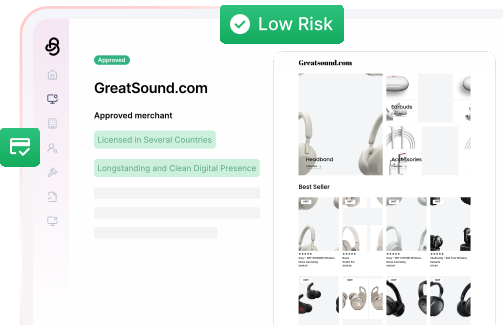
Ballerine's merchant underwriting platform automates adverse media screening across global news sources, legal databases, and regulatory enforcement actions. The system surfaces relevant matches while filtering common false positives. Compliance teams can configure risk-based screening rules, set ongoing monitoring triggers, and maintain audit-ready documentation for every screening decision.
For organizations managing merchant risk at scale, Ballerine integrates adverse media screening into a unified workflow alongside merchant monitoring and partner oversight, ensuring consistent risk evaluation across the entire merchant lifecycle.


Reduced manual efforts
Improved review resolution time
Increase in detected fraud
.webp)

.webp)
.png)
.svg)


.webp)