

Trusted by








.webp)

.webp)

.webp)
A payment gateway is a technology service that securely transmits transaction data from a merchant to a payment processor or acquiring bank. In card-not-present (CNP) environments, the gateway functions as the digital equivalent of a physical point-of-sale terminal, encrypting payment credentials and routing authorization requests through the card network infrastructure.
Choosing and managing a payment gateway presents several challenges for risk teams and operators:
We recommend the following approach when selecting or auditing a gateway provider:
1. Assess security and compliance credentials
Verify that the gateway is PCI DSS Level 1 certified. Confirm that it supports tokenization (replacing card data with non-sensitive tokens) and end-to-end encryption. Review whether the gateway logs transaction data in a way that meets regulatory requirements for your jurisdiction.
2. Map routing and integration requirements
List the processors, acquirers, and PSPs you plan to use. Determine whether the gateway supports direct integration with each. If your business operates across multiple regions or currencies, confirm that the gateway can route transactions based on geography, payment method, or processor availability.
3. Evaluate fraud and authentication capabilities
Check whether the gateway includes native fraud detection tools or integrates with third-party fraud engines. Verify support for 3D Secure 2.0 or equivalent strong customer authentication (SCA) protocols required in markets such as the European Economic Area (EEA).
4. Test performance and failover mechanisms
Run load testing to understand the gateway's uptime, latency, and transaction throughput. Identify whether the gateway supports failover routing (automatic switching to a backup processor if the primary one is unavailable). Document what happens when authorization requests time out or fail.
5. Review reporting and reconciliation features
Ensure that the gateway provides transaction-level reporting with sufficient detail for reconciliation. Confirm that it generates logs or exports compatible with your existing financial and fraud monitoring systems.
A payment gateway sits between the merchant's checkout interface and the payment processor. When a customer submits payment credentials, the gateway captures the data, encrypts it, and transmits it to the processor. The processor forwards the request to the card network (such as Visa or Mastercard), which routes it to the issuing bank. The issuer responds with an approval or decline, and the message travels back through the same path.
This flow means the gateway does not underwrite merchants or assume liability for chargebacks. Its function is limited to secure data transmission and, in some cases, preliminary fraud checks. Acquirers and PSPs bear the financial risk. Risk teams at acquirers or PayFacs (Payment Facilitators) should understand that a gateway alone does not provide comprehensive fraud prevention or merchant due diligence. These functions require layered controls, including merchant underwriting, ongoing transaction monitoring, and policy enforcement.
In markets with complex regulatory requirements (for example, mandatory SCA in the EEA, or consumer protection rules in certain jurisdictions), the gateway must support compliance features such as 3D Secure or region-specific authentication flows. Failing to implement these can result in authorization declines, higher chargeback rates, or regulatory action.
A marketplace operating in the United States and the European Union processes payments through two acquirers: one specialized in USD transactions, the other in EUR. The marketplace uses a gateway that supports intelligent routing.
When a buyer in Germany initiates a purchase, the gateway identifies the transaction as EUR-denominated and routes it to the European acquirer. If that acquirer experiences downtime, the gateway automatically fails over to a secondary processor that supports EUR. This reduces authorization declines and maintains a consistent customer experience.
Without intelligent routing, the marketplace would need to hardcode processor selection in its application logic. This increases development complexity and slows response to operational issues such as processor outages or changes in interchange fees.
Payment gateways are one component in a broader risk infrastructure. Effective merchant risk management also requires:
For more on how risk teams structure these controls, see the PCI DSS compliance framework and card network requirements for merchant monitoring.
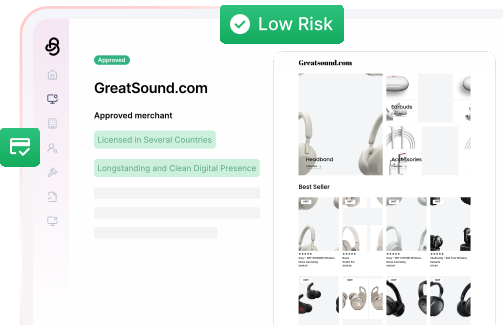
Ballerine provides merchant risk management tools designed for acquirers, PSPs, and PayFacs. Our platform integrates with payment gateways and processors to automate merchant underwriting, continuous monitoring, and policy enforcement.
We enable risk teams to:
Our system connects to existing gateway and processor APIs, reducing integration time and allowing teams to extend their risk infrastructure without replacing existing tools.


Reduced manual efforts
Improved review resolution time
Increase in detected fraud
.webp)

.webp)
.png)
.svg)


.webp)