

Trusted by








.webp)

.webp)

.webp)
PEP screening is the process of identifying whether a merchant, business owner, or ultimate beneficial owner (UBO) holds or has recently held a prominent public position (such as senior government official, judge, military leader, or head of a state-owned enterprise) to determine if enhanced due diligence (EDD) is required under anti-money laundering (AML) regulations.
PEPs present elevated risk for corruption, bribery, and illicit financial activity due to their access to public funds and political influence. Acquirers, payment service providers (PSPs), and financial institutions are legally required to identify PEP status during merchant onboarding and apply stricter monitoring controls throughout the business relationship.
PEP databases often contain limited identifying information (name, birth year, country), leading to false matches with common names. A merchant named "John Smith" may match dozens of PEP records globally, requiring manual review to disambiguate. This creates operational bottlenecks and delays legitimate merchants.
Different regulators define PEPs differently. The Financial Action Task Force (FATF) includes heads of state, senior politicians, and high-ranking military officers, but local AML regimes vary on whether family members, close associates, or former PEPs (after a certain time period) require EDD. Payment providers operating across multiple jurisdictions must reconcile these definitions.
PEP status changes over time. An individual who was not a PEP at onboarding may later be appointed to a government role. Similarly, a former PEP may no longer require EDD after stepping down (depending on local rules). Continuous monitoring is necessary but resource-intensive, particularly for merchant monitoring at scale.
When a PEP is identified, risk teams must investigate the origin of their wealth and the specific funds used in the business relationship. This requires documentation (tax filings, employment records, asset disclosures) and may involve politically sensitive inquiries, particularly in jurisdictions with weak rule of law.
No single PEP database is comprehensive.
We recommend combining:
Cross-referencing reduces false negatives (missed PEPs) and provides corroborating evidence for positive matches.
Automated PEP screening should use fuzzy matching algorithms to account for name variations, transliterations, and common misspellings. However, any match above a low threshold (e.g., 70% similarity) should trigger manual review rather than automatic rejection.
Risk analysts should verify:
If insufficient data is available to confirm or rule out a match, request additional documentation from the merchant.
Enhanced due diligence for PEPs typically includes:
Document these steps in your AML policy and train underwriting teams on when to escalate. Effective merchant underwriting requires clear workflows for PEP risk assessment and approval.
Many jurisdictions allow reduced scrutiny for individuals who have not held a prominent position for a certain period (commonly 12-18 months).
Consult local AML regulations and define:
Without clear rules, risk teams may apply inconsistent controls or waste resources on outdated risks.
5. Automate Continuous Monitoring
PEP status is not static. Implement automated re-screening at defined intervals (quarterly or semi-annually) and trigger alerts when:
Continuous monitoring ensures compliance with ongoing due diligence requirements and reduces surprise findings during audits.
A payment facilitator (PayFac) onboards an e-commerce merchant selling luxury goods. During UBO verification, the compliance team identifies that one of the beneficial owners (25% stake) is a former deputy minister of transportation in an Eastern European country. The individual left office 14 months ago.
The risk team escalates the case for EDD. They request:
The UBO provides documentation showing that the funds originated from the sale of a family property, supported by a notarized real estate transaction. The risk team approves the merchant with enhanced monitoring (monthly transaction review and quarterly re-screening for sanctions or adverse media). They document that the former PEP no longer requires full EDD after the 18-month threshold per their jurisdiction's AML regulations, but will maintain closer scrutiny for the first year of the relationship.
Six months later, automated monitoring flags that the former minister has been appointed as a board member of a state-owned bank. The risk team re-applies full PEP EDD controls and requests updated source of funds documentation.
AML regulations in most jurisdictions (including the EU's 5th AML Directive, the U.S. Bank Secrecy Act, and FATF recommendations) explicitly require financial institutions to identify PEPs and apply EDD. Failure to screen for PEPs or document EDD decisions exposes payment providers to regulatory fines, enforcement actions, and reputational damage. Auditors and regulators will review PEP screening logs, match resolution records, and EDD documentation during examinations.
Processing payments for a PEP later linked to corruption or sanctions can result in negative media coverage, customer attrition, and loss of banking relationships. Even if the payment provider was unaware of the PEP status at onboarding, the association with financial crime damages credibility with partners, regulators, and the public.
PEPs are statistically more likely to be involved in bribery, embezzlement, and money laundering schemes due to their access to public resources.
Identifying PEP status early allows risk teams to scrutinize transaction patterns for red flags such as:
Early detection reduces exposure to illicit funds and limits liability if the merchant is later investigated by law enforcement.
In payment facilitation and marketplace models, a single PEP merchant can create systemic risk. If the PEP is involved in a public scandal, the platform may face scrutiny over its onboarding and monitoring processes. Additionally, banking partners (sponsor banks, card networks) may impose penalties or terminate relationships if they perceive inadequate PEP controls. Acquirers and payment facilitators need robust partner oversight to manage these cascading risks.
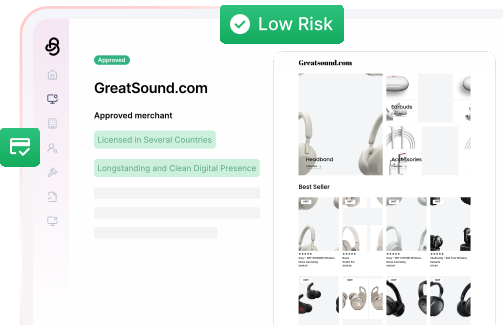
Ballerine's merchant risk management platform integrates PEP screening into the onboarding workflow, combining automated database checks with case management tools for manual review.
Risk teams can:
For payment facilitators and acquirers managing high merchant volumes, Ballerine's merchant monitoring solution tracks PEP status changes over time and flags behavioral anomalies in PEP-linked accounts, reducing manual oversight while maintaining regulatory compliance.



Reduced manual efforts
Improved review resolution time
Increase in detected fraud
.webp)

.webp)
.png)
.svg)


.webp)