The Visa Acquirer Monitoring Program (VAMP) is Visa's unified compliance framework for monitoring and managing merchant risk across fraud, disputes, and content integrity. Effective April 1, 2025, VAMP consolidates legacy programs (Visa Integrity Risk Program, Visa Fraud Monitoring Program, and Visa Dispute Monitoring Program) into a single lifecycle-based system that shifts enforcement from reactive outlier detection to continuous portfolio-wide risk evaluation.
Why VAMP Is a Challenge for Payment Providers
VAMP fundamentally changes how acquirers, payment facilitators (PayFacs), and independent sales organizations (ISOs) manage merchant risk. Where legacy programs focused on flagging extreme outliers after breaches occurred, VAMP requires continuous monitoring across an entire merchant portfolio with standardized global thresholds.
Core Challenges:
- Broader Liability Scope: Acquirers are now responsible for merchant violations across fraud, chargebacks, and prohibited content simultaneously. A merchant may pass fraud checks but fail on content monitoring (e.g., selling unlicensed pharmaceuticals).
- Proactive Detection Requirements: Payment providers must identify risk signals before merchants cross VAMP thresholds. Reactive controls that trigger only after chargebacks spike are insufficient under the new framework.
- Portfolio-Wide Accountability: Visa evaluates acquirers based on aggregate merchant performance. Repeated violations across a portfolio can result in compliance plans, financial penalties, or required merchant terminations regardless of individual merchant profitability.
- Data Integration Gaps: Effective VAMP compliance requires integrating transaction data, dispute records, and website content monitoring. Payment providers relying on siloed data sources struggle to build unified risk views.
How to Build an Effective VAMP Compliance Program
Payment providers that treat VAMP as a checklist exercise rather than a systemic risk management upgrade consistently fail audits and incur enforcement actions. Compliance requires both structural changes and operational discipline.
1. Establish Baseline Merchant Risk Profiles at Onboarding
Conduct comprehensive merchant due diligence before activation:
- Website and content review: Verify the merchant is not selling prohibited goods (counterfeit products, unlicensed pharmaceuticals, adult content in violation of acceptable use policies).
- Business model validation: Confirm the merchant category code (MCC) aligns with actual business operations. Misclassified merchants (e.g., nutraceutical sellers coded as general retail) create immediate VAMP exposure.
- Historical performance checks: For merchants with prior processing history, review chargeback ratios, fraud rates, and any previous program violations across the card network ecosystem.
Acquirers with weak merchant onboarding controls consistently onboard high-risk merchants that later breach VAMP thresholds, creating portfolio-wide risk.
2. Implement Real-Time Transaction and Behavioral Monitoring
VAMP thresholds are calculated on rolling 30-day windows. Waiting for monthly reconciliation reports to identify risk creates a structural delay that results in threshold breaches before corrective action is possible.
Deploy systems that:
- Track fraud and chargeback velocity in real time: Monitor daily merchant performance against VAMP thresholds (e.g., fraud-to-sales ratio, chargeback count per transaction volume).
- Detect behavioral anomalies: Sudden spikes in transaction volume, changes in average ticket size, or geographic distribution shifts can indicate compromised accounts or merchant misconduct.
- Integrate dispute data immediately: Link chargeback reasons (e.g., "product not received", "unauthorized transaction") to merchant operations to distinguish operational failures from fraud patterns.
We see payment providers with strong merchant monitoring infrastructure identify at-risk merchants 10-15 days before VAMP thresholds are breached, allowing time for merchant engagement or processing restrictions.
3. Conduct Continuous Website and Content Monitoring
VAMP includes content integrity as a core risk pillar. Merchants may shift to selling prohibited goods after approval, and acquirers are responsible for detecting these changes.
Effective content monitoring includes:
- Periodic website scraping: Review merchant websites weekly or monthly to detect changes in product catalogs, terms of service, or customer complaint patterns.
- Keyword and image analysis: Identify prohibited terms (e.g., "replica", "generic Viagra") or visual indicators of counterfeit goods in product listings.
- Cross-referencing external databases: Compare merchant domains against known fraud lists, regulatory enforcement databases, and intellectual property violation records.
We recommend automated monitoring systems that flag content changes for manual review. Pure automation without human oversight creates false positives (e.g., flagging legitimate pharmaceutical merchants with proper licensing), but manual-only processes fail to scale.
4. Define Merchant Intervention Protocols
When merchants approach VAMP thresholds, payment providers must have predefined escalation workflows:
- Threshold proximity alerts (70-80% of limit): Contact merchants to review operational issues. For chargeback spikes, investigate fulfillment delays, product quality complaints, or unclear billing descriptors.
- Processing restrictions (80-90% of limit): Implement temporary holds, reduce processing limits, or require additional reserves until the merchant demonstrates corrective action.
- Mandatory termination (threshold breach): Once VAMP thresholds are exceeded, Visa typically requires acquirers to terminate the merchant relationship unless extraordinary circumstances justify continued processing.
Payment providers without clear escalation protocols often delay action, leading to prolonged violations and compounding penalties.
5. Maintain Documentation and Audit Readiness
Visa audits VAMP compliance through periodic reviews of acquirer controls, merchant files, and remediation actions. Payment providers must retain evidence of:
- Merchant onboarding due diligence (website reviews, business validation, ownership verification)
- Monitoring system configurations and alert thresholds
- Merchant communications regarding threshold proximity or violations
- Termination decisions and supporting rationale
We typically advise maintaining documentation for a minimum of 24 months to satisfy audit requirements and demonstrate good-faith compliance efforts.
VAMP in Practice: A Real-World Scenario
An acquirer onboards a merchant classified under MCC 5999 (Miscellaneous and Specialty Retail) selling wellness supplements. Initial underwriting finds no red flags. The merchant's website lists standard vitamin products, and the business owner provides clean background checks.
Three months after activation, the acquirer's monitoring system detects:
- Chargeback ratio increase: The merchant's chargeback rate rises from 0.3% to 1.2% in a 30-day period (VAMP threshold: 1.5%).
- Chargeback reason concentration: 80% of disputes cite "product not as described" or "unauthorized recurring billing".
- Website content change: A periodic website scrape identifies new product listings for "cognitive enhancement supplements" with ambiguous health claims that approach prohibited pharmaceutical territory.
The acquirer's risk team reviews the merchant file and identifies:
- The merchant implemented a subscription billing model post-onboarding without notifying the acquirer
- Marketing emails include aggressive upsell tactics that confuse customers about billing terms
- Product descriptions contain unsubstantiated health claims that violate FDA regulations
Outcome: The acquirer places the merchant on processing restrictions, requiring pre-approval for all subscription enrollments and removal of prohibited health claims. When the merchant fails to comply within 14 days, the acquirer terminates the relationship before VAMP thresholds are breached. Visa reviews the case during a quarterly audit and finds the acquirer's actions reasonable and timely, avoiding penalties.
Counterfactual: If the acquirer had not detected the website changes and chargeback trends proactively, the merchant would have breached VAMP thresholds within 10-15 additional days. The acquirer would face fines, mandatory compliance plan submission, and potential restrictions on onboarding similar merchant categories.
Strategic Context: VAMP's Impact on the Payments Ecosystem
VAMP represents a strategic shift in how card networks manage systemic risk. By holding acquirers accountable for portfolio-wide merchant performance, Visa aims to reduce fraud and dispute losses network-wide while improving cardholder experience.
Implications for Payment Providers:
- Higher operational costs: Compliance requires investment in monitoring technology, content analysis tools, and risk analyst headcount. Small acquirers and ISOs without scale struggle to absorb these costs.
- Merchant selectivity pressure: Payment providers increasingly avoid high-risk merchant categories (nutraceuticals, adult content, cryptocurrency-related services) due to VAMP exposure. This concentrates risk on specialized high-risk acquirers.
- Competitive advantage for compliance infrastructure: Acquirers with sophisticated risk monitoring systems can onboard merchants faster, detect issues earlier, and avoid enforcement actions. This creates a structural advantage over competitors relying on manual processes.
Implications for Merchants:
- Greater underwriting scrutiny: Merchants in ambiguous or elevated-risk categories face longer approval timelines, higher reserve requirements, and more frequent reviews.
- Faster terminations: Payment providers are less tolerant of merchants approaching VAMP thresholds. We see merchants with historically acceptable chargeback rates (0.8-1.0%) terminated preemptively to avoid acquirer liability.
- Transparency requirements: Merchants must proactively communicate business model changes, product expansions, or operational issues to acquirers. Failure to do so creates compliance risk for both parties.
How Ballerine Supports VAMP Compliance
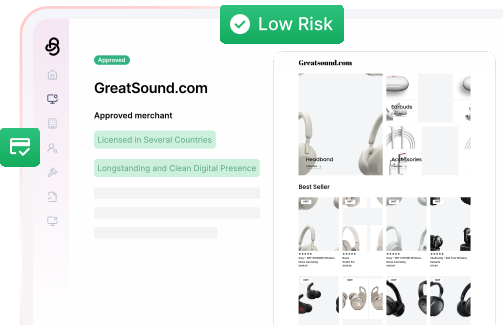
Ballerine provides merchant risk intelligence infrastructure designed specifically for VAMP requirements. Our platform integrates onboarding due diligence, transaction monitoring, and website content analysis into a unified workflow that enables payment providers to:
- Detect risk signals before VAMP thresholds are breached: Real-time monitoring of fraud rates, chargeback velocity, and behavioral anomalies with configurable alerting based on acquirer risk appetite.
- Automate website and content monitoring at scale: Periodic scraping, keyword analysis, and visual content review across entire merchant portfolios without manual effort.
- Maintain audit-ready documentation: Centralized evidence repository for onboarding files, monitoring configurations, merchant communications, and remediation actions that satisfies Visa audit requirements.
Payment providers using Ballerine typically reduce VAMP violation rates by 40-60% within the first six months of implementation by identifying at-risk merchants earlier and taking corrective action before enforcement is required.










.webp)

.webp)

.webp)



.webp)

.webp)
.png)
.svg)


.webp)