

Trusted by








.webp)

.webp)

.webp)
Mastercard is a global payment network that establishes the compliance framework, risk standards, and enforcement mechanisms that govern how acquirers, payment service providers (PSPs), and payment facilitators (PayFacs) must underwrite, monitor, and manage merchants.
Mastercard's role extends beyond payment processing. It defines the risk thresholds, merchant transparency requirements, and enforcement protocols that determine whether a merchant portfolio remains compliant or faces sanctions. The card scheme monitors fraud rates, chargeback ratios, and merchant behavior patterns through network-level surveillance. When thresholds are breached, acquirers face fines, increased reserves, or loss of processing rights.
Key challenges for risk teams include:
Compliance is not a static checklist. Acquirers must build systems that detect, assess, and respond to risk before it triggers network enforcement.
We recommend the following operational controls:
Configure alerts that trigger when individual merchants approach 0.9% fraud rates or 1% chargeback ratios (the typical thresholds for review). Do not wait until breaches occur. We see teams that monitor at 75% of the threshold gain an average of 14 additional days to investigate and intervene before formal enforcement begins.
Transaction laundering (when a merchant processes payments for undisclosed third parties) is a top Mastercard enforcement priority.
Risk teams should flag merchants that exhibit:
We advise running weekly queries against processing data to identify these patterns before Mastercard's automated systems do.
Certain merchant categories trigger elevated scrutiny from Mastercard, including nutraceuticals (MCC 5499), telemarketing services (MCC 5967), and dating services (MCC 7273). For these categories, baseline Know Your Business (KYB) checks are insufficient.
We look for evidence such as:
Acquirers that implement category-specific underwriting workflows reduce their exposure to scheme violations by building a defensible rationale for why they approved a merchant, even if that merchant later becomes problematic.
Mastercard's MMSP program certifies third-party risk intelligence providers that meet the card scheme's standards for merchant risk assessment, portfolio monitoring, and compliance reporting. MMSP partners deliver standardized merchant risk data, underwriting intelligence, and early warning indicators that align with Mastercard's enforcement criteria.
The MMSP certification process requires providers to demonstrate technical capabilities in areas such as:
Participation in the MMSP program does not exempt acquirers from liability, but it provides a structured approach to meeting Mastercard's merchant transparency requirements. We usually advise teams to integrate MMSP data feeds into their existing case management systems rather than treating them as standalone reports. This allows risk analysts to correlate MMSP flags with internal transaction data, creating a more complete view of merchant behavior.
Ballerine operates as a certified Mastercard MMSP partner, providing acquirers with compliance-grade merchant intelligence that meets the card scheme's technical and reporting standards.
When Mastercard initiates an investigation, acquirers must produce evidence that they followed appropriate underwriting and monitoring procedures.
This means maintaining records of:
We've seen investigations close more favorably when acquirers can demonstrate a documented, repeatable risk assessment process, even if that process ultimately approved a merchant that later violated scheme rules.
Mastercard enforcement actions create cascading operational and financial consequences. A merchant placed into an Excessive Chargeback Program (ECP) or Excessive Fraud Merchant (EFM) program triggers immediate reserve increases (typically 100% of monthly processing volume) and monthly fines (starting at $25,000 and escalating with continued non-compliance). If the merchant cannot remediate within the designated timeframe, the acquirer must terminate the relationship or face portfolio-level sanctions.
Beyond direct fines, non-compliance creates second-order costs:
An acquirer onboarded a registered e-commerce merchant selling handmade crafts. Initial underwriting appeared clean. The merchant processed $80,000 in monthly volume with a 0.3% chargeback rate.
Six months into the relationship, the merchant's volume increased to $420,000 per month. Mastercard flagged the account due to descriptor inconsistencies. Cardholder complaints revealed the merchant was processing payments for multiple unregistered sellers operating through a private Facebook group. None of these sellers had been underwritten by the acquirer.
Mastercard classified this as transaction laundering and placed the acquirer into a compliance program requiring enhanced monitoring of all merchants with similar transaction patterns. The acquirer faced $75,000 in fines and was required to terminate the merchant immediately. The remediation process took four months and required manual reviews of 200+ merchants in related MCCs.
This case demonstrates why transaction pattern analysis must be ongoing, not just performed during initial onboarding. The merchant's early behavior was compliant, but operational changes went undetected until Mastercard's network-level surveillance identified the violations.
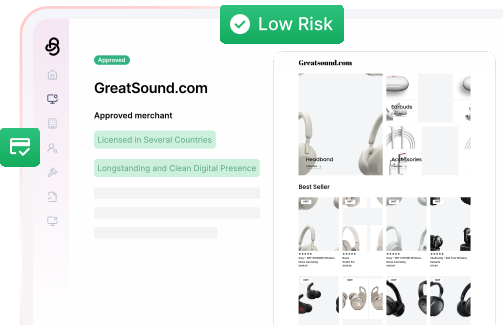
As a certified Mastercard MMSP partner, Ballerine provides acquirers and PSPs with merchant monitoring and underwriting infrastructure that meets the card scheme's compliance standards. The platform automates chargeback and fraud rate tracking, flags descriptor mismatches, and correlates transaction patterns against historical baselines. Risk teams receive alerts when merchants approach Mastercard thresholds, with investigation workflows that document all remediation actions for scheme audits.
The MMSP-certified capabilities include continuous merchant website verification, business legitimacy checks, and portfolio-level risk analytics aligned with Mastercard's transparency requirements. This certification ensures that risk intelligence delivered through the platform meets the technical standards Mastercard expects from its monitoring service providers, reducing the compliance burden on acquirers while maintaining scheme adherence.
Reduced manual efforts
Improved review resolution time
Increase in detected fraud
.webp)




.webp)
.png)
.svg)


.webp)