


Related Questions

.png)
Gain a structured, verification-ready framework for detecting merchant business model misrepresentation, with operational assessment protocols and risk controls tailored for risk and compliance leaders.
Merchant onboarding reviews typically focus on the homepage: clean design, professional copy, benign product descriptions. But the homepage is marketing. The truth lives in the checkout items, refund policies, delivery timelines, FAQ sections, metadata, linked domains, and customer support scripts.
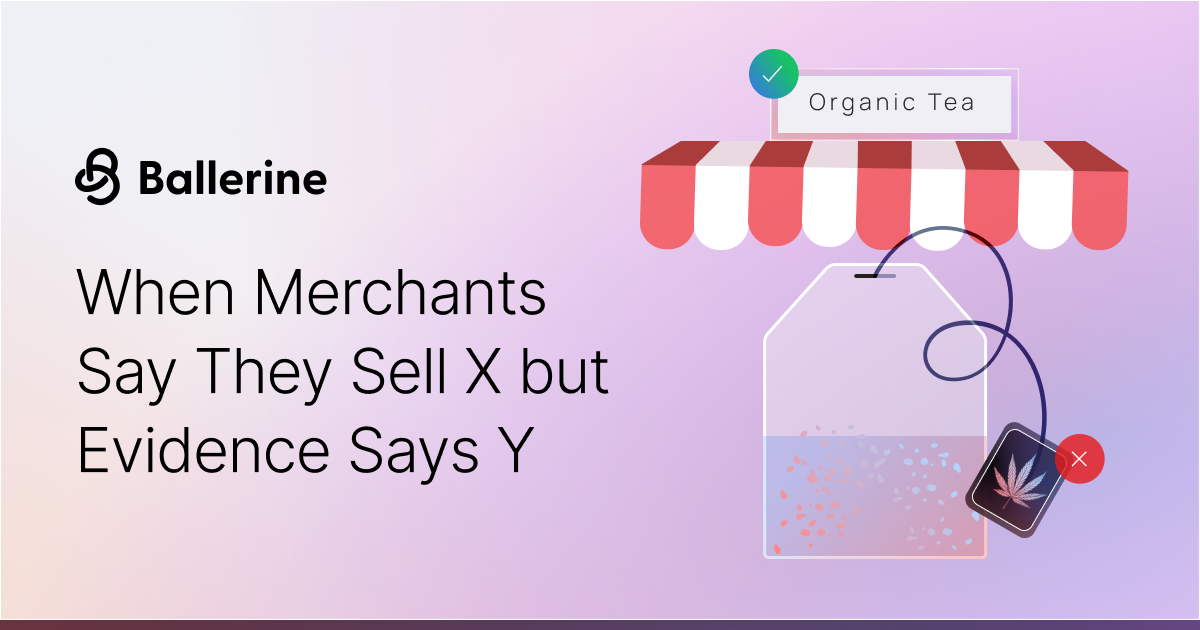
When merchants claim to sell one thing but operational evidence reveals another, the consequences extend beyond simple fraud detection. Misclassified merchants create regulatory exposure, card scheme violations, unexpected chargebacks, and reputational risk for acquirers and payment facilitators.
The stakes:
Processors who fail to accurately classify merchant business models face card scheme fines, regulatory scrutiny, and financial losses from elevated chargeback rates. Getting classification right requires moving beyond stated descriptions to examine operational evidence.
The complete resource includes:
Card schemes have intensified monitoring of merchant classification accuracy, with particular focus on high-risk businesses operating under low-risk MCCs (Merchant Category Codes).
Violations result in compliance reviews, fines, and increased scrutiny of merchant portfolios.
Misrepresenting merchants no longer simply select the wrong MCC. They build multi-layered facades including professional storefronts, compliant-looking policies, and segregated inventory that reveals restricted products only to qualified buyers.
Traditional underwriting that relies on homepage review and merchant-provided documentation cannot detect these patterns.
When high-risk merchants process as low-risk, reserves and risk controls are insufficient. Gambling operators presenting as software companies, CBD retailers claiming to sell cosmetics, and pharmaceuticals hidden behind supplement storefronts each carry chargeback rates and regulatory requirements that standard controls do not address.
The gap between actual risk and assigned controls becomes financial exposure.
Read the complete detection guide →
Essential assessment breaks down into four core areas:
The homepage shows what the merchant wants you to see. The full catalog shows what they are actually selling.
Risk teams that only review landing pages miss the real inventory. We examine complete product catalogs, hidden categories, and SKUs that do not appear in top-level navigation.
Critical verification includes discovering products accessible only via direct URLs or search (not linked from navigation), identifying generic product descriptions masking restricted items, and analyzing volume and pricing inconsistencies that indicate counterfeits or unauthorized goods.
Testing protocols include full site crawls to discover all pages, search testing for high-risk product terms, account creation to verify if login reveals additional inventory, and checkout simulation across product types.
The checkout process reveals the merchant's actual business model. Payment terms, shipping options, and final itemization expose what is really being sold.
We see discrepancies between storefront presentation and checkout reality: sites presenting as physical goods retailers that offer only digital delivery, or trial offers that convert to subscriptions at checkout.
Essential checks include verifying transaction descriptors match the business name and claimed model, confirming delivery timelines align with product type, detecting hidden recurring charges or subscription conversions, and examining payment method restrictions that suggest processor avoidance.
What distinguishes legitimate operations from concealment is consistency: the transaction descriptor, delivery method, and final charges should align precisely with storefront claims.
Refund policies, terms of service, and FAQ sections reveal operational reality. Restrictive or unusual policies indicate the merchant may be selling something different than advertised.
We examine policy documents for internal consistency and alignment with stated business model. Discrepancies are evidence of misrepresentation.
Key analysis includes comparing business descriptions in terms of service against storefront claims, evaluating whether refund policies are appropriate for product type, examining jurisdiction mismatches between claimed location and governing law, and identifying liability disclaimers disproportionate to stated business.
FAQ sections contain information about actual operations, with questions sometimes referencing undisclosed products or compliance requirements for different industries than claimed.
Domain registration, hosting infrastructure, site metadata, and technical fingerprints reveal operational reality beyond what merchants claim.
We examine technical evidence to identify networks of related sites, shell operations, and sophisticated misrepresentation schemes.
Critical analysis includes domain age and registration transparency verification, metadata consistency checks between technical markup and visible content, reverse analytics searches to identify undisclosed domain networks, and third-party service patterns that reveal actual customer base or operational needs.
Merchants operating networks of storefronts share analytics tracking codes, payment processors, or template designs across domains, exposing relationships they do not disclose during onboarding.
Read the complete detection guide →
Organizations that implement these assessment protocols can gain:
Classification accuracy
Operational verification that ensures merchants are assigned correct MCCs and risk profiles, reducing card scheme compliance violations.
Risk exposure reduction
Detection of high-risk businesses before processing begins, allowing proper reserve allocation and monitoring controls.
Regulatory confidence
Clear evidence that merchant classification relies on verified operational data rather than merchant self-reporting, reducing examination risk.
Operational efficiency
A systematic assessment framework teams can apply consistently, eliminating subjective judgment and repeated classification errors.
Defensible decisions
Documentation standards demonstrating that classification decisions are based on thorough investigation of operational evidence, not surface-level review.
Ballerine provides infrastructure to make ongoing consistency verification manageable at scale: automated website monitoring to detect when merchants add restricted products or change business models post-onboarding, ecosystem mapping to reveal connections between domains and identify operator networks, and checkout flow analysis to verify that transaction presentation remains consistent with merchant representations.
The foundational knowledge in this guide equips risk teams to ask the right questions during merchant onboarding: what appears in the checkout that does not appear on the homepage, who receives the funds and under what business name, what do the refund policies and FAQs reveal about actual operations, and what does the technical infrastructure tell us about the merchant's network and history. These operational realities determine accurate classification, regardless of what the merchant claims.
For continuous monitoring of merchant consistency across your entire portfolio, our merchant monitoring capabilities maintain visibility into catalog changes, policy updates, and technical infrastructure evolution, detecting business model drift before compliance exposure accumulates.
.png)


.svg)
.svg)
.svg)
.svg)
.svg)
.svg)
.svg)
.svg)
.png)


