How to Detect Prohibited Activity Hiding Inside Marketplaces
How to Detect Prohibited Activity Hiding Inside Marketplaces
This guide provides a systematic approach for marketplaces to detect and prevent prohibited seller activity before it scales, offering a detailed framework to identify hidden violations, enforce category rules, and maintain platform integrity through active monitoring and rapid response.
Prohibited activity in marketplaces occurs when sellers list, promote, or sell products or services that violate platform policies, legal requirements, or category restrictions. Unlike traditional merchant processing where a single entity controls inventory and branding, marketplaces create a distributed risk environment where thousands of sellers operate with varying degrees of oversight.
The marketplace model introduces a fundamental risk asymmetry: the platform is legally and financially liable for seller conduct, but sellers control the actual listings, fulfillment, and customer interactions.
Scale and Impact
Prohibited activity in marketplaces represents significant regulatory and reputational exposure.
The U.S. Consumer Product Safety Commission (CPSC) has increasingly focused on marketplace platforms. In 2021, the CPSC issued a unanimous ruling that Amazon is legally a "distributor" of third-party products sold on its platform, making it liable for recalls and safety violations.
Card networks have established programs to monitor platforms for prohibited seller activity. Platforms processing payments for sellers engaged in counterfeit sales, prohibited goods, or undisclosed high-risk activity face potential fines, audits, or termination of acquiring relationships.
In our experience working with marketplace operators, newly onboarded sellers exhibit prohibited activity indicators within the first 90 days at rates that make manual review insufficient. Not all cases represent intentional policy violations, but the volume of seller-generated content requires systematic detection.
Common Prohibited Activity Scenarios
Category drift:
Seller approved for apparel listings begins selling electronics, supplements, or other unrelated categories
Product catalog expands into prohibited or restricted categories without approval (cannabidiol (CBD), tobacco accessories, weapons, adult products, pharmaceuticals)
Seller uses miscategorization to evade enforcement (lists CBD products as "essential oils", weapons accessories as "sporting goods", counterfeit items as "inspired by" or "compatible with")
Prohibited products:
Counterfeit or trademark-infringing goods (replica designer products, unauthorized brand merchandise)
Unsafe or recalled products (banned toys, products with safety violations, items subject to CPSC recalls)
Age-restricted products sold without verification (alcohol, tobacco, adult content)
Products requiring licensing or certification sold without compliance (prescription medications, medical devices, pesticides)
Illegal or controlled substances (narcotics, drug paraphernalia, precursor chemicals)
Deceptive practices:
False product descriptions, fake reviews, or manipulated ratings
Bait-and-switch tactics (advertised product differs from delivered product)
Unsubstantiated health or safety claims (supplements claiming to cure diseases, masks claiming Food and Drug Administration (FDA) approval without authorization)
Hidden fees or unauthorized charges added after purchase
Multi-account abuse:
Seller operates multiple accounts to evade enforcement actions (banned seller returns under new identity)
Seller uses multiple identities to manipulate rankings, reviews, or category placement
Coordinated seller networks engage in review fraud or competitive sabotage
Single entity operates numerous seller accounts to avoid volume-based restrictions or scrutiny
Why Prohibited Activity Occurs
From the seller perspective, prohibited activity generates higher profit margins:
Counterfeit products cost less to produce than authentic goods, enabling substantial profit margins
Prohibited products command premium pricing due to restricted access (CBD, kratom, nootropics)
Products with false claims require no research, testing, or certification costs
Marketplace fees and oversight are lower than launching an independent e-commerce operation
From a risk management perspective, marketplaces face structural enforcement challenges:
Seller-generated listings scale faster than manual review capacity (thousands of new listings per day)
Product catalogs change continuously (sellers add, edit, and remove listings without pre-approval)
Category boundaries are ambiguous (is a CBD topical a "wellness product" or a "prohibited substance"?)
International sellers operate across jurisdictions with varying legal standards
We observe that some prohibited activity is opportunistic (seller tests boundaries to see what enforcement exists), while other cases involve operations designed specifically to exploit marketplace oversight gaps. Effective seller onboarding, listing moderation, and continuous monitoring distinguish between the two.
Acquirers and payment partners exit relationships with high-risk platforms
Operational costs:
Manual investigation and enforcement drain compliance team resources
Customer service costs increase as complaints rise
Refunds and chargebacks erode revenue
Legal defense and regulatory response require significant expense
The Marketplace Detection Challenge
Marketplaces operate differently from traditional single-merchant environments. Detection programs built for merchant monitoring fail when applied to seller-generated content at scale.
Seller-generated listings:
Sellers control product titles, descriptions, images, and categorization
In our experience, marketplaces without seller-level transaction traceability struggle to enforce prohibited activity policies. By the time an issue surfaces through customer complaints, the violating seller has already processed volume and potentially created exposure for the platform.
What We Check
Detecting prohibited activity in marketplaces requires monitoring at five control points: seller onboarding, listing moderation, category enforcement, complaint loops, and seller payouts.
Seller Onboarding
Why it matters: Onboarding determines what information exists when investigation becomes necessary. Without adequate seller documentation, platforms cannot effectively investigate or enforce when prohibited activity is detected.
Identity and Entity Verification
High-Risk Onboarding Patterns:
Email address and bank account only (no business verification)
No beneficial owner identification (entity verified, but individuals controlling it unknown)
Unverified contact information (email bounces, phone disconnected post-onboarding)
No documentation of inventory source, fulfillment method, or supply chain
Acceptable Verification:
Business registration documents (articles of incorporation, business licenses)
Ultimate Beneficial Owner (UBO) identification and Know Your Business (KYB) checks on individuals controlling the seller entity
Tax identification numbers (Employer Identification Number (EIN), Value-Added Tax (VAT), Goods and Services Tax (GST)) validated against government databases
Address verification (physical location exists and matches business documentation)
International sellers: Additional verification for cross-border regulatory compliance
High-volume sellers: Financial documentation and inventory verification required
Seller onboarding
Seller cannot list products until identity verification completes
Category approvals are explicit (seller must request access to restricted categories)
Onboarding collects enough information to conduct investigation if issues arise
Beneficial owners identified and background-checked
Inventory source and fulfillment method documented
Contact information verified (email confirmation, phone verification)
Red flag threshold:
Self-service onboarding with no verification = CRITICAL RISK
No beneficial owner identification = HIGH RISK
Unverified contact information = HIGH RISK
No category approval process = MEDIUM RISK
Effective merchant risk assessments include an "Ecosystem" section mapping all storefronts and domains operated by the same entity or related parties. This practice reveals undisclosed marketplace or multi-brand operations early.
Listing Moderation
Why it matters: Listings are the mechanism through which prohibited products reach customers. Without moderation, platforms have no systematic way to prevent policy violations at scale.
Pre-Publication Review
Moderation Workflow Options:
Pre-approval required: New listings reviewed before becoming visible to customers (highest safety, slower seller experience)
Post-publication with rapid review: Listings go live but reviewed within 24 hours (balances speed and safety)
Listings do not go live until moderation completes (or reviewed within 24 hours if post-publish)
Seller receives clear feedback on rejected listings with specific policy violations cited
Moderation speed balances safety and seller experience (24-48 hour turnaround)
Audit trail records who approved each listing and what checks were performed
Keyword and image screening cover known prohibited content patterns
False positive rate monitored and screening rules adjusted
Red flag threshold:
No pre-publication review at all = CRITICAL RISK
Keyword screening easily evaded (narrow blocklist) = HIGH RISK
No image screening = HIGH RISK
Category restrictions honor-system only = HIGH RISK
Category Enforcement
Why it matters: Categories define what sellers are permitted to sell. Without ongoing enforcement, initial category approvals become meaningless as sellers drift into prohibited or undisclosed categories.
Policy Clarity
Required Policy Documentation:
Prohibited category list (explicitly prohibited products and services)
Restricted category list (categories requiring approval with specific requirements)
Category definitions with examples and edge cases
Policy update communication process (30-day notice for new restrictions)
Ongoing Category Monitoring
What to Track:
Metric
Threshold
Action
Category shift
Seller adds prohibited category
Immediate listing suspension, investigation
Product mix drift
>20% volume in unapproved category
Review seller catalog, require approval
SKU proliferation
New seller with 5,000+ SKUs
Investigation (inventory implausibility)
Cohort pattern
Multiple sellers pivot to same high-risk category
Enhanced monitoring of category
Restricted Category Controls
Approval Requirements:
Seller must apply for restricted category access (cannot self-select)
No post-onboarding category monitoring = HIGH RISK
Manual enforcement only (no automation) = HIGH RISK
Seller self-certification for restricted categories = HIGH RISK
Automated ongoing monitoring can maintain elevated surveillance for high-risk seller cohorts without manual intervention, detecting category drift as it occurs.
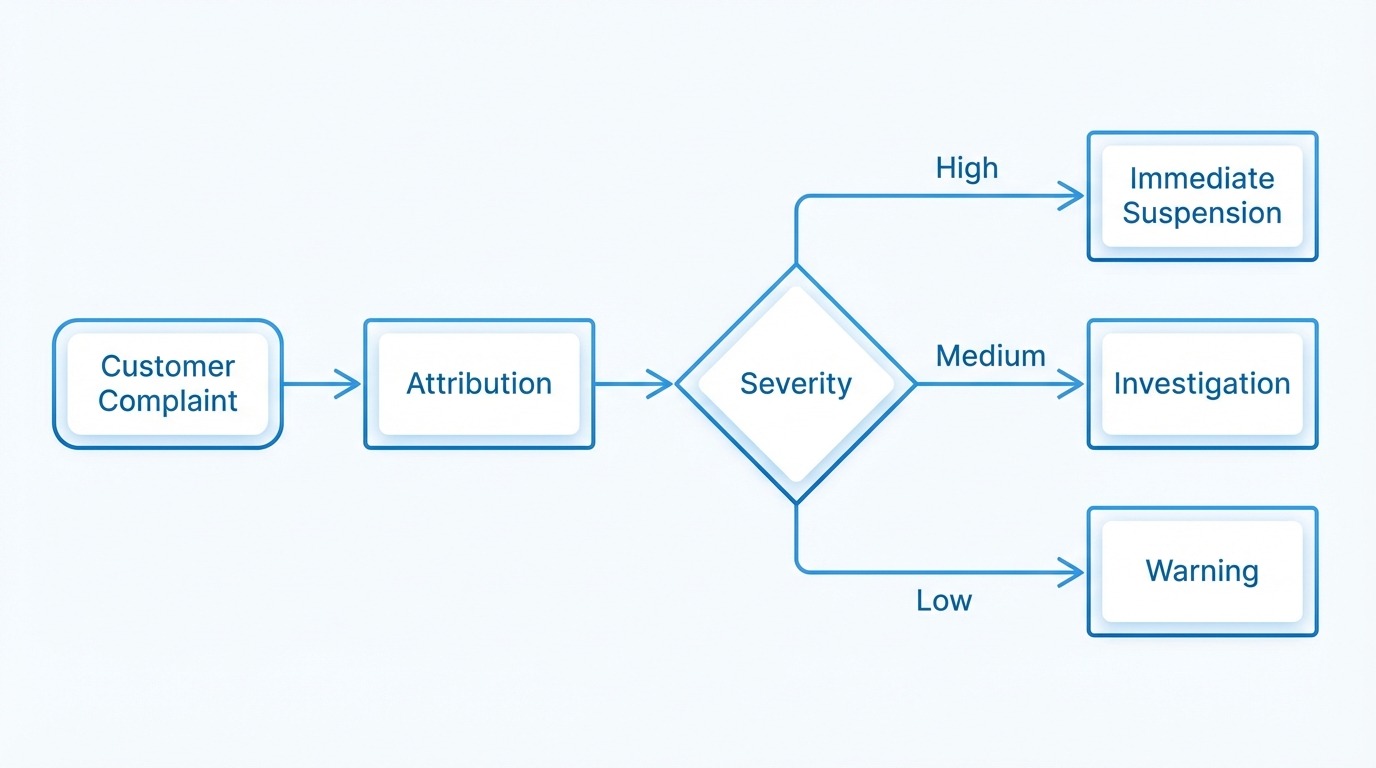
Complaint Loops
Why it matters: Customer complaints provide early signals of prohibited activity, product misrepresentation, and seller misconduct. Without seller-level complaint attribution and automated response, this data remains unactionable.
Customer Complaint Attribution
Required Attribution Fields:
Seller ID
Listing ID
Product SKU
Complaint category (counterfeit, not as described, prohibited item, safety concern, never delivered)
Complaint timestamp and resolution status
Complaint-to-Action Workflow
Automated Alert Thresholds:
Threshold
Action
Complaint rate >2%
Automated alert to compliance team
>10 complaints in 7 days
Seller payout hold, investigation opened
Single high-severity complaint
Immediate listing suspension
Pattern across multiple sellers
Category-level policy review
Pattern Detection
What to Analyze:
Complaint themes across sellers (counterfeit complaints for 20 sellers all sourcing from same supplier)
Complaint velocity by seller cohort (new sellers vs. established sellers)
Geographic patterns (certain regions generate disproportionate complaints)
Product-level patterns (specific SKUs or product types consistently problematic)
What to Request from Marketplace
Category
Documentation Needed
Complaint attribution
Support ticket system showing seller ID and listing ID linkage
Complaint data integrated with seller monitoring systems
Compliance and risk teams have access to complaint data
Sellers notified of complaints and required to respond
Red flag threshold:
Complaints aggregated at platform level only = CRITICAL RISK
No seller-level complaint attribution = CRITICAL RISK
Manual complaint categorization only = HIGH RISK
No automated action on complaint velocity = HIGH RISK
Seller Payouts and Holds
Why it matters: Seller payout infrastructure determines whether the platform can trace transactions, attribute chargebacks, and recover funds when prohibited activity is detected. Without transaction-to-seller linkage, enforcement becomes operationally impossible.
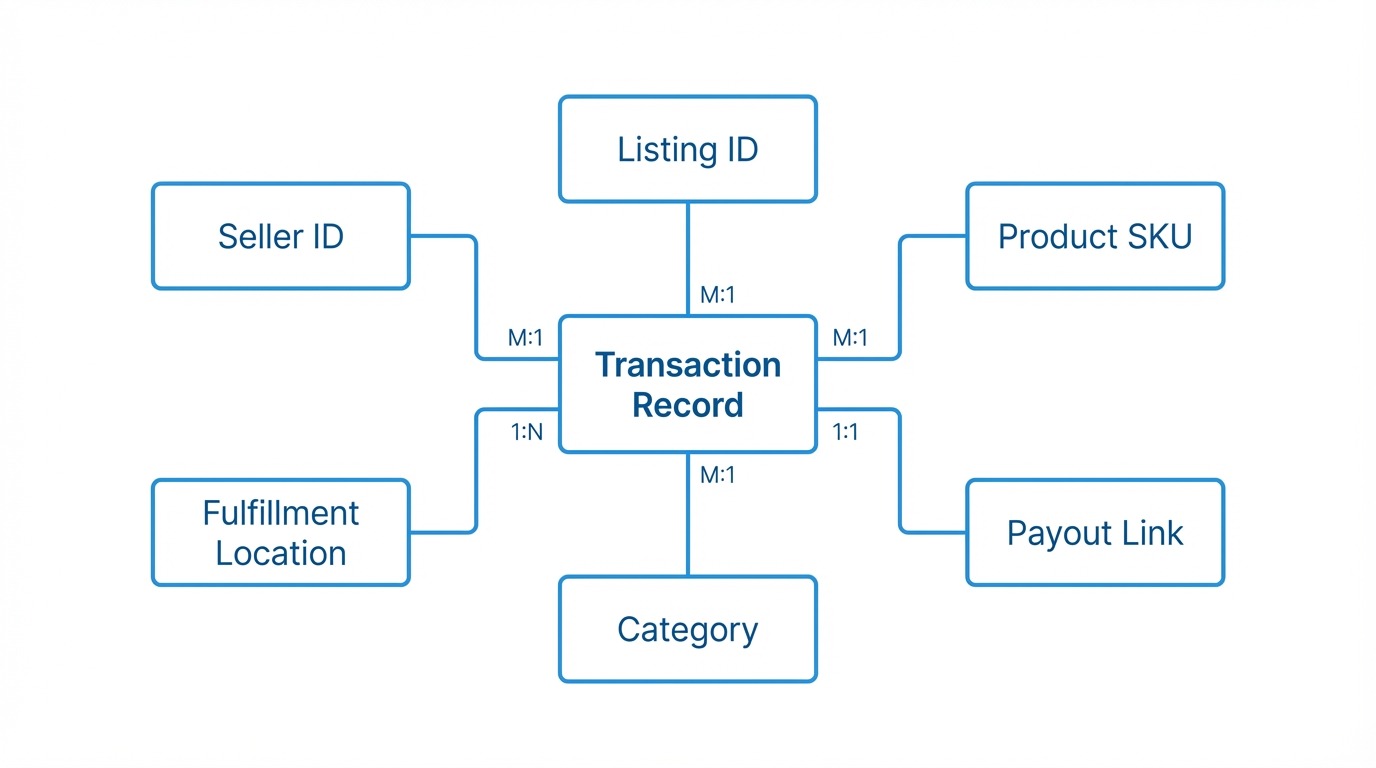
Transaction-to-Seller Traceability
Required Data Fields:
Seller ID
Listing ID
Product SKU
Category
Fulfillment location
Transaction amount
Platform fee
Seller net payout amount
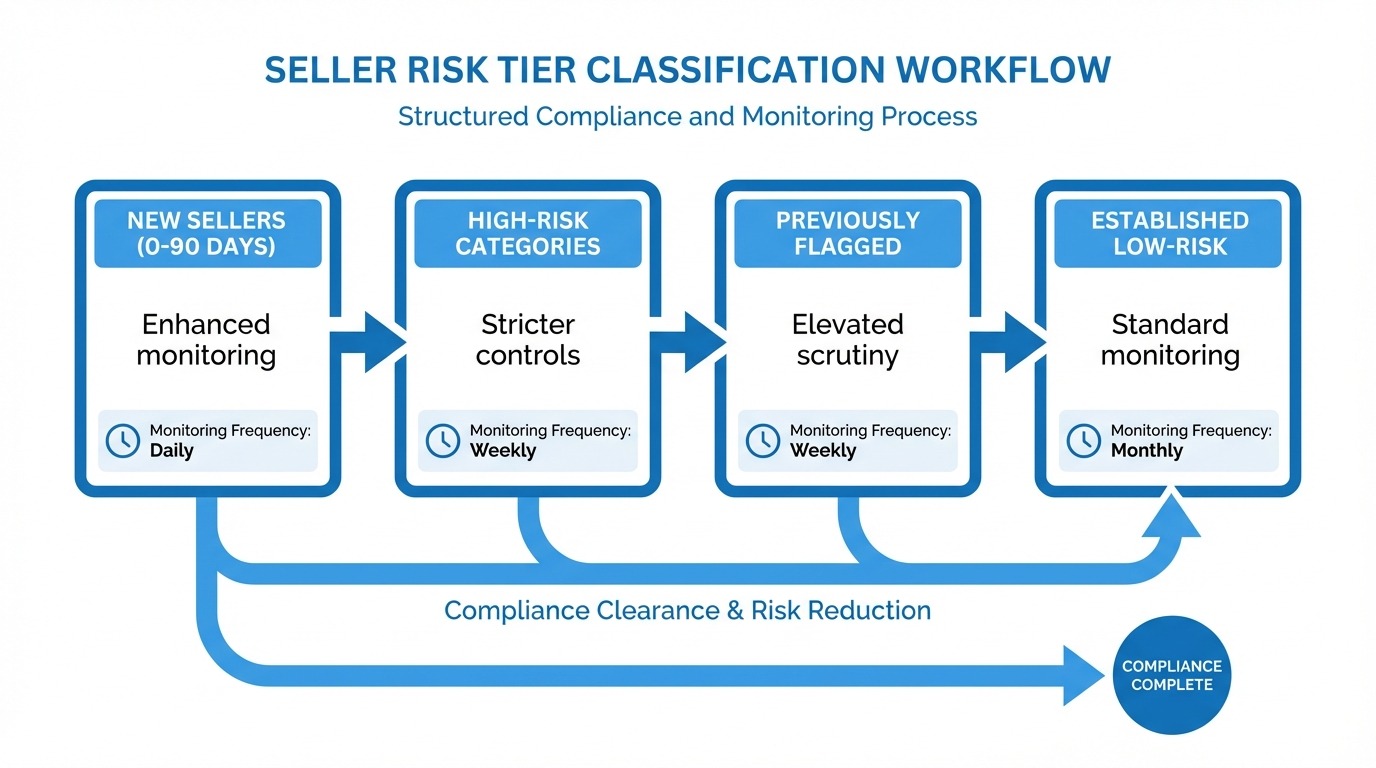
Payout Holds and Reserves
Risk-Based Hold Structure:
Seller Tier
Hold Period
Reserve %
Release Conditions
New sellers (0–90 days)
30–60 day rolling hold
10–20%
No complaints, policy compliance verified
High-risk categories
60–90 day rolling hold
15–25%
Category-specific compliance maintained
Previously flagged
90+ day hold
20–30%
Sustained clean performance
Established low-risk
7–14 day hold
0–5%
Continued performance
Note: These figures represent ranges observed across marketplace risk programs, not universal standards. Each marketplace should calibrate holds based on their specific risk profile and seller mix.
Transaction records include seller ID, listing ID, product SKU, category, fulfillment location
Complaints, chargebacks, and refunds linked to specific seller and listing
Seller payout records enable transaction reconstruction
Audit trail supports regulatory inquiry or legal investigation
Common Misses
We observe that marketplaces fail to detect prohibited activity due to the following gaps:
No Ability to Trace Transaction to Seller and Listing
The problem:
Transaction data aggregates at platform level only (cannot identify which seller processed which transaction)
Listing IDs not recorded in transaction metadata (cannot link payment to specific product listing)
Seller ID exists in database but not accessible to risk or compliance teams (data siloed in engineering systems)
Payout system cannot correlate funds to specific transactions
Impact: When a chargeback, complaint, or regulatory inquiry occurs, the platform cannot identify the responsible seller or listing. Investigation requires manual correlation across disconnected systems, delaying enforcement and allowing prohibited activity to continue.
What good looks like: Every transaction record includes seller ID and listing ID. Risk and compliance teams can query transactions by seller. Payout system links each dollar amount to specific transactions.
Reactive Enforcement Only
The problem:
Listings not reviewed until customer complaint (no proactive moderation)
Seller behavior not monitored until chargeback spike (no drift detection)
Prohibited activity detected only when severe consequences occur
No systematic sampling or audit program
Impact: By the time prohibited activity is detected, significant volume has processed and platform liability has accrued. Sellers learn they can operate undetected for months, incentivizing policy violations.
What good looks like: Listings moderated within 24-48 hours of publication. Seller behavior monitored continuously with automated drift alerts. Systematic sampling reviews random listings weekly.
Seller Onboarding Insufficient for Investigation
The problem:
Minimal seller information collected at onboarding
No beneficial owner identification
No documentation of inventory source, fulfillment method, or supply chain
Seller contact information not verified
Impact: When prohibited activity is detected, the platform cannot conduct effective investigation or enforcement. Seller disappears or is judgment-proof. Platform absorbs chargebacks and regulatory penalties.
What good looks like: Seller onboarding collects business registration, beneficial owners, verified contact information, inventory source documentation, and fulfillment method. Platform can locate and investigate seller if issues arise.
Category Controls Rely on Seller Honesty
The problem:
Sellers self-select categories with no validation
No documentation required for restricted categories
Category drift not monitored post-onboarding
Miscategorization not penalized
Impact: Sellers exploit category ambiguity and self-selection to list prohibited products. Platform has no systematic way to detect or prevent miscategorization at scale.
What good looks like: Restricted categories require approval with documentation. Seller product mix monitored continuously for category drift. Miscategorization results in listing removal and seller warning.
Complaint Data Not Integrated
The problem:
Customer complaints stored in support system, not visible to risk or compliance teams
Complaints not linked to seller ID or listing ID
No seller-level complaint metrics or dashboards
Complaint trends not analyzed
Impact: Customer feedback provides early prohibited activity signals but is not actionable. By the time complaints reach risk teams, enforcement is reactive and delayed.
What good looks like: Support tickets automatically tagged with seller ID and listing ID. Complaint data flows to risk team dashboards in real time. Seller complaint rates calculated and monitored continuously.
Payout Holds Not Risk-Adjusted
The problem:
All sellers receive same payout terms regardless of risk
No reserve requirements for high-risk categories
Payout holds shorter than chargeback window
No automated payout suspension based on risk signals
Impact: Sellers engaging in prohibited activity can extract funds before violations are detected. When platform seeks recovery, seller accounts are empty or closed.
What good looks like: New sellers subject to 30-90 day holds. High-risk categories have higher reserves. Automated payout holds trigger when investigations open. Payout schedules extend beyond typical chargeback window.
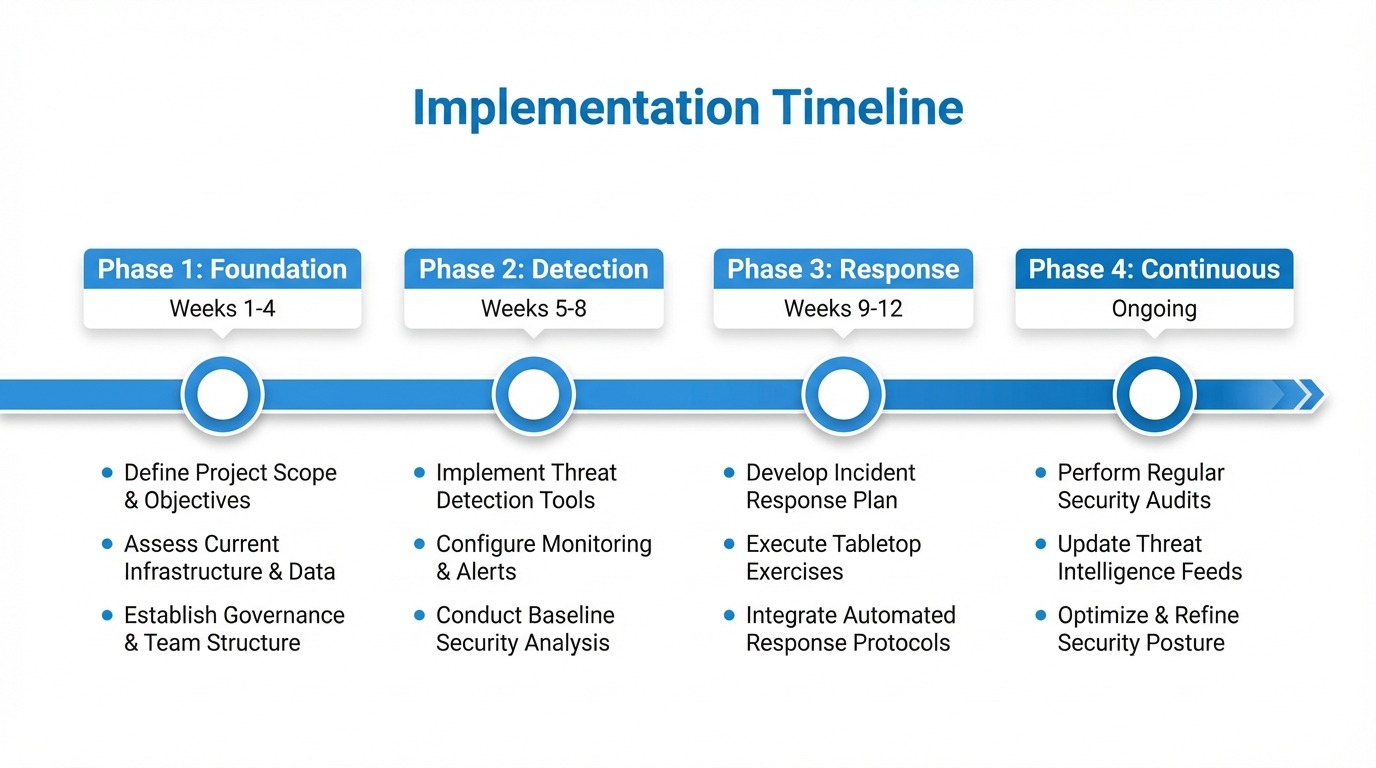
Implementation Roadmap
Marketplaces can build prohibited activity detection capabilities incrementally:
Phase 1: Foundation (Weeks 1-4)
Establish seller-to-transaction traceability:
Ensure transaction records include seller ID, listing ID, product SKU, category
Build reporting infrastructure to query transactions by seller
Enable complaint and chargeback attribution to seller and listing
Verify payout system can link funds to specific transactions
Assess prohibited activity recurrence (do terminated sellers return under new accounts?)
Update policies and rules:
Review prohibited category list quarterly (add new risks, remove outdated restrictions)
Refine keyword and image screening rules based on false positives and misses
Adjust seller risk tiers and monitoring cadence based on observed patterns
Incorporate new data sources (brand owner complaints, regulatory alerts, payment network bulletins)
Benchmark against industry:
Participate in industry forums (share anonymized threat intelligence with other marketplaces)
Monitor regulatory enforcement actions and network bulletins (learn from others' violations)
Assess emerging prohibited activity trends (new product categories, new evasion tactics)
Key Metrics to Track
Effective prohibited activity detection programs track the following metrics:
Seller onboarding metrics
Seller approval rate
Onboarding verification completion time
Rejected seller reasons
Onboarding-to-first-transaction time
Listing moderation metrics
Listings reviewed per day
Moderation completion time
Listing rejection rate
Listing appeal rate
Prohibited activity detection
Drift alerts generated
Investigations opened
Detection speed
Prohibited listings by category
Enforcement metrics
Listings suspended per week
Seller warnings and suspensions
Enforcement-to-detection time
Seller appeal and reinstatement rate
Outcome metrics
Complaint rate by seller cohort
Chargeback rate by seller cohort
Transaction volume by flagged vs clean sellers
Regulatory incidents
The Critical Question
Can you link a transaction to a seller and listing today?
If a customer calls with a complaint, a payment network issues an inquiry, or a regulator requests transaction details, can your platform:
Identify which seller processed the transaction?
Identify which product listing the transaction relates to?
Retrieve the product description, images, and category at the time of transaction?
Trace the funds from customer to platform to seller payout?
Produce a complete audit trail within hours?
If the answer is no, your marketplace lacks the foundational infrastructure for prohibited activity detection. The ability to link transactions to sellers and listings is not a preference, it is the minimum requirement for enforceable policies.
Marketplaces that cannot answer this question operate with significant blind spots. Prohibited activity detection, chargeback attribution, regulatory response, and seller enforcement all depend on transaction traceability.
In our experience, this gap is the single most common reason marketplaces fail to detect prohibited activity until severe consequences occur.
How Ballerine Supports Prohibited Activity Detection in Marketplaces
Ballerine provides infrastructure for seller onboarding, ongoing monitoring, and case management designed specifically for marketplace risk environments.
Seller onboarding workflows:
Identity verification, UBO checks, and business documentation collection
Configurable approval rules by seller category and risk tier
Integration with merchant risk assessment tools to map seller ecosystems (other storefronts, related entities, principals)
Listing and transaction monitoring:
Seller-level transaction attribution and anomaly detection
Seller cohort analysis and drift signal alerts (category changes, volume spikes, complaint velocity)
Integration with complaint, chargeback, and payout data for unified seller risk view
Case management:
Investigation workflows tracking evidence, seller communication, and enforcement decisions
Prohibited activity in marketplaces occurs when sellers list, promote, or sell products or services that violate platform policies, legal requirements, or category restrictions. Unlike traditional merchant processing where a single entity controls inventory and branding, marketplaces create a distributed risk environment where thousands of sellers operate with varying degrees of oversight.
The marketplace model introduces a fundamental risk asymmetry: the platform is legally and financially liable for seller conduct, but sellers control the actual listings, fulfillment, and customer interactions.
Scale and Impact
Prohibited activity in marketplaces represents significant regulatory and reputational exposure.
The U.S. Consumer Product Safety Commission (CPSC) has increasingly focused on marketplace platforms. In 2021, the CPSC issued a unanimous ruling that Amazon is legally a "distributor" of third-party products sold on its platform, making it liable for recalls and safety violations.
Card networks have established programs to monitor platforms for prohibited seller activity. Platforms processing payments for sellers engaged in counterfeit sales, prohibited goods, or undisclosed high-risk activity face potential fines, audits, or termination of acquiring relationships.
In our experience working with marketplace operators, newly onboarded sellers exhibit prohibited activity indicators within the first 90 days at rates that make manual review insufficient. Not all cases represent intentional policy violations, but the volume of seller-generated content requires systematic detection.
Common Prohibited Activity Scenarios
Category drift:
Seller approved for apparel listings begins selling electronics, supplements, or other unrelated categories
Product catalog expands into prohibited or restricted categories without approval (cannabidiol (CBD), tobacco accessories, weapons, adult products, pharmaceuticals)
Seller uses miscategorization to evade enforcement (lists CBD products as "essential oils", weapons accessories as "sporting goods", counterfeit items as "inspired by" or "compatible with")
Prohibited products:
Counterfeit or trademark-infringing goods (replica designer products, unauthorized brand merchandise)
Unsafe or recalled products (banned toys, products with safety violations, items subject to CPSC recalls)
Age-restricted products sold without verification (alcohol, tobacco, adult content)
Products requiring licensing or certification sold without compliance (prescription medications, medical devices, pesticides)
Illegal or controlled substances (narcotics, drug paraphernalia, precursor chemicals)
Deceptive practices:
False product descriptions, fake reviews, or manipulated ratings
Bait-and-switch tactics (advertised product differs from delivered product)
Unsubstantiated health or safety claims (supplements claiming to cure diseases, masks claiming Food and Drug Administration (FDA) approval without authorization)
Hidden fees or unauthorized charges added after purchase
Multi-account abuse:
Seller operates multiple accounts to evade enforcement actions (banned seller returns under new identity)
Seller uses multiple identities to manipulate rankings, reviews, or category placement
Coordinated seller networks engage in review fraud or competitive sabotage
Single entity operates numerous seller accounts to avoid volume-based restrictions or scrutiny
Why Prohibited Activity Occurs
From the seller perspective, prohibited activity generates higher profit margins:
Counterfeit products cost less to produce than authentic goods, enabling substantial profit margins
Prohibited products command premium pricing due to restricted access (CBD, kratom, nootropics)
Products with false claims require no research, testing, or certification costs
Marketplace fees and oversight are lower than launching an independent e-commerce operation
From a risk management perspective, marketplaces face structural enforcement challenges:
Seller-generated listings scale faster than manual review capacity (thousands of new listings per day)
Product catalogs change continuously (sellers add, edit, and remove listings without pre-approval)
Category boundaries are ambiguous (is a CBD topical a "wellness product" or a "prohibited substance"?)
International sellers operate across jurisdictions with varying legal standards
We observe that some prohibited activity is opportunistic (seller tests boundaries to see what enforcement exists), while other cases involve operations designed specifically to exploit marketplace oversight gaps. Effective seller onboarding, listing moderation, and continuous monitoring distinguish between the two.
Acquirers and payment partners exit relationships with high-risk platforms
Operational costs:
Manual investigation and enforcement drain compliance team resources
Customer service costs increase as complaints rise
Refunds and chargebacks erode revenue
Legal defense and regulatory response require significant expense
The Marketplace Detection Challenge
Marketplaces operate differently from traditional single-merchant environments. Detection programs built for merchant monitoring fail when applied to seller-generated content at scale.
Seller-generated listings:
Sellers control product titles, descriptions, images, and categorization
In our experience, marketplaces without seller-level transaction traceability struggle to enforce prohibited activity policies. By the time an issue surfaces through customer complaints, the violating seller has already processed volume and potentially created exposure for the platform.
What We Check
Detecting prohibited activity in marketplaces requires monitoring at five control points: seller onboarding, listing moderation, category enforcement, complaint loops, and seller payouts.
Seller Onboarding
Why it matters: Onboarding determines what information exists when investigation becomes necessary. Without adequate seller documentation, platforms cannot effectively investigate or enforce when prohibited activity is detected.
Identity and Entity Verification
High-Risk Onboarding Patterns:
Email address and bank account only (no business verification)
No beneficial owner identification (entity verified, but individuals controlling it unknown)
Unverified contact information (email bounces, phone disconnected post-onboarding)
No documentation of inventory source, fulfillment method, or supply chain
Acceptable Verification:
Business registration documents (articles of incorporation, business licenses)
Ultimate Beneficial Owner (UBO) identification and Know Your Business (KYB) checks on individuals controlling the seller entity
Tax identification numbers (Employer Identification Number (EIN), Value-Added Tax (VAT), Goods and Services Tax (GST)) validated against government databases
Address verification (physical location exists and matches business documentation)
International sellers: Additional verification for cross-border regulatory compliance
High-volume sellers: Financial documentation and inventory verification required
Seller onboarding
Seller cannot list products until identity verification completes
Category approvals are explicit (seller must request access to restricted categories)
Onboarding collects enough information to conduct investigation if issues arise
Beneficial owners identified and background-checked
Inventory source and fulfillment method documented
Contact information verified (email confirmation, phone verification)
Red flag threshold:
Self-service onboarding with no verification = CRITICAL RISK
No beneficial owner identification = HIGH RISK
Unverified contact information = HIGH RISK
No category approval process = MEDIUM RISK
Effective merchant risk assessments include an "Ecosystem" section mapping all storefronts and domains operated by the same entity or related parties. This practice reveals undisclosed marketplace or multi-brand operations early.
Listing Moderation
Why it matters: Listings are the mechanism through which prohibited products reach customers. Without moderation, platforms have no systematic way to prevent policy violations at scale.
Pre-Publication Review
Moderation Workflow Options:
Pre-approval required: New listings reviewed before becoming visible to customers (highest safety, slower seller experience)
Post-publication with rapid review: Listings go live but reviewed within 24 hours (balances speed and safety)
Listings do not go live until moderation completes (or reviewed within 24 hours if post-publish)
Seller receives clear feedback on rejected listings with specific policy violations cited
Moderation speed balances safety and seller experience (24-48 hour turnaround)
Audit trail records who approved each listing and what checks were performed
Keyword and image screening cover known prohibited content patterns
False positive rate monitored and screening rules adjusted
Red flag threshold:
No pre-publication review at all = CRITICAL RISK
Keyword screening easily evaded (narrow blocklist) = HIGH RISK
No image screening = HIGH RISK
Category restrictions honor-system only = HIGH RISK
Category Enforcement
Why it matters: Categories define what sellers are permitted to sell. Without ongoing enforcement, initial category approvals become meaningless as sellers drift into prohibited or undisclosed categories.
Policy Clarity
Required Policy Documentation:
Prohibited category list (explicitly prohibited products and services)
Restricted category list (categories requiring approval with specific requirements)
Category definitions with examples and edge cases
Policy update communication process (30-day notice for new restrictions)
Ongoing Category Monitoring
What to Track:
Metric
Threshold
Action
Category shift
Seller adds prohibited category
Immediate listing suspension, investigation
Product mix drift
>20% volume in unapproved category
Review seller catalog, require approval
SKU proliferation
New seller with 5,000+ SKUs
Investigation (inventory implausibility)
Cohort pattern
Multiple sellers pivot to same high-risk category
Enhanced monitoring of category
Restricted Category Controls
Approval Requirements:
Seller must apply for restricted category access (cannot self-select)
No post-onboarding category monitoring = HIGH RISK
Manual enforcement only (no automation) = HIGH RISK
Seller self-certification for restricted categories = HIGH RISK
Automated ongoing monitoring can maintain elevated surveillance for high-risk seller cohorts without manual intervention, detecting category drift as it occurs.
Complaint Loops
Why it matters: Customer complaints provide early signals of prohibited activity, product misrepresentation, and seller misconduct. Without seller-level complaint attribution and automated response, this data remains unactionable.
Customer Complaint Attribution
Required Attribution Fields:
Seller ID
Listing ID
Product SKU
Complaint category (counterfeit, not as described, prohibited item, safety concern, never delivered)
Complaint timestamp and resolution status
Complaint-to-Action Workflow
Automated Alert Thresholds:
Threshold
Action
Complaint rate >2%
Automated alert to compliance team
>10 complaints in 7 days
Seller payout hold, investigation opened
Single high-severity complaint
Immediate listing suspension
Pattern across multiple sellers
Category-level policy review
Pattern Detection
What to Analyze:
Complaint themes across sellers (counterfeit complaints for 20 sellers all sourcing from same supplier)
Complaint velocity by seller cohort (new sellers vs. established sellers)
Geographic patterns (certain regions generate disproportionate complaints)
Product-level patterns (specific SKUs or product types consistently problematic)
What to Request from Marketplace
Category
Documentation Needed
Complaint attribution
Support ticket system showing seller ID and listing ID linkage
Complaint data integrated with seller monitoring systems
Compliance and risk teams have access to complaint data
Sellers notified of complaints and required to respond
Red flag threshold:
Complaints aggregated at platform level only = CRITICAL RISK
No seller-level complaint attribution = CRITICAL RISK
Manual complaint categorization only = HIGH RISK
No automated action on complaint velocity = HIGH RISK
Seller Payouts and Holds
Why it matters: Seller payout infrastructure determines whether the platform can trace transactions, attribute chargebacks, and recover funds when prohibited activity is detected. Without transaction-to-seller linkage, enforcement becomes operationally impossible.
Transaction-to-Seller Traceability
Required Data Fields:
Seller ID
Listing ID
Product SKU
Category
Fulfillment location
Transaction amount
Platform fee
Seller net payout amount
Payout Holds and Reserves
Risk-Based Hold Structure:
Seller Tier
Hold Period
Reserve %
Release Conditions
New sellers (0–90 days)
30–60 day rolling hold
10–20%
No complaints, policy compliance verified
High-risk categories
60–90 day rolling hold
15–25%
Category-specific compliance maintained
Previously flagged
90+ day hold
20–30%
Sustained clean performance
Established low-risk
7–14 day hold
0–5%
Continued performance
Note: These figures represent ranges observed across marketplace risk programs, not universal standards. Each marketplace should calibrate holds based on their specific risk profile and seller mix.
Transaction records include seller ID, listing ID, product SKU, category, fulfillment location
Complaints, chargebacks, and refunds linked to specific seller and listing
Seller payout records enable transaction reconstruction
Audit trail supports regulatory inquiry or legal investigation
Common Misses
We observe that marketplaces fail to detect prohibited activity due to the following gaps:
No Ability to Trace Transaction to Seller and Listing
The problem:
Transaction data aggregates at platform level only (cannot identify which seller processed which transaction)
Listing IDs not recorded in transaction metadata (cannot link payment to specific product listing)
Seller ID exists in database but not accessible to risk or compliance teams (data siloed in engineering systems)
Payout system cannot correlate funds to specific transactions
Impact: When a chargeback, complaint, or regulatory inquiry occurs, the platform cannot identify the responsible seller or listing. Investigation requires manual correlation across disconnected systems, delaying enforcement and allowing prohibited activity to continue.
What good looks like: Every transaction record includes seller ID and listing ID. Risk and compliance teams can query transactions by seller. Payout system links each dollar amount to specific transactions.
Reactive Enforcement Only
The problem:
Listings not reviewed until customer complaint (no proactive moderation)
Seller behavior not monitored until chargeback spike (no drift detection)
Prohibited activity detected only when severe consequences occur
No systematic sampling or audit program
Impact: By the time prohibited activity is detected, significant volume has processed and platform liability has accrued. Sellers learn they can operate undetected for months, incentivizing policy violations.
What good looks like: Listings moderated within 24-48 hours of publication. Seller behavior monitored continuously with automated drift alerts. Systematic sampling reviews random listings weekly.
Seller Onboarding Insufficient for Investigation
The problem:
Minimal seller information collected at onboarding
No beneficial owner identification
No documentation of inventory source, fulfillment method, or supply chain
Seller contact information not verified
Impact: When prohibited activity is detected, the platform cannot conduct effective investigation or enforcement. Seller disappears or is judgment-proof. Platform absorbs chargebacks and regulatory penalties.
What good looks like: Seller onboarding collects business registration, beneficial owners, verified contact information, inventory source documentation, and fulfillment method. Platform can locate and investigate seller if issues arise.
Category Controls Rely on Seller Honesty
The problem:
Sellers self-select categories with no validation
No documentation required for restricted categories
Category drift not monitored post-onboarding
Miscategorization not penalized
Impact: Sellers exploit category ambiguity and self-selection to list prohibited products. Platform has no systematic way to detect or prevent miscategorization at scale.
What good looks like: Restricted categories require approval with documentation. Seller product mix monitored continuously for category drift. Miscategorization results in listing removal and seller warning.
Complaint Data Not Integrated
The problem:
Customer complaints stored in support system, not visible to risk or compliance teams
Complaints not linked to seller ID or listing ID
No seller-level complaint metrics or dashboards
Complaint trends not analyzed
Impact: Customer feedback provides early prohibited activity signals but is not actionable. By the time complaints reach risk teams, enforcement is reactive and delayed.
What good looks like: Support tickets automatically tagged with seller ID and listing ID. Complaint data flows to risk team dashboards in real time. Seller complaint rates calculated and monitored continuously.
Payout Holds Not Risk-Adjusted
The problem:
All sellers receive same payout terms regardless of risk
No reserve requirements for high-risk categories
Payout holds shorter than chargeback window
No automated payout suspension based on risk signals
Impact: Sellers engaging in prohibited activity can extract funds before violations are detected. When platform seeks recovery, seller accounts are empty or closed.
What good looks like: New sellers subject to 30-90 day holds. High-risk categories have higher reserves. Automated payout holds trigger when investigations open. Payout schedules extend beyond typical chargeback window.
Implementation Roadmap
Marketplaces can build prohibited activity detection capabilities incrementally:
Phase 1: Foundation (Weeks 1-4)
Establish seller-to-transaction traceability:
Ensure transaction records include seller ID, listing ID, product SKU, category
Build reporting infrastructure to query transactions by seller
Enable complaint and chargeback attribution to seller and listing
Verify payout system can link funds to specific transactions
Assess prohibited activity recurrence (do terminated sellers return under new accounts?)
Update policies and rules:
Review prohibited category list quarterly (add new risks, remove outdated restrictions)
Refine keyword and image screening rules based on false positives and misses
Adjust seller risk tiers and monitoring cadence based on observed patterns
Incorporate new data sources (brand owner complaints, regulatory alerts, payment network bulletins)
Benchmark against industry:
Participate in industry forums (share anonymized threat intelligence with other marketplaces)
Monitor regulatory enforcement actions and network bulletins (learn from others' violations)
Assess emerging prohibited activity trends (new product categories, new evasion tactics)
Key Metrics to Track
Effective prohibited activity detection programs track the following metrics:
Seller onboarding metrics
Seller approval rate
Onboarding verification completion time
Rejected seller reasons
Onboarding-to-first-transaction time
Listing moderation metrics
Listings reviewed per day
Moderation completion time
Listing rejection rate
Listing appeal rate
Prohibited activity detection
Drift alerts generated
Investigations opened
Detection speed
Prohibited listings by category
Enforcement metrics
Listings suspended per week
Seller warnings and suspensions
Enforcement-to-detection time
Seller appeal and reinstatement rate
Outcome metrics
Complaint rate by seller cohort
Chargeback rate by seller cohort
Transaction volume by flagged vs clean sellers
Regulatory incidents
The Critical Question
Can you link a transaction to a seller and listing today?
If a customer calls with a complaint, a payment network issues an inquiry, or a regulator requests transaction details, can your platform:
Identify which seller processed the transaction?
Identify which product listing the transaction relates to?
Retrieve the product description, images, and category at the time of transaction?
Trace the funds from customer to platform to seller payout?
Produce a complete audit trail within hours?
If the answer is no, your marketplace lacks the foundational infrastructure for prohibited activity detection. The ability to link transactions to sellers and listings is not a preference, it is the minimum requirement for enforceable policies.
Marketplaces that cannot answer this question operate with significant blind spots. Prohibited activity detection, chargeback attribution, regulatory response, and seller enforcement all depend on transaction traceability.
In our experience, this gap is the single most common reason marketplaces fail to detect prohibited activity until severe consequences occur.
How Ballerine Supports Prohibited Activity Detection in Marketplaces
Ballerine provides infrastructure for seller onboarding, ongoing monitoring, and case management designed specifically for marketplace risk environments.
Seller onboarding workflows:
Identity verification, UBO checks, and business documentation collection
Configurable approval rules by seller category and risk tier
Integration with merchant risk assessment tools to map seller ecosystems (other storefronts, related entities, principals)
Listing and transaction monitoring:
Seller-level transaction attribution and anomaly detection
Seller cohort analysis and drift signal alerts (category changes, volume spikes, complaint velocity)
Integration with complaint, chargeback, and payout data for unified seller risk view
Case management:
Investigation workflows tracking evidence, seller communication, and enforcement decisions


.png)


.png)




.svg)
.svg)
.svg)
.svg)
.svg)
.svg)
.svg)
.svg)
.png)


