

Related Questions

.png)
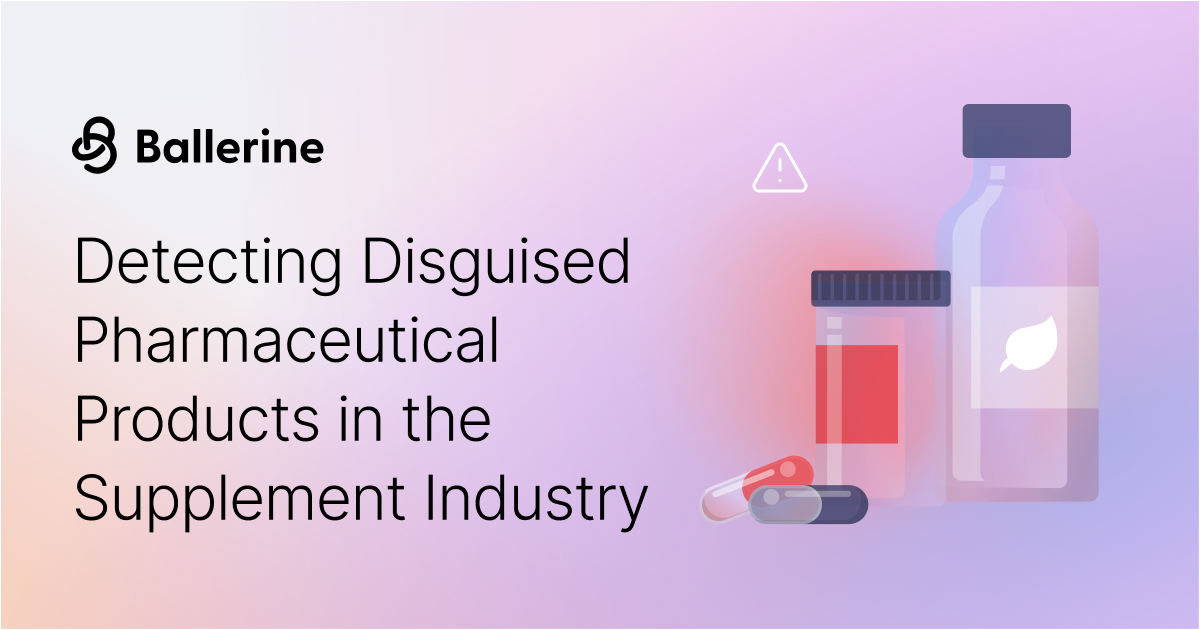
The supplement industry generates $50+ billion annually in the United States, but not all products operate within regulatory boundaries. When supplements make drug claims, contain undeclared pharmaceutical ingredients, or use deceptive billing practices, they create shared liability for financial institutions under Food and Drug Administration (FDA) enforcement authority and card network rules.
This is not a product classification problem. It is a marketing compliance and underwriting verification problem. A turmeric capsule sold as "joint health support" presents minimal risk. The same product marketed as "eliminates arthritis pain, stop taking prescription NSAIDs" crosses into drug territory and exposes payment processors to enforcement action.
The FDA has enforcement authority over products making drug claims regardless of whether they are labeled as supplements or pharmaceuticals. Under the Federal Food, Drug, and Cosmetic Act (FD&C Act), FDA regulates products based on their intended use as determined by marketing claims, not product formulation.
In enforcement actions, FDA cites advertising across all channels (social media ads, landing pages, email marketing, affiliate content) as evidence of intended use. Payment processors who facilitate transactions for merchants making unapproved drug claims face compliance exposure when merchants receive warning letters, consent decrees, or injunctions.
Visa and Mastercard compliance programs monitor merchant advertising, customer complaints, and chargeback patterns. Networks assess whether products are marketed in ways that violate network rules on misleading advertising, undisclosed continuity billing, or high-risk business practices.
Acquirers and Payment Service Providers (PSPs) are expected to verify merchant marketing claims during underwriting and monitor for drift post-approval. Network violations can result in fines, merchant termination requirements, or portfolio remediation mandates.
Supplement merchants with aggressive marketing claims (specific weight loss guarantees, disease treatment promises, comparisons to prescription drugs) generate elevated chargeback rates regardless of product quality. When ads promise outcomes that cannot be delivered, customers dispute charges.
We observe supplement merchants with drug-like claims in advertising generating 15-25% chargeback rates compared to 2-5% for merchants using structure/function claims only. The marketing promise is the primary predictor of payment disputes.
Read the complete underwriting guide
Regulatory and chargeback risk concentrates in advertising, not product composition. Underwriting must evaluate the complete customer acquisition funnel including paid ads (Facebook, Instagram, TikTok, Google, native networks), landing pages, video sales letters, email marketing sequences, and affiliate materials.
Claims fall into categories with different risk profiles. Structure/function claims (supports, promotes, maintains) are permissible for supplements. Disease claims (treats, prevents, cures, reverses) classify products as drugs under FDA regulations. Outcome guarantees (lose X pounds in Y days) and comparisons to prescription medications create both regulatory and chargeback exposure.
We recommend extracting claims systematically, categorizing by risk level, and verifying that disclosed marketing materials match actual live campaigns using public ad transparency tools.
Hidden continuity billing models correlate directly with chargebacks. When merchants bury subscription terms in small font, use pre-checked opt-in boxes, or create difficult cancellation processes, dispute rates increase regardless of product quality.
Our framework includes completing test purchases, measuring disclosure visibility (font size, location, timing), documenting confirmation email clarity, and testing cancellation procedures. We see merchants with transparent billing and easy cancellation generating 3-7% chargeback rates, while merchants with hidden trials and difficult cancellation reach 15-25%.
Critical evaluation points include subscription term disclosure location and visibility, checkbox default states, confirmation email content, cancellation process accessibility, and customer service responsiveness.
Manufacturing transparency correlates with product quality consistency and FDA compliance. Supplements must be manufactured in facilities following Current Good Manufacturing Practice (cGMP) regulations under 21 CFR Part 111.
Underwriting should verify manufacturing facility disclosure (name, address, relationship), GMP certification from third parties (NSF International, UL), Certificates of Analysis for finished products from independent labs, and ingredient sourcing documentation including country of origin.
Geographic fulfillment patterns provide signals. Products manufactured in FDA-inspected U.S. facilities with third-party testing present lower risk than products of unknown origin fulfilled from overseas warehouses.
Existing complaint patterns predict future disputes. Multiple public sources provide evidence of merchant track records including FDA warning letter databases, Federal Trade Commission (FTC) enforcement actions, state attorney general consumer protection cases, Better Business Bureau profiles, and social media complaint patterns.
We recommend checking these sources, interpreting complaint volume and resolution rates, identifying disqualifying regulatory history, and requesting documentation of prior enforcement and remediation efforts.
We see the largest underwriting gap in reviewing merchant websites in isolation while failing to verify actual advertising. Merchants maintain compliant websites to pass payment processor review while running ads with prohibited claims.
Our protocol includes using Facebook Ad Library, Google Ads Transparency Center, and platform-specific tools to independently verify active campaigns, comparing disclosed materials to actual live ads, searching for affiliate sites promoting the product, and documenting the complete customer journey from ad impression to checkout.
Discrepancies between disclosed and actual marketing materials indicate the merchant knows certain claims are problematic and is concealing them during underwriting.
Supplement merchants frequently operate multiple brands, domains, or marketing funnels. Understanding the complete ecosystem is necessary because risk exposure extends beyond the applicant entity.
When the same principals operate five supplement brands and one receives an FDA warning letter for drug claims, all five share similar risk profiles. Domain networks signal intent to test different marketing boundaries, segment high-risk products, or evade enforcement by shifting to new domains after violations.
Underwriting should map related domains through WHOIS records, identify other brands through Facebook Ad Library disclaimers and trademark searches, verify affiliate relationships, and document related entity structures.
Read the complete underwriting guide
Documentation demonstrating that underwriting verified marketing claim compliance with FDA structure/function standards, billing transparency meeting FTC requirements, and manufacturing quality controls under cGMP regulations.
Early identification of marketing patterns that predict elevated dispute rates, allowing for either merchant declination or required claim revisions before processing begins.
Systematic verification of merchant advertising across all channels, reducing exposure to Visa and Mastercard violations for misleading marketing or high-risk billing practices.
Risk-based reserve calculations accounting for claim aggressiveness, billing structure, complaint history, and manufacturing transparency rather than applying uniform percentages.
Standardized workflow and documentation checklist eliminating guesswork, reducing re-underwriting cycles, and enabling consistent decisions across merchant review teams.
We provide infrastructure for systematic supplement merchant underwriting at scale. Our platform enables automated marketing funnel capture, continuous ad creative monitoring across Facebook, Google, and TikTok, checkout flow testing for billing transparency, regulatory database tracking (FDA warnings, FTC actions, state attorney general cases), and external complaint aggregation from Better Business Bureau, social media, and review sites.
Risk teams use Ballerine to document the complete marketing funnel during underwriting, monitor for claim drift post-approval, automate re-review triggers based on chargeback thresholds or regulatory actions, and maintain audit trails across the merchant lifecycle.
The result is faster merchant onboarding with comprehensive coverage of the risk vectors that traditional Know Your Business (KYB) and website review processes miss. Explore our merchant underwriting solution or review our merchant monitoring capabilities.
edited%205.webp)

.svg)
.svg)
.svg)
.svg)
.svg)
.svg)
.svg)
.svg)