





Back to Glossary

Merchant Monitoring Program (MMP)

A Merchant Monitoring Program (MMP) is a mandatory compliance framework implemented by card schemes, most notably Mastercard's MMP, requiring acquirers and payment service providers (PSPs) to continuously monitor merchant activities throughout the entire lifecycle of the merchant relationship. Unlike traditional periodic reviews, MMP mandates real-time surveillance of merchant websites, transaction behaviors, and risk signals to detect violations of the Global Brand Protection Program (GBPP), Brand Reputation and Misuse (BRAM) violations, and transaction laundering schemes.

How MMP Works

MMP operates on three foundational principles that fundamentally shift merchant risk management from reactive to proactive:

1. Continuous Monitoring Requirements

Acquirers must engage approved Merchant Monitoring Service Providers (MMSPs) to perform ongoing surveillance that includes:

  • Pre-boarding scans: Content and transaction laundering detection before merchant activation
  • Real-time website monitoring: Automated crawling of merchant digital properties for prohibited content, product mismatches, or BRAM violations
  • Transaction behavior analysis: Cross-referencing Merchant Category Codes (MCCs) against actual products sold, pricing consistency, and geographic patterns
  • Portfolio-level oversight: Aggregated risk views across entire merchant portfolios to identify systemic exposure

2. Lifecycle Compliance

MMP compliance is no longer a checkpoint but a continuous operational requirement. Acquirers must monitor merchants from onboarding through offboarding, detecting changes in:

  • Website content and product offerings
  • Business models or ownership structures
  • Geographic expansion into restricted markets
  • Pricing anomalies or sudden transaction spikes
  • Signs of card testing, enumeration attacks, or laundering

3. Mandatory Reporting and Remediation

When violations are detected, acquirers must:

  • Report findings to Mastercard within specified timeframes
  • Take corrective action (merchant education, restrictions, or termination)
  • Demonstrate audit trails showing compliance with MMP requirements

Why MMP Matters for Acquirers and PSPs

The introduction of MMP in January 2026, alongside Visa's VAMP program, represents the most significant shift in merchant risk management in years. Here's why it's critical:

Portfolio-Wide Risk Exposure: A single non-compliant merchant can trigger scheme-level penalties affecting your entire portfolio. MMP shifts accountability from individual merchant failures to systemic monitoring failures.

Operational Complexity: Traditional underwriting and quarterly reviews can't keep pace with merchant evolution. Businesses change products, expand geographies, or drift into prohibited activities between review cycles.

Early Detection Imperative: By the time chargebacks spike or fraud patterns emerge, significant damage has occurred. MMP requires identifying red flags weeks or months earlier through behavioral intelligence.

Regulatory Pressure: Non-compliance with MMP carries financial penalties, mandatory remediation programs, and potential restrictions on processing capabilities. For payment facilitators and ISOs, this creates cascading liability across sub-merchant portfolios.

Key Challenges Without Proper MMP Infrastructure

Acquirers and PSPs face several obstacles implementing effective MMP compliance:

  • Scale: Monitoring thousands of merchants manually is impossible. Legacy tools provide static snapshots rather than dynamic intelligence.
  • Signal Detection: Identifying meaningful risk signals (product-MCC mismatches, bot-like traffic patterns, sudden geography changes) requires sophisticated analysis beyond basic transaction monitoring.
  • False Positives: Overly aggressive monitoring generates alert fatigue, while under-detection leaves exposure unaddressed.
  • Integration Gaps: Connecting website monitoring data with transaction behavior, pricing intelligence, and portfolio analytics requires unified infrastructure.

How Ballerine Addresses MMP Requirements

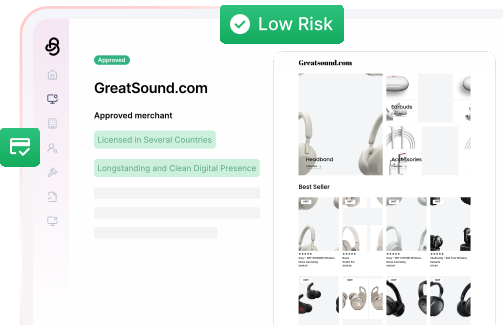
Ballerine provides the merchant intelligence infrastructure that makes MMP compliance operationally scalable and focuses purely on merchant monitoring and risk detection.

Continuous Merchant Risk Monitoring

Ballerine automatically monitors merchant websites for:

  • Content changes: Detecting when merchants add prohibited products or drift into restricted categories
  • Product-MCC alignment: Validating that stated business types match actual offerings
  • Pricing consistency: Identifying anomalies that suggest fraud or misrepresentation
  • Geographic signals: Tracking expansion into high-risk jurisdictions or markets requiring additional licensing

Transaction-Behavior Intelligence

Ballerine cross-references digital footprint with transaction patterns:

  • MCC vs. Product validation: Ensuring merchants aren't miscoding transactions to avoid scrutiny
  • BIN vs. Geography matching: Detecting cross-border patterns inconsistent with business model
  • Burst detection: Identifying sudden spikes in low-value transactions that indicate card testing
  • Currency anomalies: Flagging unexpected currency usage suggesting laundering or fraud

Portfolio-Level Dashboards

Risk teams get comprehensive views showing:

  • Risk by merchant segment: Which verticals or categories drive the most exposure
  • Geographic concentration: Where portfolio risk clusters geographically
  • Trending merchants: Which merchants are moving toward threshold violations
  • Behavioral patterns: Early indicators of fraud, disputes, or compliance drift

Early-Warning System

Ballerine functions as a radar system alerting you when:

  • Website content stops matching transaction behavior
  • Merchants exhibit patterns resembling money laundering or card testing
  • Product lines suddenly shift into restricted or prohibited categories
  • Traffic patterns become bot-like or show enumeration characteristics

This gives acquirers the ability to intervene before Mastercard detects violations, protecting both individual merchant relationships and portfolio-level compliance standing.

MMP vs. VAMP: Understanding the Difference

While Visa's VAMP program focuses on fraud rates, dispute ratios, and authorization patterns at the portfolio level, Mastercard's MMP emphasizes merchant-level compliance and content monitoring. Both programs require:

  • Proactive rather than reactive monitoring
  • Portfolio-level visibility and reporting
  • Early detection capabilities
  • Continuous surveillance infrastructure

The convergence of these programs in 2025-2026 makes comprehensive merchant intelligence platforms essential rather than optional.

Implementation Considerations

Successful MMP compliance requires acquirers and PSPs to:

  1. Select approved MMSPs with proven detection capabilities for BRAM and transaction laundering
  2. Integrate monitoring data with existing transaction monitoring and underwriting systems
  3. Establish clear workflows for violation detection, investigation, and remediation
  4. Train risk teams on new signal types and behavioral indicators
  5. Build documentation demonstrating continuous monitoring and appropriate action

The Bottom Line

MMP represents a fundamental evolution in how payment ecosystems manage merchant risk. Static underwriting and periodic reviews are no longer sufficient. The question for acquirers and PSPs isn't whether to implement continuous monitoring but how to do so at scale without overwhelming risk operations.

Platforms like Ballerine that combine website intelligence, transaction behavior analysis, and portfolio-level visibility transform MMP from a compliance burden into a strategic advantage, enabling safer growth and more confident merchant relationships.


Trusted by

Trusted by Leaders in the Payments Ecosystem

70%

Reduced manual efforts

49%

Improved review resolution time

30%

Increase in 
detected fraud

“We were able to downsize our compliance staff’s workload significantly, which allowed us to allocate the savings and workforce into more improvement projects.”

Shmulik Davar

VP Product at Fido

67%

Reduced Hiring Time

“Proactively navigating fintech regulations requires faster technology adoption. Next-gen compliance infrastructures should seamlessly integrate with existing and new systems and data sources.”

Ran Nachman

VP Regulation Solutions 
at eToro

67%

Reduced Hiring Time

“Proactively navigating fintech regulations requires faster technology adoption. Next-gen compliance infrastructures should seamlessly integrate with existing and new systems and data sources.”

Vicente Mederos

Head of Risk 

at Access Group

98%

Local Compliance

“User-friendly, reliable, and fast. It’s exactly what we needed to scale without adding complexity.”

Emily Rivera

Co-Founder

4.8 rating from 1.5k reviews

Author ImageAuthor ImageAuthor ImageAuthor Image

10+

Download from app store

Download for iOS

Ready to transform how your bank onboards, underwrites, and manages merchant risk?