


Trusted by









.webp)

.webp)

.webp)
Merchant web monitoring is the continuous scanning and analysis of a merchant's online presence (websites, storefronts, product listings) to verify that the business continues to operate in compliance with card network rules, regulatory requirements, and the agreed-upon business model.
Merchants can change their business after approval. A merchant approved to sell nutritional supplements can add prescription medications to their product catalog within hours. Another merchant operating a licensed gaming site can introduce unlicensed gambling offerings without notifying their acquirer.
These changes expose payment providers to:
Card Network Penalties
Visa's Integrity Risk Program (VIRP) and Mastercard's Business Risk Assessment and Mitigation (BRAM) program impose fines and enforcement actions when merchants violate prohibited or restricted content rules. Payment facilitators and acquirers are held accountable for the merchants they sponsor.
Regulatory Risk
Merchants selling unlicensed pharmaceuticals, counterfeit goods, or illegal products create liability for their payment providers. Regulators can impose sanctions on the entire payment chain when prohibited goods flow through the system.
Reputational Damage
Association with fraud, counterfeiting, or illegal activity damages trust with banking partners, card networks, and end customers.
Chargeback and Fraud Losses
Merchants that pivot into high-risk or illegal product categories often see elevated chargeback rates, fraud claims, and customer disputes. These costs ultimately fall on the payment provider.
We see this show up most frequently in:
The core problem is that post-onboarding oversight through manual reviews is not scalable. Risk teams cannot manually revisit thousands of merchant websites every month. Automated merchant web monitoring provides continuous visibility into merchant behavior.
Determine which merchants require active monitoring and how often their sites should be scanned. High-risk categories (nutraceuticals, gaming, adult content, travel, electronics resale) warrant more frequent monitoring than low-risk verticals.
Monitoring frequency depends on risk tier:
Monitoring scope includes:
Manual website reviews do not scale. Automated web crawlers can:
Modern solutions apply natural language processing (NLP) and image recognition to flag suspicious patterns. For example, a site selling "herbal supplements" that includes product descriptions with terms like "prescription-strength" or "pharmaceutical-grade" would trigger alerts.
Alerts generated by web monitoring tools must be evaluated against:
We recommend building a decision matrix that maps detected content types to enforcement actions:
When violations are detected:
Risk teams should document each finding, merchant response, and final disposition. This audit trail is critical when responding to card network inquiries or regulatory examinations.
Merchants often operate multiple storefronts under different business names or domains to distribute risk.
Effective merchant monitoring includes:
This "ecosystem view" reveals when a terminated merchant re-emerges under a new entity or when a compliant merchant has undisclosed affiliates selling prohibited goods.
An acquirer onboards a merchant operating under the business name "Premium Nutrition Co." with an MCC code for 5499 (Miscellaneous Food Stores). The initial underwriting review shows a standard e-commerce site selling protein powders, vitamins, and meal replacement shakes.
Three months later, the acquirer's automated web monitoring solution scans the merchant's website and flags the following changes:
The monitoring system generates an alert categorizing this as a Tier 3 (Critical) violation.
The compliance team takes immediate action:
Without automated web monitoring, this merchant could have processed thousands of transactions for illegal pharmaceutical sales, exposing the acquirer to:
This example demonstrates why web monitoring is not optional for payment providers operating at scale. Manual oversight cannot detect these changes fast enough to prevent harm.
Web monitoring is not a standalone compliance activity. It functions as part of a broader merchant risk monitoring program that includes:
The most effective risk programs integrate these signals. For example:
We see payment providers struggle when these controls operate in silos. Transaction monitoring teams see anomalies but lack visibility into what changed on the merchant's website. Compliance teams receive web monitoring alerts but do not cross-reference them with chargeback data. Effective programs break down these silos and create unified merchant risk profiles.
Card networks are also increasing enforcement. Mastercard's Merchant Monitoring Service Provider (MMSP) Standards require acquirers to implement continuous monitoring programs that cover website content, transaction behavior, and business changes. Payment providers that cannot demonstrate robust monitoring face higher reserve requirements and potential loss of card network sponsorship.
For payment facilitators and marketplaces, the risk is compounded. A single sub-merchant violation can trigger audits of the entire platform, affecting thousands of compliant merchants. Scalable, automated web monitoring is the only viable approach to managing this risk.
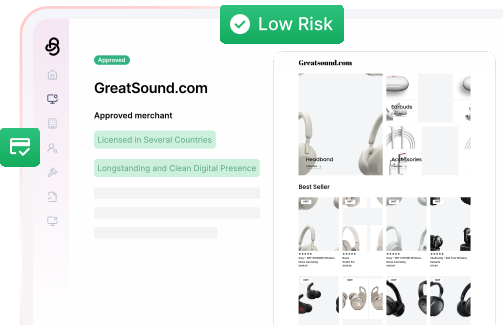
Ballerine provides a merchant risk management platform purpose-built for acquirers, payment facilitators, and marketplaces. Our merchant monitoring solution combines automated web crawling, AI-driven content analysis, and continuous risk scoring to help payment providers detect compliance violations, policy breaches, and fraud signals before they escalate. Risk teams use Ballerine to monitor thousands of merchants at scale, integrate web monitoring findings with transaction data and chargeback alerts, and maintain audit-ready documentation for card network and regulatory reviews.



Reduced manual efforts
Improved review resolution time
Increase in detected fraud
.webp)

.webp)
.png)
.svg)


.webp)