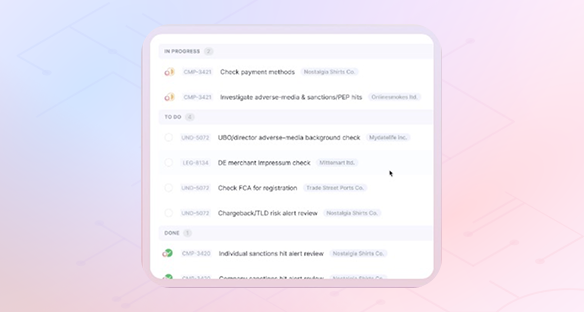
Most risk and compliance leaders at acquiring institutions did not set out to build a fragmented stack. It happened incrementally: one tool for onboarding, another for transaction monitoring, a third for adverse media screening, a fourth for chargeback reporting. Each decision made sense at the time.
The collective result is a merchant risk program that requires constant manual stitching just to answer a basic question: what is the current risk profile of this merchant?
This article examines why that fragmentation is a structural risk, what a consolidated merchant risk platform actually looks like in practice, and how acquirers can move toward it without disrupting existing workflows.
The State of the Acquirer Risk Stack
According to research published by Datos Insights (formerly Aite-Novarica) in their report Managing Merchant Risk: Best Practices for Underwriting, Onboarding, and Monitoring, acquirers use multiple point solutions across merchant onboarding and ongoing monitoring.
The research, which drew on interviews with 20 acquirers across North America and Europe, found that while point solutions can be effective in isolation, their narrow scope creates integration gaps. Risk signals in one system rarely add value to another, which limits fraud detection and increases false positives.
The practical consequence is familiar to most heads of risk: analysts spend a meaningful portion of their time pulling data from separate systems and reconciling it before any actual risk judgment can be made. Compliance reporting requires exporting from three or four sources, normalizing the data, and hoping nothing was missed in the gap between the last sync and today.
This is not just an efficiency problem. It is a risk exposure.
Why Fragmentation Creates Risk, Not Just Overhead
The central issue with disconnected tools is that a merchant's risk profile is not static. A business that passed underwriting cleanly eighteen months ago may have changed its product offering, acquired new ownership, or begun processing in a different category.
If the data collected at onboarding lives in a separate system from ongoing monitoring alerts, risk teams have no reliable way to surface that drift.
As PaymentsJournal noted in its analysis of merchant risk in a complex payments ecosystem, many institutions collect less information upfront to accelerate onboarding, which reduces visibility into accurate risk profiles and can allow higher-risk merchants to enter the payments ecosystem undetected.
That dynamic is compounded when the monitoring layer has no access to the original underwriting context.
Specific failure modes we observe in fragmented stacks include:
- Context loss at the handoff point. The underwriting team approves a merchant based on a full review. That review, including the risk rationale and supporting documentation, rarely transfers into the monitoring system. Monitoring analysts work without the underwriting context that would make their alerts meaningful.
- No single merchant view. When a monitoring alert fires, analysts must cross-reference multiple systems to understand whether the behavior is a deviation from baseline. That baseline is not always accessible, or it was captured in a format that does not map cleanly to current transaction data.
- Audit trail fragmentation. Regulatory examinations and card network inquiries require a coherent account of decisions made over the merchant lifecycle. Assembling that account from four separate systems, with different data schemas and user logs, is slow and error-prone.
- Alert fatigue from missing context. Monitoring systems that cannot weight signals against a merchant's original risk tier generate alerts without prioritization. Risk teams end up reviewing low-priority activity while genuinely elevated-risk merchants move through the queue at the same speed.
The data Datos Insights collected reinforces this: without integration between point solutions, the risk signal from one system cannot inform another, and fraud detection suffers as a result.
What a Unified Merchant Risk Platform Actually Means
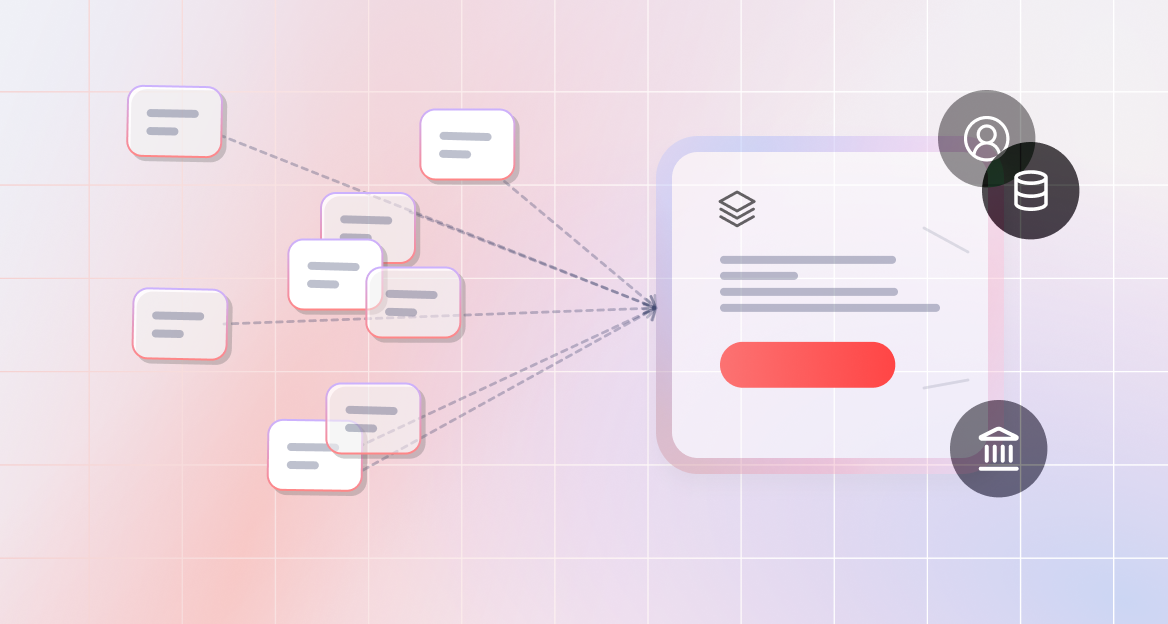
Consolidation is often framed as a cost conversation. The more important frame is a risk architecture conversation. A unified merchant underwriting and monitoring platform means that the risk profile created at onboarding does not stop being useful after approval. It becomes the baseline for everything that follows.
In practice, this means:
- A persistent merchant risk record. The merchant's KYB (Know Your Business) documentation, beneficial ownership structure, risk tier assignment, and underwriting rationale exist in the same system that generates monitoring alerts. When an alert fires, the reviewing analyst sees the full context, not just the triggering signal.
- Onboarding data that feeds monitoring logic. A merchant approved with a conditional risk note, such as a high-risk product category or a thin ownership history, can have that condition reflected in monitoring sensitivity. The underwriting decision informs how the merchant is watched afterward.
- Contextual alerts, not volume alerts. Monitoring that understands a merchant's approved processing profile can distinguish between normal growth and suspicious deviation. A merchant processing three times their stated volume is a very different signal depending on whether their category is physical goods, digital services, or high-risk subscriptions.
- One audit trail. Every decision, review, escalation, and remediation is logged in the same system. Regulatory reporting and card network compliance documentation draw from a single source of truth.
This architecture also changes how compliance reporting functions. Rather than assembling a report from exports, compliance officers can generate audit-ready documentation from one platform because the data was never separated to begin with.
The Business Case for Consolidation
The efficiency gains are real, but they are secondary to the risk management argument. Integrated risk operations reduce the window between a merchant's behavior changing and a risk team being able to act on it.
Research on integrated risk architectures consistently finds that when data flows between functions without manual intervention, the time from detection to decision compresses materially compared to fragmented stacks that require manual reconciliation between systems.
For acquirers, the operational costs of fragmentation are also direct:
- Analyst time spent on data reconciliation rather than risk judgment
- Duplicate vendor contracts for overlapping capabilities
- Higher error rates in compliance reporting due to manual aggregation
- Slower onboarding decisions when underwriting teams cannot access integrated data signals
- Escalated investigation costs when audit requests require reconstructing merchant histories from multiple systems
The calculus shifts when a single platform carries the merchant from initial onboarding through ongoing risk monitoring. The overhead is in the integration work once, not in the reconciliation work continuously.
A Practical Migration Path
The question compliance leaders ask most often is not whether consolidation is worth pursuing. It is whether it is operationally feasible without disrupting the existing merchant portfolio and team workflows.
A phased approach is typically more realistic than a full replacement. The sequence we most commonly see work is:
Phase 1: Centralize monitoring first. Monitoring is generally the higher-urgency problem and involves less disruption to merchant-facing processes than replacing the underwriting workflow.
Standing up a unified merchant monitoring layer that consolidates alert management, case tracking, and compliance reporting creates an immediate operational improvement and establishes the data architecture for the next phase.
Phase 2: Connect underwriting to the monitoring baseline. Once monitoring is running on the unified platform, the underwriting workflow can be migrated progressively. New merchant applications flow through the consolidated system, building the persistent risk records that monitoring can reference. Existing merchants are migrated using historical data imports to populate their baseline profiles.
Phase 3: Run parallel systems during the transition. For a period, both the legacy and new underwriting workflows may run simultaneously for different merchant segments. This is expected and manageable.
The key is that monitoring for all merchants, including those still in the legacy underwriting path, is centralized from the start, so the audit trail is complete regardless of which onboarding path a merchant entered through.
The transition does not require a freeze on merchant onboarding or a halt to monitoring operations. API-first platforms can ingest existing merchant data, map it to the new risk profile structure, and begin generating contextualized alerts without requiring the full legacy system to be decommissioned first.
The organizational question is often harder than the technical one. Risk teams that have built expertise in specific point solutions will need time to adapt to consolidated workflows. Compliance officers used to exporting from separate systems will need to trust a new reporting layer. Both concerns are addressed through parallel running and incremental cutover, not through a hard switch.
About Ballerine
Ballerine is a merchant risk platform built for the full merchant lifecycle. Underwriting, onboarding, and ongoing monitoring operate within a single environment, so the risk profile created during the application process does not end at approval. It persists, and it informs how each merchant is watched afterward.
Risk teams work from a single merchant record that carries KYB documentation, beneficial ownership data, underwriting rationale, transaction signals, and monitoring history together. Compliance reporting draws from one audit trail rather than from exports assembled across multiple systems.
The platform is API-first and is designed to integrate with existing data sources and workflows, which makes phased migration feasible without requiring a full replacement of legacy infrastructure on day one.
For acquirers evaluating whether consolidation is operationally realistic, the starting point is understanding what full lifecycle coverage actually looks like in practice.
Schedule a demo to see how underwriting, monitoring, and compliance reporting work together in one platform.
About the Author

Andy Vrabel
Payments Risk & Compliance Expert
@
Ballerine
Andrew Vrabel is a payments risk and compliance expert with deep expertise in merchant risk intelligence, merchant monitoring, anti-money laundering, and fraud prevention across the payments ecosystem. He works with payment companies, acquirers, payfacs, and other financial services stakeholders to help strengthen merchant onboarding, improve ongoing monitoring, and identify high-risk activity through data-driven risk and compliance strategies.




.svg)
.svg)
.svg)
.svg)
.svg)
.svg)
.svg)
.svg)