

Trusted by









.webp)

.webp)

.webp)
Agentic commerce readiness is the operational condition in which a merchant, payment service provider (PSP), acquirer, or marketplace has the controls needed to participate in agent-driven commerce responsibly. It combines verified merchant identity, accurate product and inventory data, clear commercial policies, agent-specific operating limits, and continuous monitoring.
Readiness is not a formal card-network certification, and it is not established by technical integration alone. A merchant may connect to an agent commerce protocol while still exposing incomplete catalog data, inconsistent return terms, or products that fall outside the PSP’s approved risk profile.
Operational readiness concerns whether the merchant can support agent-driven transactions accurately and whether the PSP can maintain oversight as conditions change.
A technical connection determines whether an AI agent and a merchant system can exchange information or submit an order. It does not determine whether the merchant is legitimate, whether the information being exchanged is accurate, or whether the merchant will fulfill the transaction according to the terms presented to the user.
This distinction matters because an AI agent acts on merchant data. It may rely on product descriptions, current prices, inventory availability, shipping commitments, subscription terms, and return policies. If those inputs are incomplete or inconsistent, the agent can follow the technical process correctly while producing an outcome that does not match the user’s expectations.
Readiness therefore sits across several functions. Merchant onboarding teams confirm who the merchant is. Risk teams determine whether the business model and products fit the institution’s policies. Operations teams maintain catalog and fulfillment data.
Monitoring teams detect changes after activation. A merchant should not be treated as ready simply because one of these functions has completed its part.
The merchant must first pass the identity, ownership, and business-model checks that apply to the broader merchant relationship. Merchant verification establishes whether the legal entity exists, who owns or controls it, and whether its declared activity fits the PSP’s or acquirer’s risk criteria.
For agentic commerce, that baseline must also be current. An ownership transfer, new product category, change in operating geography, or shift in fulfillment model may affect whether the merchant remains suitable for an agent-driven channel.
Product names, descriptions, variants, prices, availability, and fulfillment conditions should be complete and consistent across the sources an AI agent may access. Structured data makes a merchant readable to an agent, but it does not guarantee that the underlying information is correct.
Readiness requires a process for identifying differences between the merchant’s live operating conditions and the information exposed to agent platforms. A product that appears available but is routinely out of stock, or a price feed that does not reflect checkout conditions, creates a foreseeable source of failed orders and consumer complaints.
Return, refund, cancellation, shipping, and subscription terms must be stated clearly enough for an agent to represent them accurately. Where policies vary by product, geography, promotion, or customer type, those conditions should be explicit.
The relevant question is not only whether a policy exists. It is whether the policy presented to the agent matches the policy the merchant will apply after the transaction. Differences between machine-readable terms, website copy, and actual merchant practice weaken readiness.
A PSP or merchant may need to define additional controls for agent-driven transactions. These may include maximum transaction values, permitted product categories, geographic restrictions, additional confirmation requirements, or limits on recurring purchases.
The appropriate controls depend on the merchant’s risk profile, the agent platform’s authorization model, and the PSP’s own risk appetite. They should be documented rather than assumed, and merchants should understand the conditions they are expected to maintain.
Readiness must be supported by continuous monitoring. Relevant changes include catalog updates, new restricted products, revised policies, ownership events, unusual transaction behavior, and shifts in the merchant’s business model.
The PSP should also retain evidence of what was checked, what conditions applied at the time, and how a detected issue was handled. A readiness program is incomplete if it identifies a discrepancy but does not define who reviews it, how the merchant is notified, what remediation is required, and when agent-channel access should be restricted.
A merchant that meets readiness criteria at launch may fall below them later. The merchant may introduce new products, change its return policy, alter subscription terms, move into a new market, or begin fulfilling orders through a different operating model.
For example, a merchant may initially expose a 30-day return policy to agent platforms and later make discounted items final sale. If the merchant updates its website but not the structured policy information used by agents, the agent may continue presenting the older terms. The merchant was ready at activation, but the policy inconsistency creates a new operational gap.
This is why agentic commerce readiness should be managed as part of ongoing monitoring, not as a separate one-time review. The readiness baseline establishes the approved state. Monitoring determines whether the merchant continues to operate within it.
Merchant web monitoring can support this process by identifying changes in merchant content, products, and policies. Agentic commerce extends the monitoring surface to include the structured information and representations that agents use when making decisions for consumers.
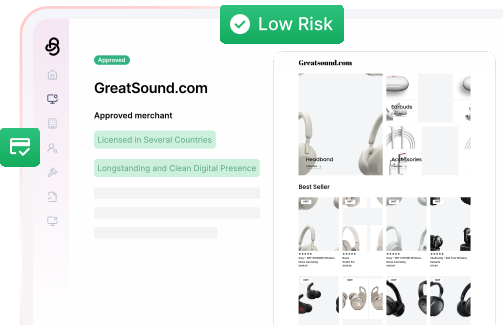
Ballerine’s Trusted Agentic Commerce Enablement Platform supports initial merchant readiness and continuous governance. During preparation and enablement, Ballerine helps PSPs assess merchant legitimacy, establish agent-specific policy controls, and create readiness profiles for operational review.
After activation, Ballerine monitors inventory and catalog changes, policy drift, merchant legitimacy signals, and behavioral anomalies. Detected issues can be routed into remediation workflows, while audit-ready evidence records the checks and policy states associated with each merchant. This allows PSPs to manage readiness as an ongoing condition rather than a historical onboarding result.
Reduced manual efforts
Improved review resolution time
Increase in detected fraud
.webp)




.webp)
.png)
.svg)


.webp)