

Trusted by








.webp)

.webp)

.webp)
Risk mitigation is the process of implementing controls to reduce the likelihood or impact of identified threats, such as fraud, financial loss, regulatory violations, or operational disruption. For payment facilitators (PayFacs), acquirers, and marketplaces, risk mitigation involves continuous decision-making on how to manage merchants, transactions, and partners based on observed behavior and external intelligence.
Risk mitigation is not a one-time activity. It requires ongoing decisions about which merchants to accept, which to monitor, and which to offboard. Several factors make this challenging:
We recommend a structured approach that addresses risk at multiple stages of the merchant lifecycle:
Segment applicants by risk level using Know Your Business (KYB) checks, UBO verification, and business model analysis. High-risk categories (e.g., crypto, adult, travel) should trigger enhanced due diligence.
Practical steps:
Mitigation does not end at approval. Merchant monitoring should track behavioral shifts that indicate increased risk, such as chargebacks spikes, transaction pattern changes, or negative press.
We look for:
Establish triggers for intervention. For example, if a merchant's chargeback rate exceeds 0.9%, move them to a watch list or impose a rolling reserve. If it exceeds 1.5%, escalate to manual review or suspend processing.
We usually advise teams to define escalation paths in advance so frontline operators know when to act and when to escalate to senior risk analysts.
For platforms facilitating sub-merchants (e.g., marketplaces, PayFacs), risk mitigation extends to partner oversight. This includes monitoring the risk profile of downstream partners, enforcing contractual compliance, and ensuring sub-merchants meet the same standards as directly acquired merchants.
Use data from declined applicants, offboarded merchants, and fraud incidents to refine underwriting policies. Regular reviews (quarterly or biannually) help ensure policies reflect current threats rather than outdated assumptions.
A payment facilitator onboards a merchant selling electronics. Initial KYB checks show a registered company, verified UBO, and a legitimate-looking website. The merchant is approved.
Three months later, monitoring systems flag the following:
The risk team triggers a mitigation workflow:
This scenario illustrates why mitigation must combine automated alerts with investigative capacity. The merchant passed onboarding, but behavioral changes required intervention.
Failure to mitigate risk effectively has measurable consequences:
For acquirers and PayFacs, mitigation is not optional. It is a foundational requirement for maintaining scheme compliance and protecting margins.
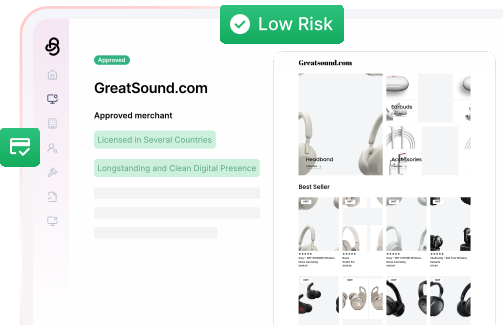
Ballerine provides a risk decisioning platform that integrates onboarding, monitoring, and investigation workflows. Our merchant underwriting solution automates data collection from dozens of sources (company registries, sanctions lists, adverse media), scoring applicants based on configurable risk models.
For ongoing mitigation, our monitoring engine tracks transaction patterns, chargeback trends, and external signals, alerting teams to behavioral shifts that warrant intervention. Investigations are centralized in a case management system that consolidates merchant history, supporting documents, and audit trails for regulatory reporting.
Teams using Ballerine report reduced manual review time, faster investigation resolution, and improved fraud detection accuracy.
Reduced manual efforts
Improved review resolution time
Increase in detected fraud
.webp)




.webp)
.png)
.svg)


.webp)