

Trusted by









.webp)

.webp)

.webp)
Transaction analysis is the systematic examination of merchant payment data, including transaction volumes, velocity, MCC classifications, geographic patterns, and behavioral trends, to identify anomalies and mismatches that indicate merchant fraud, transaction laundering, or business model misrepresentation. In merchant risk, transaction analysis extends beyond rule-based monitoring by correlating what a merchant processes against what they actually are: cross-referencing payment patterns with the merchant's website, digital infrastructure, stated business model, and web presence to surface risk that transaction data alone cannot reveal.
Fraud teams at acquiring banks, payment facilitators, and payment networks rely on transaction monitoring as their primary defense against merchant fraud. But the gap between what a merchant processes and what they actually do is precisely where material losses accumulate. Three structural problems limit how far transaction data alone can take you.
The Transaction Laundering Blind Spot
Transaction laundering, also called unauthorized aggregation or factoring, is designed to pass through rule-based monitoring undetected. A merchant processes transactions on behalf of an undisclosed business, often selling illegal or prohibited goods, while presenting the payment network with clean-looking volume, low chargebacks, and a legitimate MCC. No individual rule fires. The signal only becomes visible when transaction patterns are compared against what the merchant actually does: their website content, pricing model, customer geography, and business activity. Acquirers relying purely on transactional signals routinely miss this exposure until chargebacks or regulatory action surface it.
The Context Problem
Transaction data has no memory of what a merchant said they were at onboarding. A merchant approved as a software company may gradually shift to selling nutraceuticals, adult content, or financial products, and none of that would trigger a transaction-level alert unless chargeback rates deteriorate. MCC misclassification is both common and consequential: Mastercard's Merchant Monitoring Program (MMP) requires acquirers to actively detect and remediate MCC violations and transaction laundering on an ongoing basis. Without a mechanism to compare a merchant's current real-world behavior against their stated category, those mismatches accumulate silently.
The Analyst Capacity Problem
Even when fraud teams have access to meaningful transaction data, reviewing merchants at portfolio scale is not viable manually. Analysts working through case queues without automated prioritization, contextual evidence, or explainable risk signals spend most of their time either dismissing low-quality alerts or gathering data that should have been assembled before the case reached them. The result is inconsistent review quality, missed risk in lower-volume merchants, and compliance documentation that does not hold up to regulatory scrutiny.
1. Define What You Are Actually Looking For
Transaction analysis serves different detection objectives, and conflating them leads to poorly calibrated programs. The three primary use cases require different data inputs and review logic:
Defining which problem you are solving determines what data you need to ingest and what signals constitute a meaningful finding.
2. Cross-Reference Transaction Data with Digital Signals
The most significant limitation in traditional transaction monitoring is that it treats the merchant as an abstraction defined only by their MID and MCC. In practice, a merchant has a website, a digital footprint, a web traffic profile, and a business model that can be analyzed independently of their payment activity. Effective transaction analysis programs correlate payment behavior against:
Mismatches between any of these dimensions and the transaction record are the primary indicators of laundering or misrepresentation.
3. Build Explainability Into Every Finding
Compliance teams cannot act on findings that say a merchant is suspicious without explaining why. Regulatory reviewers, acquiring bank auditors, and card scheme compliance teams all require traceable evidence, not algorithmic scores. Each merchant risk finding should include:
This is directly relevant to scheme compliance requirements. FATF Recommendation 20 requires financial institutions to flag unusual fund movements for further analysis and maintain case management systems capable of timely review. Meeting that standard requires findings that are explainable and auditable, not just scored.
4. Establish Thresholds for Escalation and Disposition
Not every anomaly requires the same response. A transaction analysis program that routes every finding to the same queue will collapse under volume. Define escalation tiers in advance:
Documented escalation criteria protect against both inconsistent decision-making and missed risk at the margins.
5. Automate Monitoring Across the Full Portfolio
Transaction analysis is most valuable when it runs continuously across all active merchants, not only on merchants who have already triggered alerts through other channels. By the time a merchant's chargeback rate deteriorates or a consumer complaint reaches the network, the underlying problem has usually been present for months. Scheduled automated analysis across the full merchant portfolio allows risk teams to:
Portfolio-scale automation does not replace analyst judgment. It ensures analyst judgment is applied where it is actually needed.
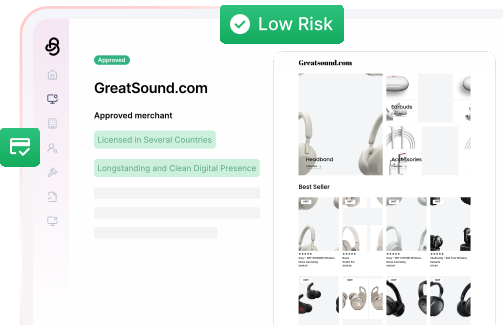
Ballerine's merchant monitoring platform automates transaction analysis across the full merchant portfolio, cross-referencing payment data with each merchant's digital footprint, website content, and business model. The system identifies transaction laundering, MCC mismatches, and behavioral anomalies without manual rule configuration, and delivers explainable risk reports with ranked signals and full evidence trails ready for analyst review, annotation, and export.
For organizations subject to Mastercard MMP requirements, Ballerine's MMSP-aligned compliance workflow connects transaction analysis findings directly to the documentation and reporting obligations acquirers need to meet scheme standards.
For organizations managing the full merchant lifecycle, Ballerine integrates transaction analysis into a unified workflow alongside merchant underwriting, ensuring consistent risk evaluation from application through ongoing post-approval monitoring.
Reduced manual efforts
Improved review resolution time
Increase in detected fraud
.webp)




.webp)
.png)
.svg)


.webp)