Turning Acceptable Use Policies into a Dynamic Decision Engine
Turning Acceptable Use Policies into a Dynamic Decision Engine
Apply your own Acceptable Use Policy automatically during merchant onboarding and monitoring, with clear decisions, clear reasoning, and audit-ready outcomes.
Ballerine introduces Policy Fit, a policy decision layer inside Digital Footprint.
Policy Fit allows financial institutions to upload their own Acceptable Use Policy and automatically evaluate merchants against it. Instead of relying only on generic industry rules, financial institutions receive a policy-specific verdict, with reasoning tied directly to the merchant’s actual profile.
Reduce Manual Policy Reviews Without Losing Control
Baseline industry requirements such as scheme rules, regulatory compliance, and fraud prevention are already well understood and widely enforced. These fundamentals are fully covered by Ballerine’s core Digital Footprint analysis.
The challenge begins above that baseline.
Each financial institution has its own policy preferences shaped by geography, operational complexity, regulatory exposure, and vertical focus. Two financial institutions can agree on the same risk facts and still reach different decisions because policy is not risk.
In today’s market, even semi-automated onboarding flows still require a dedicated manual policy review step. Custom policy interpretation remains a human milestone that sits outside automated risk checks, creating friction, delays, and inconsistency.
Focus your manual review time on high-risk merchants
Introducing Policy Fit by Ballerine
Policy Fit evaluates merchants against your Acceptable Use Policy using Digital Footprint signals such as:
Business model and content analysis
Buyer traffic geography
Registry and licensing checks
OSINT and contextual signals
The output is a clear policy verdict:
Neutral - the merchant was evaluated against your policy and no policy triggers were found
Restricted - allowed, but with operational constraints
Prohibited - not acceptable under policy
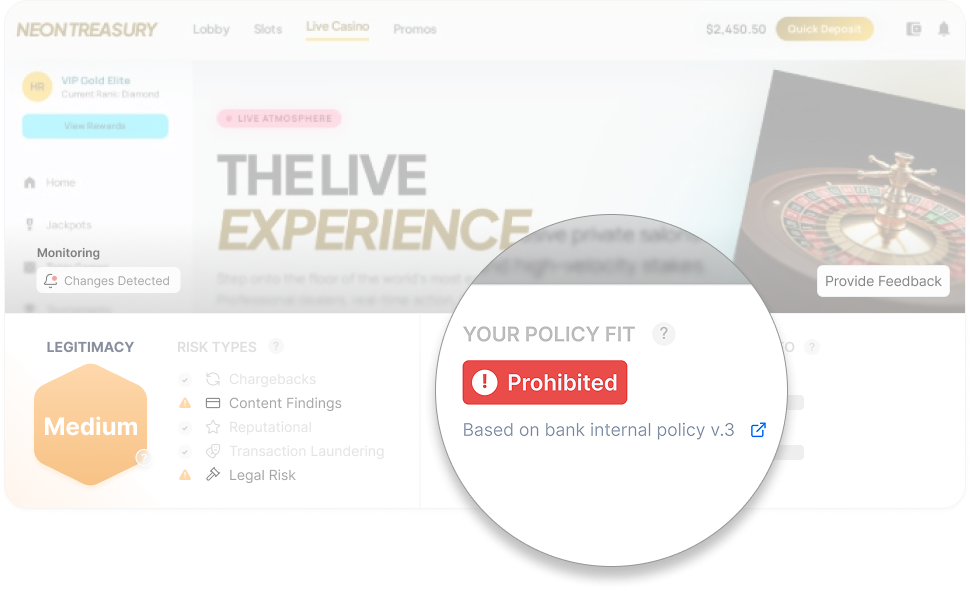
Each verdict includes clear reasoning explaining which policy rules were triggered and why.
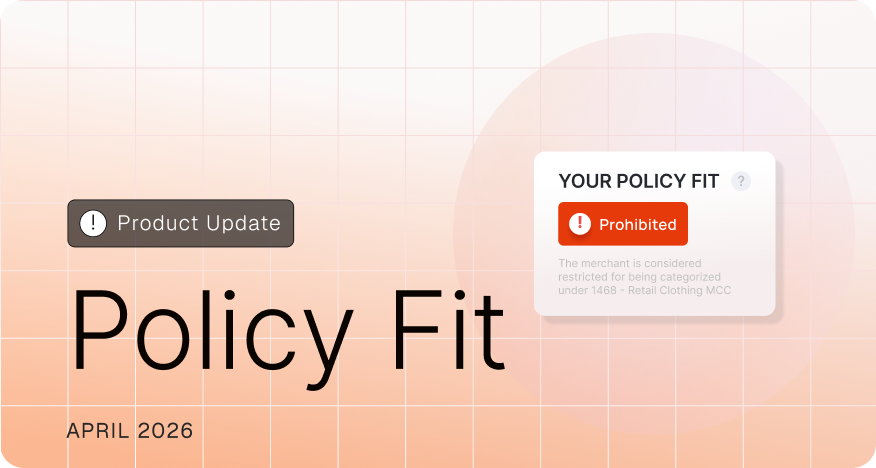
Your Policy Fit verdict and reasoning shown in the report
The Playbook: Policy Fit in Practice
Step 1: Policy Ingestion
Clients share internal policy guidelines and or a public AUP, such as Stripe’s public Acceptable Use Policy¹. These documents are ingested into Ballerine’s model and processed by an LLM-driven workflow that converts them into structured, executable policy rules.
Step 2: Policy Interpretation and Validation
The model highlights ambiguous areas and edge cases. Together with Ballerine’s customer success team, clients review the generated policy logic and validate it using known test cases and stress scenarios. This ensures version one of the policy implementation is complete and accurate before activation.
Step 3: Automated Policy Decisions
Once active, every merchant is automatically evaluated against the policy using Digital Footprint data. The result is a clear verdict with attached reasoning, ready for operational use.
Policy Examples
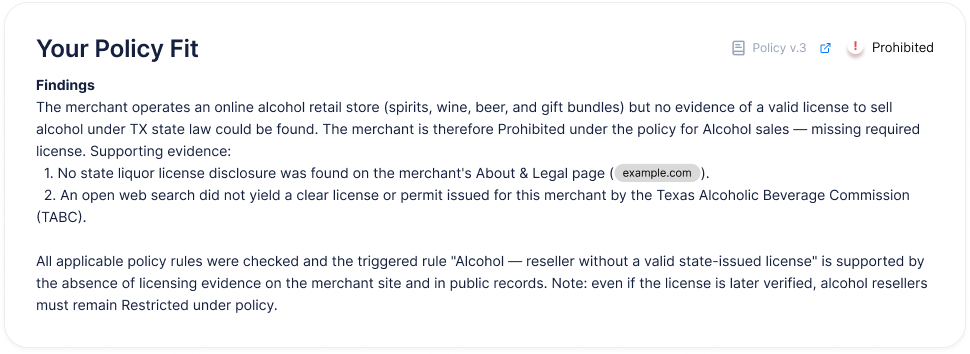
Alcohol Reseller (Prohibited with Built-In Fallback to Restricted)
A merchant selling alcohol is missing a required state license.
Verdict: Prohibited due to missing license
Reasoning also notes that even if the license is later verified, alcohol resellers must remain Restricted under policy
A policy fit verdict and reasoning example of an alcohol merchant
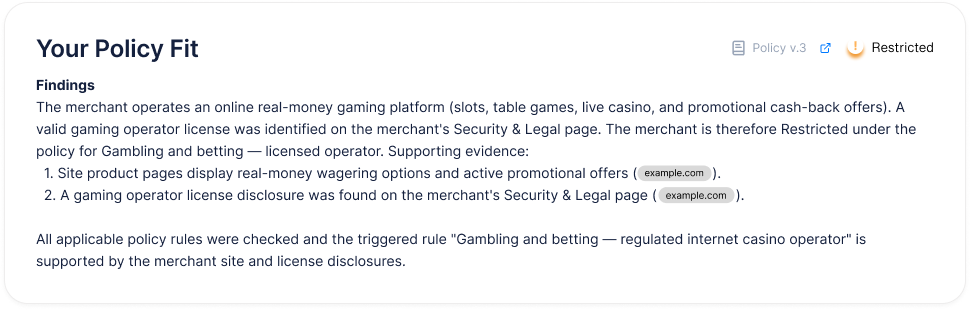
Gaming merchant
A merchant operating an online real-money casino holds a valid gaming license.
Verdict: Restricted as a licensed gambling operator
Reasoning confirms the license is present, but gambling, even when fully licensed, remains Restricted under policy due to inherent regulatory risk
A policy fit verdict and reasoning example of a gaming merchant
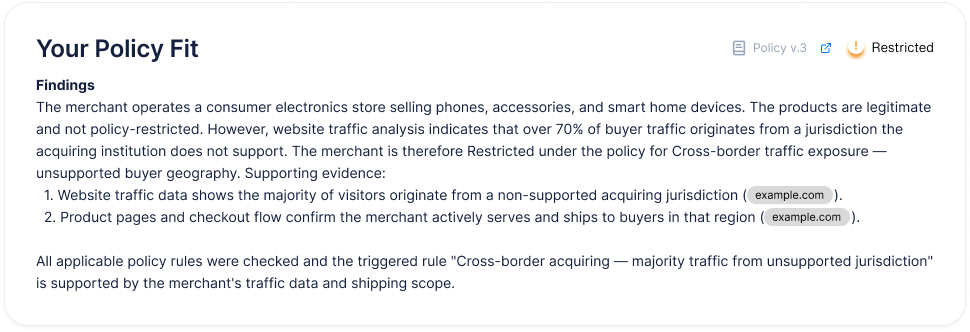
Cross-Border Traffic Exposure (Restricted)
A merchant sells legitimate consumer electronics, but the majority of buyer traffic originates from a country the acquiring institution does not support.
Verdict: Restricted due to cross-border traffic concentration
Reasoning notes that the goods themselves are compliant, but the geographic risk profile triggers a policy restriction
A policy fit verdict and reasoning example of a cross-border merchant
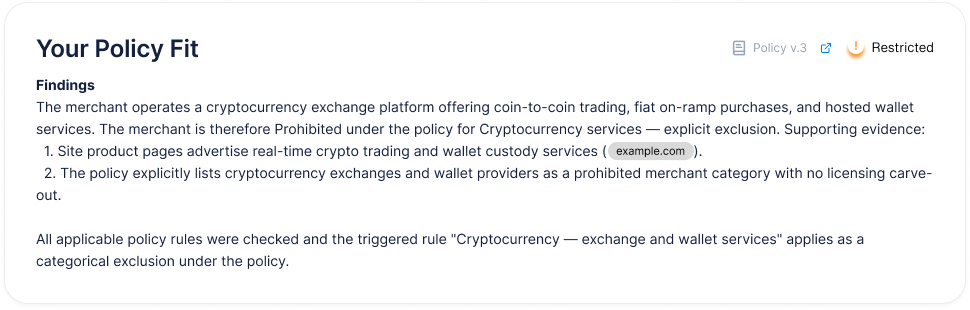
Crypto Services (Prohibited)
A merchant offers cryptocurrency exchange and wallet services.
Verdict: Prohibited under an explicit policy exclusion
Reasoning notes that crypto services are categorically excluded regardless of licensing or jurisdiction
A policy fit verdict and reasoning example of a crypto merchant
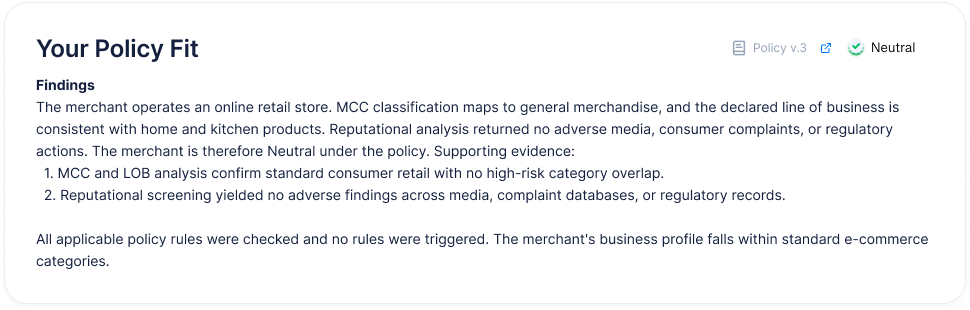
Standard E-commerce (Neutral)
A merchant sells everyday consumer goods with no policy-flagged categories or risk signals.
Verdict: Neutral
No policy rules triggered
A policy fit verdict and reasoning example of an e-commerce merchant
Why It Matters
Policy Fit turns Acceptable Use Policies into a fast, dynamic, and explainable decision engine.
Instead of relying on slow, manual policy interpretation, financial institutions gain:
Faster policy decisions embedded directly into onboarding and monitoring
Clear, explainable outcomes tied to policy rules and merchant signals
Reduced human effort, focused on oversight and exceptions
Consistent enforcement that is transparent, scalable, and auditable
Most importantly, it reflects a simple truth:
Good risk decisions are not one-size-fits-all and policy decision engines should not be either.
--- ---
¹ Ballerine uses Stripe’s publicly available Acceptable Use Policy as an illustrative example only. This does not indicate any partnership or collaboration between the companies.
See how Policy Fit works alongside Digital Footprint, onboarding, and monitoring
Gadi Ben-Amram is a technology entrepreneur and AI product leader specializing in merchant risk management, fraud prevention, and operational automation. With extensive experience building AI-driven platforms, he focuses on helping fintechs and digital businesses streamline compliance workflows, improve risk decisioning, and create safer customer experiences through intelligent automation and data-driven systems.
Related Questions
What is Policy Fit in merchant risk management?
Why do acceptable use policies need to be operationalized?
How can automated web analysis support Policy Fit?
What makes a Policy Fit decision explainable?
How does Policy Fit connect to merchant monitoring?
Ballerine introduces Policy Fit, a policy decision layer inside Digital Footprint.
Policy Fit allows financial institutions to upload their own Acceptable Use Policy and automatically evaluate merchants against it. Instead of relying only on generic industry rules, financial institutions receive a policy-specific verdict, with reasoning tied directly to the merchant’s actual profile.
Reduce Manual Policy Reviews Without Losing Control
Baseline industry requirements such as scheme rules, regulatory compliance, and fraud prevention are already well understood and widely enforced. These fundamentals are fully covered by Ballerine’s core Digital Footprint analysis.
The challenge begins above that baseline.
Each financial institution has its own policy preferences shaped by geography, operational complexity, regulatory exposure, and vertical focus. Two financial institutions can agree on the same risk facts and still reach different decisions because policy is not risk.
In today’s market, even semi-automated onboarding flows still require a dedicated manual policy review step. Custom policy interpretation remains a human milestone that sits outside automated risk checks, creating friction, delays, and inconsistency.
Focus your manual review time on high-risk merchants
Introducing Policy Fit by Ballerine
Policy Fit evaluates merchants against your Acceptable Use Policy using Digital Footprint signals such as:
Business model and content analysis
Buyer traffic geography
Registry and licensing checks
OSINT and contextual signals
The output is a clear policy verdict:
Neutral - the merchant was evaluated against your policy and no policy triggers were found
Restricted - allowed, but with operational constraints
Prohibited - not acceptable under policy
Each verdict includes clear reasoning explaining which policy rules were triggered and why.
Your Policy Fit verdict and reasoning shown in the report
The Playbook: Policy Fit in Practice
Step 1: Policy Ingestion
Clients share internal policy guidelines and or a public AUP, such as Stripe’s public Acceptable Use Policy¹. These documents are ingested into Ballerine’s model and processed by an LLM-driven workflow that converts them into structured, executable policy rules.
Step 2: Policy Interpretation and Validation
The model highlights ambiguous areas and edge cases. Together with Ballerine’s customer success team, clients review the generated policy logic and validate it using known test cases and stress scenarios. This ensures version one of the policy implementation is complete and accurate before activation.
Step 3: Automated Policy Decisions
Once active, every merchant is automatically evaluated against the policy using Digital Footprint data. The result is a clear verdict with attached reasoning, ready for operational use.
Policy Examples
Alcohol Reseller (Prohibited with Built-In Fallback to Restricted)
A merchant selling alcohol is missing a required state license.
Verdict: Prohibited due to missing license
Reasoning also notes that even if the license is later verified, alcohol resellers must remain Restricted under policy
A policy fit verdict and reasoning example of an alcohol merchant
Gaming merchant
A merchant operating an online real-money casino holds a valid gaming license.
Verdict: Restricted as a licensed gambling operator
Reasoning confirms the license is present, but gambling, even when fully licensed, remains Restricted under policy due to inherent regulatory risk
A policy fit verdict and reasoning example of a gaming merchant
Cross-Border Traffic Exposure (Restricted)
A merchant sells legitimate consumer electronics, but the majority of buyer traffic originates from a country the acquiring institution does not support.
Verdict: Restricted due to cross-border traffic concentration
Reasoning notes that the goods themselves are compliant, but the geographic risk profile triggers a policy restriction
A policy fit verdict and reasoning example of a cross-border merchant
Crypto Services (Prohibited)
A merchant offers cryptocurrency exchange and wallet services.
Verdict: Prohibited under an explicit policy exclusion
Reasoning notes that crypto services are categorically excluded regardless of licensing or jurisdiction
A policy fit verdict and reasoning example of a crypto merchant
Standard E-commerce (Neutral)
A merchant sells everyday consumer goods with no policy-flagged categories or risk signals.
Verdict: Neutral
No policy rules triggered
A policy fit verdict and reasoning example of an e-commerce merchant
Why It Matters
Policy Fit turns Acceptable Use Policies into a fast, dynamic, and explainable decision engine.
Instead of relying on slow, manual policy interpretation, financial institutions gain:
Faster policy decisions embedded directly into onboarding and monitoring
Clear, explainable outcomes tied to policy rules and merchant signals
Reduced human effort, focused on oversight and exceptions
Consistent enforcement that is transparent, scalable, and auditable
Most importantly, it reflects a simple truth:
Good risk decisions are not one-size-fits-all and policy decision engines should not be either.
--- ---
¹ Ballerine uses Stripe’s publicly available Acceptable Use Policy as an illustrative example only. This does not indicate any partnership or collaboration between the companies.







.svg)
.svg)
.svg)
.svg)
.svg)
.svg)
.svg)
.svg)
.png)