


On French consumer complaint sites, people post about mystery charges from streaming services. Each thread is about one site. Nobody in those threads knows it's the same operation.
One of those sites landed on our desk. Two hours later we'd tied nine of them to a single operator.
Nothing to find
The site looked like any streaming service: movies, tiered pricing, a big "Cancel Anytime" button. We started with the usual checks: WHOIS, company names, registered agents, scam databases, complaint sites, shared owners or addresses.
Nothing. An LLC at a commercial mailbox. Google the domain with "scam" and you get complaints about that site and only that site. By any conventional standard, one bad actor. Case closed.
That's the design. Every site gets its own brand, its own LLC, its own state, its own merchant account, its own toll-free number, its own Cloudflare proxy. No single search connects them.
The experiment we almost threw away
We'd been playing with a new technique: an embedding similarity engine. It crawls the web, computes a dense vector for every page, and returns sites that are semantically and structurally close. Not keyword matches. Sites that feel the same to a neural network, which is the kind of similarity that survives a find-and-replace on the brand name.
We fed it the URL. It returned four sites: cin█████.com, cino███.com, wav█████.com, cine█████.com.
We ran all four through the same checks. Different owner, different LLC, different state, every one. No shared registrant details. Google "cin█████.com scam" and you get complaints about cin█████, never about wav█████.
We were ready to call it a false positive. Four streaming sites on one template. Maybe they all bought the same WordPress theme.
But the similarity scores were too strong to drop, so we changed the question. "Who owns these sites?" is a question the operator engineered to have no answer. "How are these sites built?" is harder to fake. You can swap every name, address and phone number in an afternoon. Rebuilding the application is real work, and nobody running nine sites does it nine times.
Same skeleton, different skin
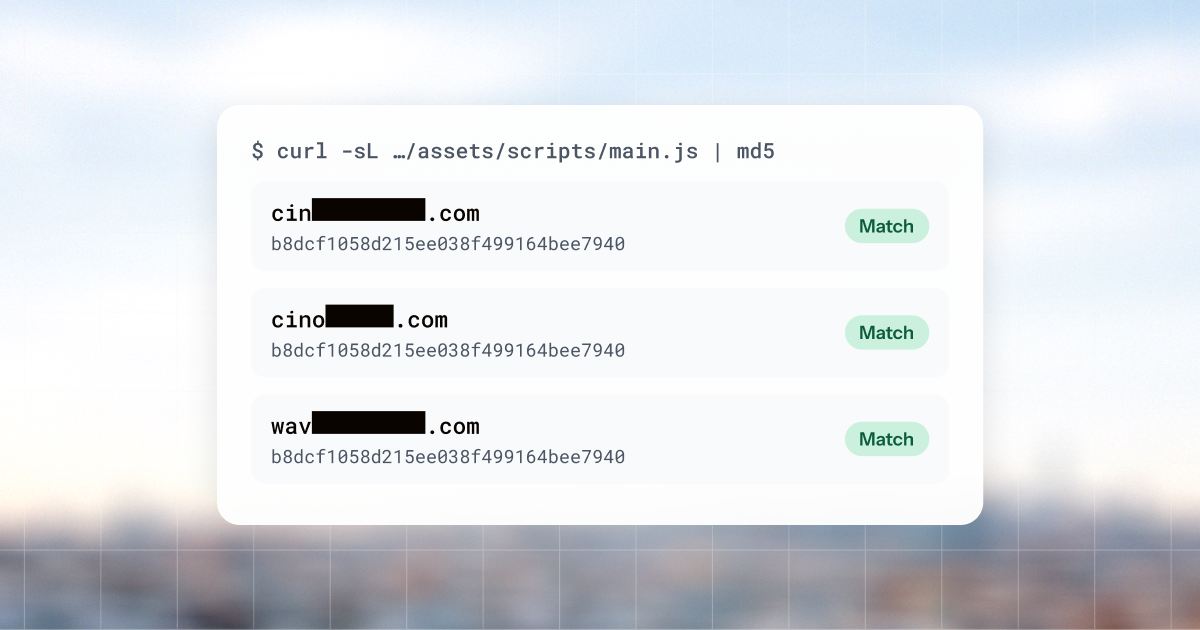
Every site loads a file called main.js. We hashed it.
Identical. A matching hash on jquery-3.6.0.min.js means nothing, since thousands of sites serve the same jQuery. main.js is 250+ lines of custom code: form validation, card number formatting, AJAX handlers, redirect flows.
The CSS was different on every site. Different colors, different fonts (OxfordStreet, Belanosima, Lora), different logo sizes. The class names underneath stayed the same: FntDx, FrmCtr, ElmBrdBox, genBtn4. Not Bootstrap, not Tailwind. One person's naming habits. The privacy policy was dated 12/16/22, six months before any of the domains were registered.
Identical jQuery is noise. Identical custom application code is signal.
main.js is also where your card goes. The signup form takes the card number, expiry and CVC in plain HTML fields, and main.js posts them straight to the operator's own PHP server. No Stripe, no Braintree, no processor iframe. Whoever runs the site holds your raw card data.
It had one more thing in it:
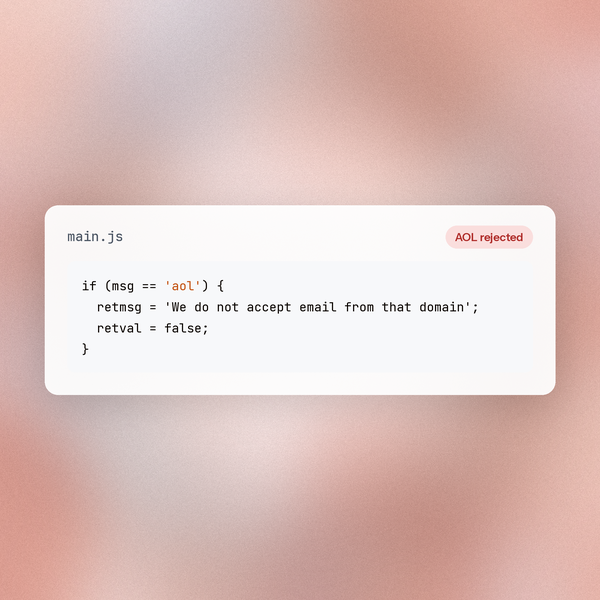
The signup form rejects AOL addresses. AOL has a history of handing over user information in response to subpoenas. Somebody thought about which email providers talk to law enforcement, and blocked one. That's not a product decision. That's counter-forensics.
The terms of service finish the picture. If your bank declines a charge, it goes to Sale Shield, a billing service run out of a UAE free zone, which retries it through a different channel.
The one they forgot to proxy
Seven of the eight streaming domains sit behind Cloudflare, which hides the real server. cin█████.com doesn't. Its DNS points straight at an AWS EC2 instance.
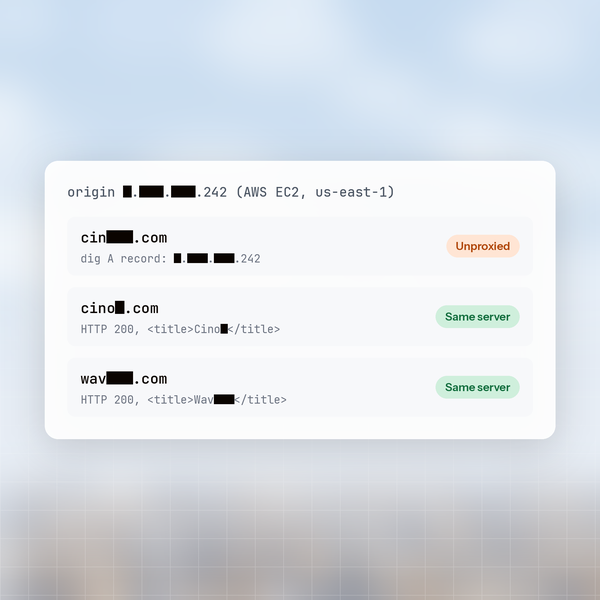
curl --resolve skips DNS and sends the request to an IP we pick. If that server answers for cino██.com with cino██'s own branded page, someone with root access set cino██ up as a virtual host on it. One unproxied domain exposed the origin for the whole network. A second one, cine██.com, turned up later and gave us two more IPs. Four EC2 instances in us-east-1, load-balanced, serving every domain.
Then we nearly embarrassed ourselves. While probing for more domains, we noticed the server returns HTTP 200 for any Host header. google.com, amazon.com, anything you like! A very welcoming server. The catch-all serves a generic games template, and six of the domains we'd tested were hitting it. Six false positives, one step from the report.
A 200 is not attribution. We compared every response against the catch-all page, and the six went away.
Nine
From there it snowballed. A marketing line all four sites shared, "a streaming service that offers a variety of movies in multiple categories on internet connected devices", led to ecni██.com. The French complaint sites gave us cinef███.com, cine███.com and cing████.com. Same main.js hash and same four origin IPs, every time.
A reCAPTCHA sitekey belongs to one Google account and only works on the domains that account authorizes. Two "independent" sites with the same key were set up in the same admin console, by someone logged into the same account.
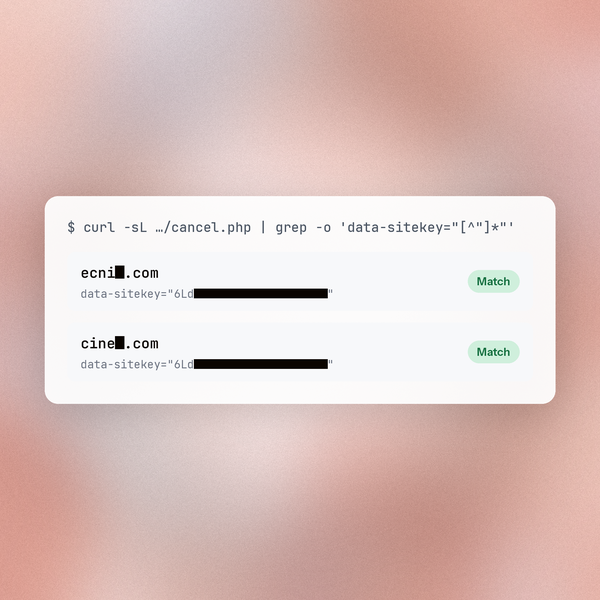
Same key. We found three pairs like this across the network. Shared servers, shared code, shared Google account. One operator.
Then it stopped being a streaming scam. One LLC, ████████ Tech LLC, was the registrant on two domains. Searching it on scam databases turned up kny████.com, a gaming site. Same Chandler, AZ mailbox, same origin IPs, same class names, same AOL block.
Nine domains, nine LLCs, six states. Every address a mailbox rental. Not one real office. The toll-free numbers rotate through 844, 833, 855, 888 and 866 so no blacklist catches the pattern.
What we had was a card mill: a subscription billing platform that collects cards and spreads the chargebacks across nine merchant accounts. Shut one down and the other eight keep billing.
Every one of those French complaint threads is about a different site. The cards in all of them went to the same four servers.
If this is your idea of a good afternoon, we're hiring.
This investigation was conducted on February 18, 2026. All domains referenced are publicly documented scam sites. Domain names, IPs, and API keys have been partially redacted. Individual names have been redacted to initials; addresses to city and state.