

Trusted by









.webp)

.webp)

.webp)
Monitoring merchants is the practice of continuously reviewing a merchant's transaction patterns, website content, business operations, and public presence throughout the merchant lifecycle to detect emerging risks, compliance violations, and changes that require intervention.
Merchants evolve constantly. A business that passed underwriting can shift its model, change products, or exhibit risky behavior within weeks. Payment service providers (PSPs), acquirers, and payment facilitators (PayFacs) face four primary challenges when monitoring their merchant portfolios:
Transaction Pattern Shifts: A merchant's transaction volume, average ticket size, or chargeback rate can change suddenly. These shifts signal potential fraud, authorization abuse, or business model changes that alter the risk profile. Without automated detection, these changes go unnoticed until scheme fines or regulatory inquiries arrive.
Website and Domain Changes: Merchants frequently update their websites, add new products, or launch additional domains. We see this show up when acquirers discover merchants selling prohibited goods, making false advertising claims, or operating undisclosed storefronts. These changes can trigger Mastercard BRAM violations or expose PSPs to regulatory action.
MCC Drift and Product Violations: A merchant onboarded for one merchant category code (MCC) may start selling products that belong in a different, higher risk category. For example, a merchant coded for general retail begins selling CBD products or financial services. This drift creates liability for the acquirer and triggers compliance violations.
False Positives and Alert Fatigue: Manual monitoring or rigid rules create alert fatigue. Risk teams spend significant time investigating benign changes while missing genuine risks. The challenge is distinguishing meaningful risk signals from normal business activity at scale.
We recommend five operational practices for building an effective merchant monitoring program:
1. Define Risk Triggers by Portfolio Segment
Not all merchants require the same monitoring intensity. Segment your portfolio by risk tier, MCC, transaction profile, and regulatory exposure. High risk merchants, such as those in travel, nutraceuticals, or subscription services, require daily or weekly checks. Lower risk merchants may need monthly reviews. Define specific triggers for each segment (for example, chargebacks exceeding 0.9%, transaction volume increases beyond 150% month over month, or keyword matches for prohibited products).
2. Monitor Multiple Data Streams Simultaneously
Effective monitoring requires analyzing transaction data, website content, domain registration records, social media activity, and public records concurrently. Relying solely on transaction metrics creates blind spots. For example, a merchant may maintain stable transaction patterns while quietly adding prohibited products to their website. We usually advise teams to integrate merchant web monitoring with transaction surveillance to capture both behavioral and operational risk.
3. Automate Routine Checks and Escalation Workflows
Manual reviews do not scale. Implement automation for routine checks (website scans, transaction threshold monitoring, and domain change detection). Configure escalation workflows that route alerts to the appropriate team based on severity and risk type. For instance, a BRAM violation should escalate to compliance immediately, while a minor website update may queue for the next review cycle.
4. Establish Response Protocols for Common Scenarios
Create documented procedures for handling frequent monitoring outcomes: MCC drift, prohibited product additions, chargeback spikes, and website compliance issues. Define timelines for merchant outreach, required remediation actions, and account suspension criteria. Clear protocols prevent inconsistent decision making and reduce response time.
5. Track Performance Metrics and Audit Trails
Measure your monitoring program's effectiveness using detection rates, false positive ratios, time to resolution, and audit coverage. Maintain detailed records of monitoring activity, alert disposition, and merchant communications. These audit trails prove to regulators and card schemes that your program meets Merchant Monitoring Program (MMP) standards and operates with appropriate oversight.
A PSP onboards a health and wellness merchant coded as MCC 5499 (Miscellaneous Food Stores). During underwriting, the merchant's website sells vitamins and supplements compliant with the stated business model. Six weeks after activation, automated website monitoring detects new product listings for kratom, a substance prohibited under the PSP's acceptable use policy and flagged by card scheme compliance programs.
The monitoring system captures the product descriptions, prices, and page URLs as evidence. An alert routes to the compliance team within hours of detection. The compliance analyst reviews the evidence, confirms the violation, and initiates the defined response protocol: temporary account suspension pending merchant explanation, a formal notice requiring product removal within 48 hours, and escalation to the relationship manager for account review.
Without continuous monitoring, this violation would remain undetected until customer complaints, chargebacks, or a card scheme audit exposed the issue. By that point, the PSP faces potential fines, reputational damage, and regulatory scrutiny.
Continuous merchant monitoring serves three strategic functions beyond compliance: risk mitigation, portfolio optimization, and relationship management.
From a risk perspective, monitoring prevents small issues from becoming scheme violations or regulatory actions. Acquirers that detect and address merchant drift early avoid the financial and operational costs of remediation programs, fines, and potential loss of card scheme sponsorship.
For portfolio management, monitoring data reveals trends across merchant segments. Risk teams can identify categories with elevated chargeback rates, MCCs with frequent policy violations, or geographic regions with higher regulatory exposure. This intelligence informs underwriting policy adjustments, pricing decisions, and strategic portfolio choices.
Monitoring also supports merchant relationships when positioned appropriately. Proactive outreach about business changes, compliance requirements, or risk mitigation demonstrates oversight without creating adversarial dynamics. Merchants that understand their acquirer actively monitors their account are less likely to engage in prohibited activities.
The operational reality is that payment ecosystems operate under constant scrutiny from regulators, card schemes, and issuing banks. Acquirers and PSPs that implement rigorous monitoring programs protect themselves from liability while enabling sustainable portfolio growth. Those that rely on reactive approaches, periodic audits, or manual reviews accumulate undetected risk until enforcement actions force expensive remediation.
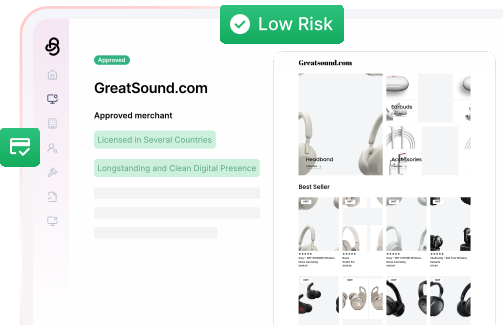
Ballerine provides continuous merchant monitoring infrastructure that combines transaction analysis, website surveillance, domain tracking, and business intelligence into a unified risk platform. The system automates routine monitoring tasks while surfacing high-priority alerts that require human review. Risk teams can configure monitoring rules by merchant segment, integrate monitoring workflows with case management systems, and maintain comprehensive audit trails for regulatory reporting. The platform supports compliance with card scheme requirements, including Mastercard MMP standards, while reducing the operational burden on risk and compliance teams.
Reduced manual efforts
Improved review resolution time
Increase in detected fraud
.webp)




.webp)
.png)
.svg)


.webp)