
Blogs
>
How underwriters catch phoenix merchants by tracing the old company

How underwriters catch phoenix merchants by tracing the old company

Guy Raveh
Nov 16, 2026
Share:

Index

Last updated: 
Nov 16, 2026

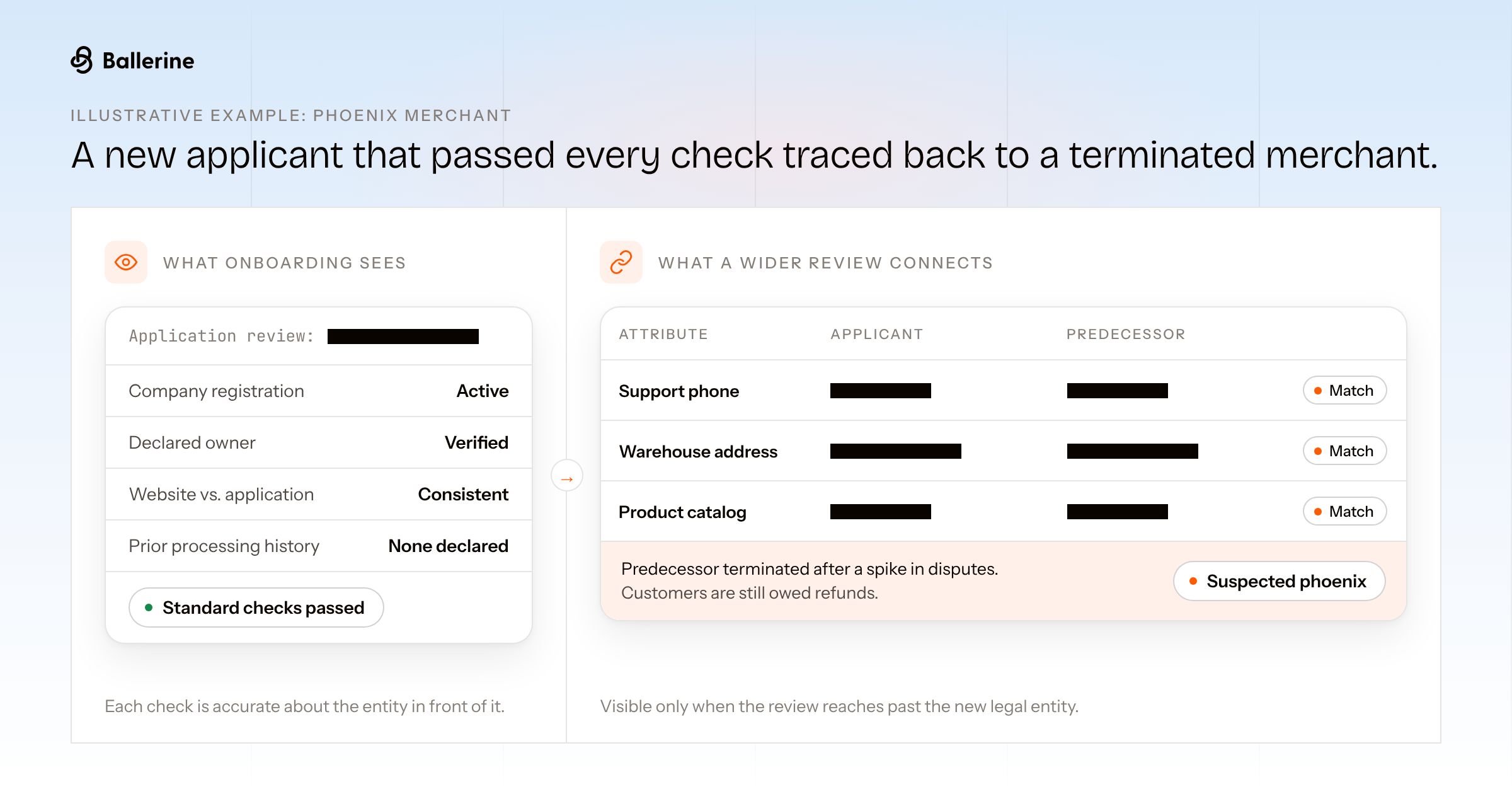
Consider a new merchant application that passes every standard check. The registration is active, the declared owner clears identity verification, and the website matches the products listed in the application. A wider review then connects the applicant’s support number, warehouse address, and product catalog to a merchant that was terminated after a spike in disputes. The applicant reported no prior processing history, and the predecessor company still owes customers refunds.

‍

Risk teams call this a phoenix merchant. The term comes from corporate insolvency, where Australian government agencies describe illegal phoenix activity as a new company created to continue the business of one that was liquidated to avoid its liabilities. In payments, we use a broader working definition: a phoenix merchant is a new or repurposed legal entity that continues substantially the same merchant operation while material liabilities, restrictions, or adverse history stay with a predecessor.

‍

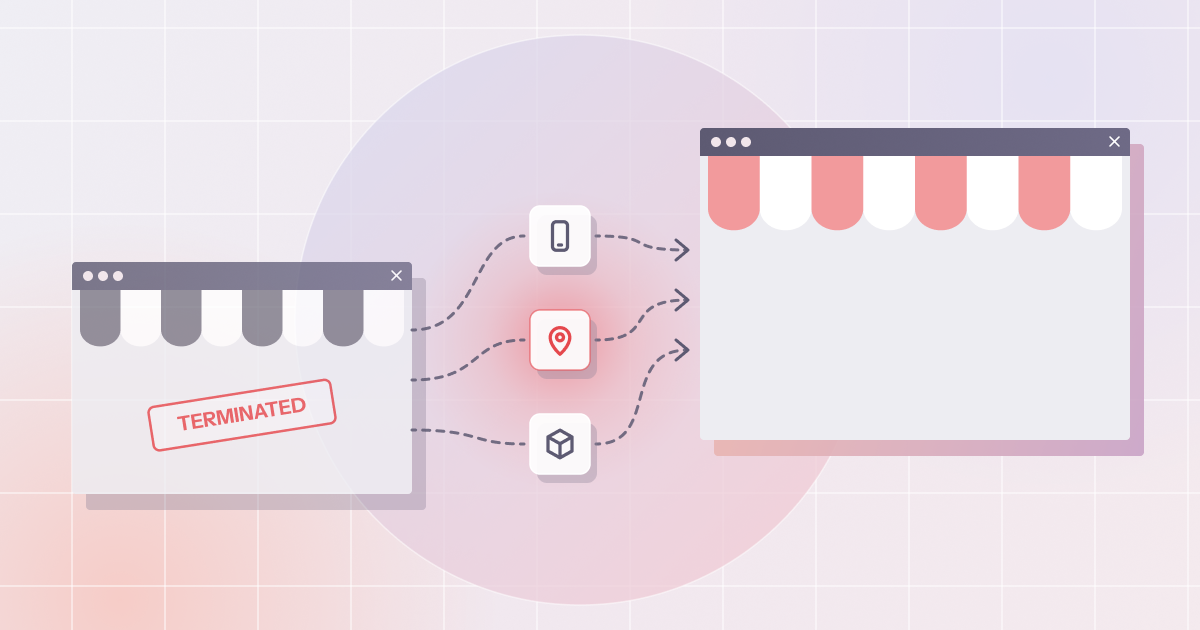
The legal name changes, while the owners, storefront, customers, fulfillment, domain, or payment behavior carry over. Revenue moves to the new company (NewCo), and refunds, chargebacks, or processing restrictions stay with the old one (OldCo). By the time an underwriter sees the application, the rebirth has already happened, so the review has to work backward from NewCo to whatever OldCo left behind.
‍

‍

‍

‍

The three routes phoenix merchants take back into payments

‍

In our experience, the rebirth follows one of three routes. In a post-failure phoenix, OldCo has dissolved, entered bankruptcy, forfeited its registration, or stopped operating before NewCo applies. In an in-flight phoenix, OldCo is still active while its sales, assets, customers, or processing volume move to NewCo. In termination evasion, OldCo loses payment access and its operators return through NewCo, a nominee owner, another sales partner, a related merchant account, or a different jurisdiction.

‍

Termination evasion deserves the closest attention because it crosses organizational boundaries. A merchant declined or terminated by one payment service provider (PSP) can approach another acquirer, apply through a different independent sales organization (ISO), sell through a marketplace, or route payments through a related company. Variants we see include serial phoenixing through several entities in sequence, partial phoenixing of a single brand or product line, nominee ownership, and a dormant company registered ahead of the termination.

‍

‍

‍

Why standard KYC and KYB checks miss the predecessor

Know Your Customer (KYC) and Know Your Business (KYB) checks verify the applicant in front of the reviewer. KYB confirms that NewCo exists and is properly registered, and KYC confirms that its declared owners are real people. Neither check is designed to reconstruct the merchant operation behind the entity, so neither will necessarily show that the same people, including undisclosed controllers, previously ran a terminated merchant through another company. Stronger ownership verification narrows that gap by identifying who actually controls the applicant.

‍

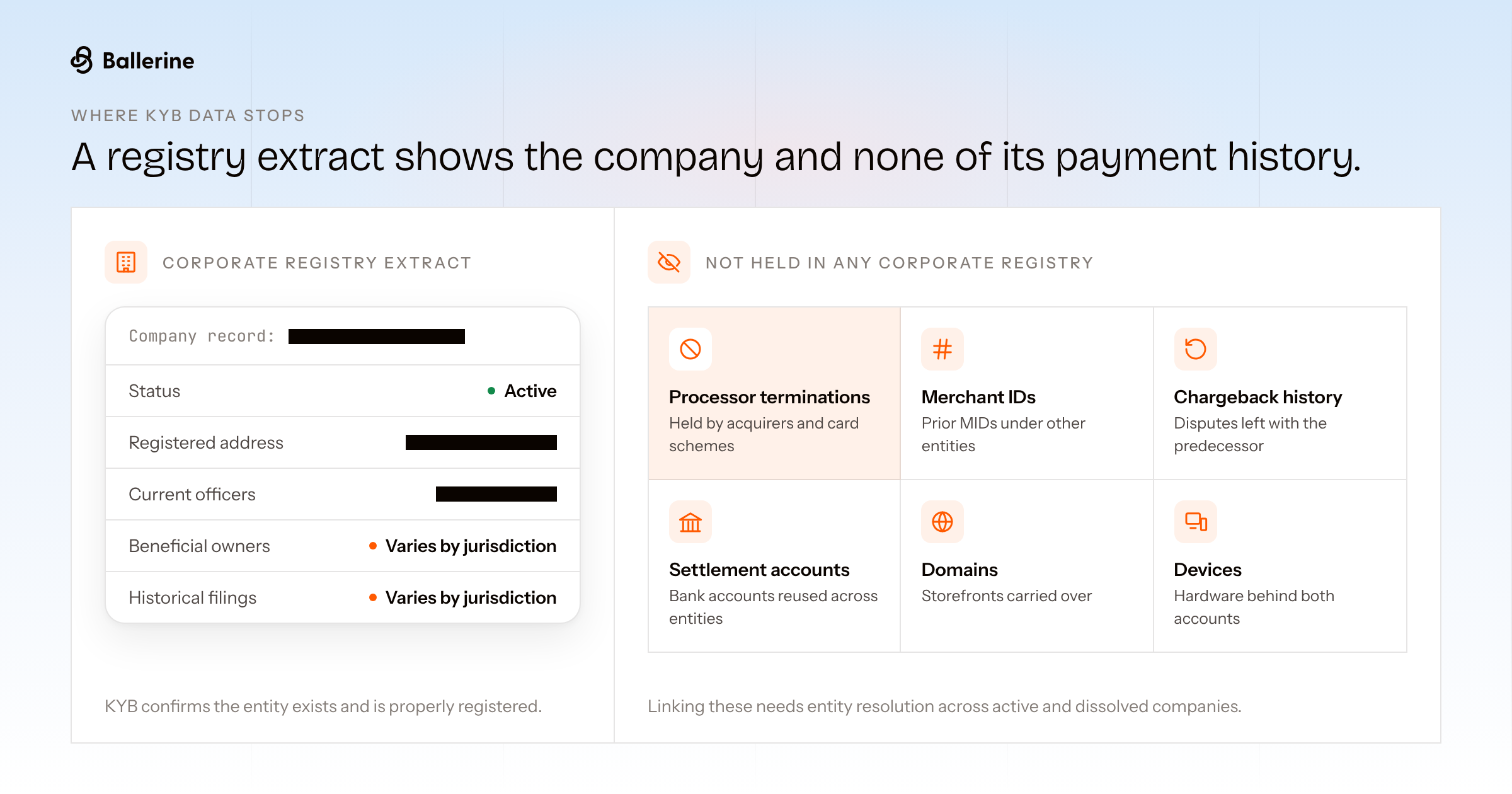
Public records have their own limits. Depending on the jurisdiction, registry data may omit beneficial owners, show only current officers, restrict access to historical filings, or fail to link the same person across several entities. The Financial Action Task Force (FATF) tightened its global standard on beneficial ownership of companies in 2022 and published implementation guidance in March 2023. Corporate registries also hold no record of processor terminations, merchant IDs (MIDs), chargeback history, settlement accounts, domains, or devices.

‍

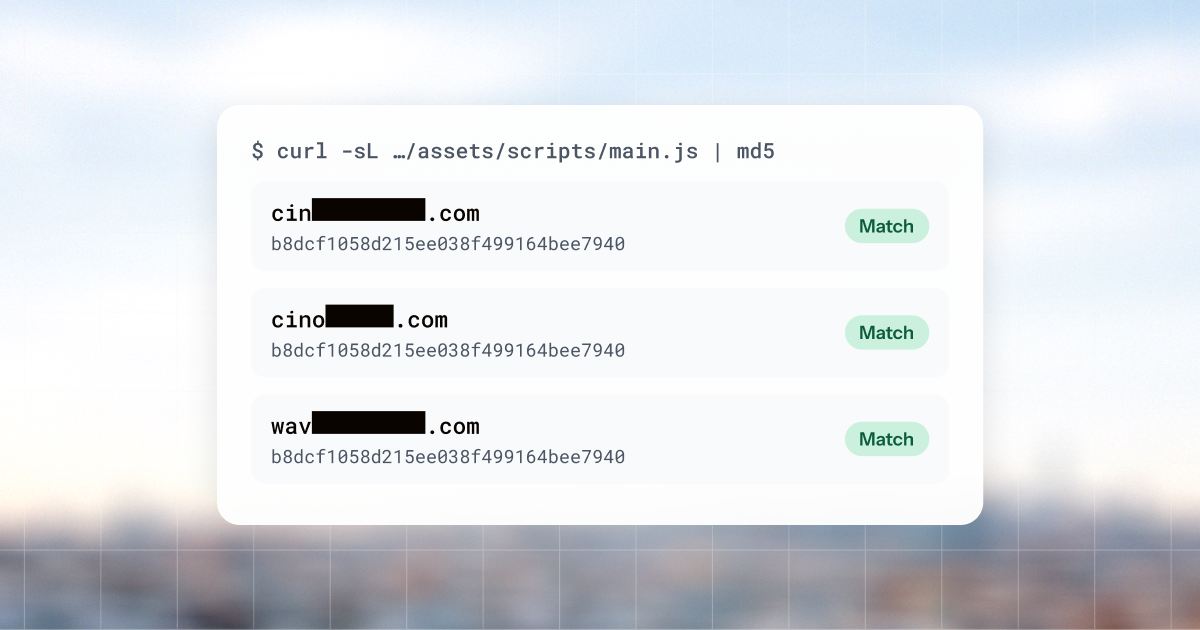
Detecting a phoenix therefore requires entity resolution across time, which means connecting active and dissolved companies through owners, officers, signers, addresses, phone numbers, bank accounts, domains, merchant accounts, and operating infrastructure.

‍

‍

‍

How phoenixing differs from adjacent merchant risks

Clear definitions keep an investigation focused and the final decision defensible. A legitimate successor buys a failed business through a disclosed, documented transaction; the continuity can look identical to a phoenix, but the relationship between the two companies and the allocation of liabilities are explained to the acquirer. A bust-out merchant builds credibility, exploits processing or credit exposure, and disappears. It may phoenix afterward, and the bust-out and the rebirth should be assessed as separate acts.

‍

Transaction laundering routes another business’s transactions through an approved merchant account. Poenixing concerns continuity from a predecessor, and one merchant can do both. Merchant identity theft impersonates an unrelated legitimate company, whereas a phoenix operator is usually connected to the predecessor and hides that link. A front merchant conceals the true operator or activity, and it becomes a phoenix case when the concealed operation continues a prior merchant.

‍

‍

‍

Five signals that build a phoenix case

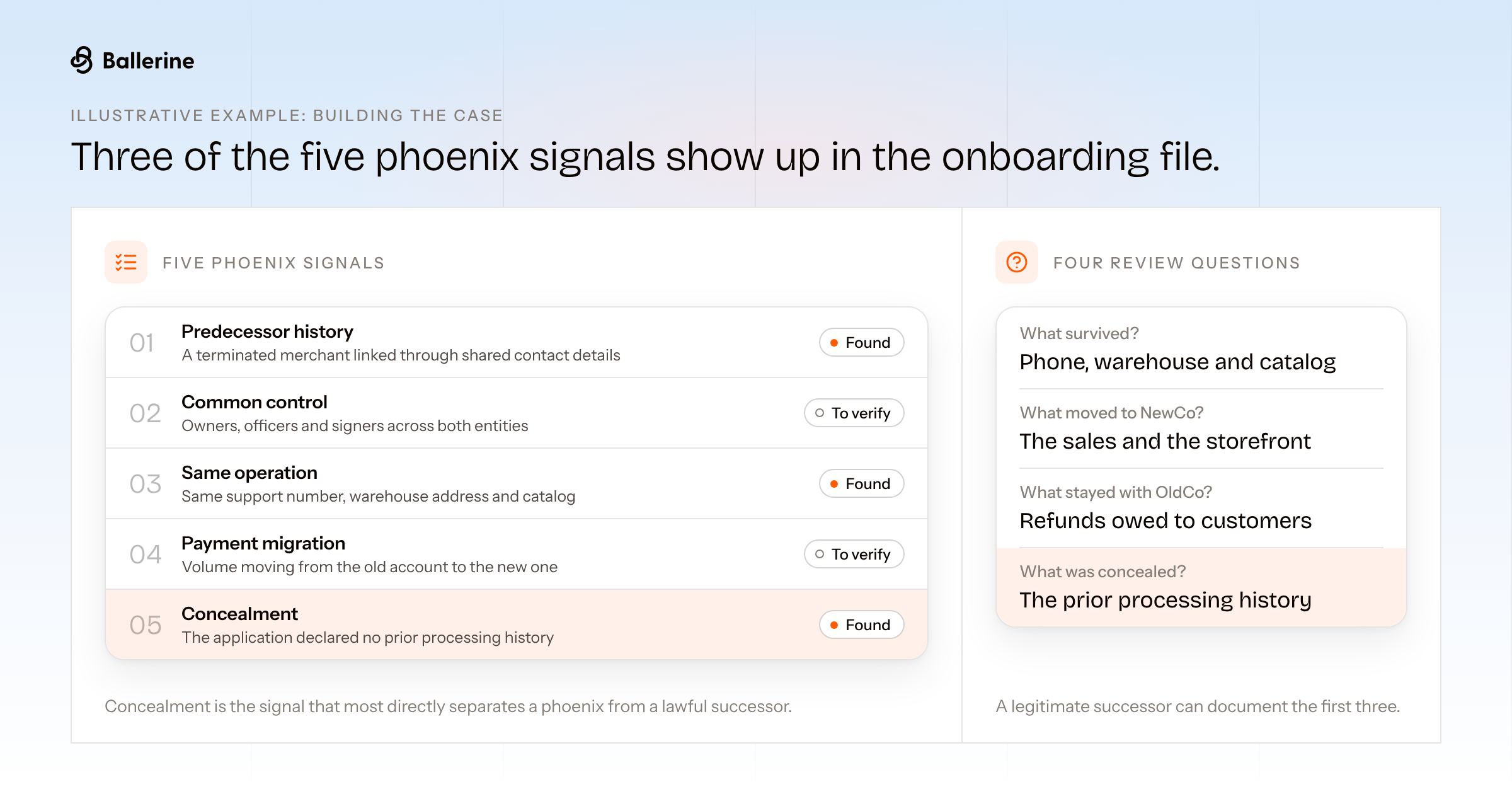
A related dissolved company is a reason to look closer, but on its own it carries little weight. The case strengthens when independent signals show both continuity and avoidance.
‍

‍

We summarize the review as four questions:

What survived the transition?

What moved to NewCo?

What stayed behind with OldCo?

And what the applicant concealed?

A legitimate successor can document answers to the first three, and evidence of concealment is the signal that most directly separates phoenixing from a lawful transfer of a business.

‍

‍

‍

Why legitimate successors still warrant enhanced due diligence

Businesses fail, assets are sold, and new management teams rescue viable operations. Disclosure, credible consideration, documented asset transfers, and a plan for existing customer obligations all support a legitimate explanation. Enhanced due diligence (EDD) is still warranted, because chargebacks, subscription renewals, warranties, and reputational exposure can survive a lawful sale. A sound EDD review covers prior processing statements, the liabilities NewCo assumed and excluded, how refunds will be funded, and the ongoing relationship between OldCo and NewCo.

‍

‍

‍

Controls that reduce phoenix exposure

Start by building a merchant genealogy that spans active, inactive, and dissolved entities, linked through names, people, infrastructure, and your own internal history. Ask applicants directly about predecessor entities, affiliated businesses, asset purchases, prior processors, and terminated accounts, so that any omission becomes a documented misstatement your team can act on.

‍

Screen owners and contact details against your internal records of declined and terminated merchants and against applicable card scheme resources such as Mastercard’s MATCH Pro system (Mastercard Alert to Control High-risk Merchants). Exact-name matching misses an operator who reapplies under a new company name, so matching should run on people, contact details, and infrastructure as well.
‍

‍

After onboarding, monitor the merchant group for volume migration, settlement account changes, new domains, and related entities that grow while another declines. Where policy and the risk assessment support it, control exposure with reserves, settlement delays, volume limits, or shorter review cycles.

‍

‍

‍

How Ballerine approaches phoenix merchants

A phoenix merchant can change its legal name, processor, and storefront, but the people, infrastructure, and obligations it carries forward remain traceable for teams that review across entities and across time. Ballerine brings KYB and ownership data together with website, domain, transaction, and portfolio signals across onboarding, underwriting, and monitoring.

With Blocklist, risk teams screen each new applicant against their own list of blocked merchants and the applicant’s connected entities, including beneficial owners, domains, and related businesses, and every match shows which property triggered it and why. Reviewers see contradictions, shared infrastructure, and changes over time in one evidence trail, then route higher-risk relationships to EDD and ongoing monitoring.


‍

About the Author
Guy Raveh
Risk and Fraud Researcher
@
Ballerine
Guy Raveh is a Risk and Intelligence Researcher at Ballerine, bringing together deep experience in AI, compliance, fraud, and risk. Over nearly a decade, he has worked on building and applying AI models, including at Wix, and has developed first-hand knowledge of the challenges facing risk and compliance teams. A Certified Anti-Money Laundering Specialist (CAMS), Guy now works closely with Ballerine’s data science team to develop new risk intelligence models and adapt them to the complex problems financial institutions face in merchant risk.

Reeza Hendricks

Consider a new merchant application that passes every standard check. The registration is active, the declared owner clears identity verification, and the website matches the products listed in the application. A wider review then connects the applicant’s support number, warehouse address, and product catalog to a merchant that was terminated after a spike in disputes. The applicant reported no prior processing history, and the predecessor company still owes customers refunds.

‍

Risk teams call this a phoenix merchant. The term comes from corporate insolvency, where Australian government agencies describe illegal phoenix activity as a new company created to continue the business of one that was liquidated to avoid its liabilities. In payments, we use a broader working definition: a phoenix merchant is a new or repurposed legal entity that continues substantially the same merchant operation while material liabilities, restrictions, or adverse history stay with a predecessor.

‍

The legal name changes, while the owners, storefront, customers, fulfillment, domain, or payment behavior carry over. Revenue moves to the new company (NewCo), and refunds, chargebacks, or processing restrictions stay with the old one (OldCo). By the time an underwriter sees the application, the rebirth has already happened, so the review has to work backward from NewCo to whatever OldCo left behind.

‍

‍

‍

‍

The three routes phoenix merchants take back into payments

‍

In our experience, the rebirth follows one of three routes. In a post-failure phoenix, OldCo has dissolved, entered bankruptcy, forfeited its registration, or stopped operating before NewCo applies. In an in-flight phoenix, OldCo is still active while its sales, assets, customers, or processing volume move to NewCo. In termination evasion, OldCo loses payment access and its operators return through NewCo, a nominee owner, another sales partner, a related merchant account, or a different jurisdiction.

‍

Termination evasion deserves the closest attention because it crosses organizational boundaries. A merchant declined or terminated by one payment service provider (PSP) can approach another acquirer, apply through a different independent sales organization (ISO), sell through a marketplace, or route payments through a related company. Variants we see include serial phoenixing through several entities in sequence, partial phoenixing of a single brand or product line, nominee ownership, and a dormant company registered ahead of the termination.

‍

‍

‍

Why standard KYC and KYB checks miss the predecessor

Know Your Customer (KYC) and Know Your Business (KYB) checks verify the applicant in front of the reviewer. KYB confirms that NewCo exists and is properly registered, and KYC confirms that its declared owners are real people. Neither check is designed to reconstruct the merchant operation behind the entity, so neither will necessarily show that the same people, including undisclosed controllers, previously ran a terminated merchant through another company. Stronger ownership verification narrows that gap by identifying who actually controls the applicant.

‍

Public records have their own limits. Depending on the jurisdiction, registry data may omit beneficial owners, show only current officers, restrict access to historical filings, or fail to link the same person across several entities. The Financial Action Task Force (FATF) tightened its global standard on beneficial ownership of companies in 2022 and published implementation guidance in March 2023. Corporate registries also hold no record of processor terminations, merchant IDs (MIDs), chargeback history, settlement accounts, domains, or devices.

‍

Detecting a phoenix therefore requires entity resolution across time, which means connecting active and dissolved companies through owners, officers, signers, addresses, phone numbers, bank accounts, domains, merchant accounts, and operating infrastructure.

‍

‍

‍

How phoenixing differs from adjacent merchant risks

Clear definitions keep an investigation focused and the final decision defensible. A legitimate successor buys a failed business through a disclosed, documented transaction; the continuity can look identical to a phoenix, but the relationship between the two companies and the allocation of liabilities are explained to the acquirer. A bust-out merchant builds credibility, exploits processing or credit exposure, and disappears. It may phoenix afterward, and the bust-out and the rebirth should be assessed as separate acts.

‍

Transaction laundering routes another business’s transactions through an approved merchant account. Poenixing concerns continuity from a predecessor, and one merchant can do both. Merchant identity theft impersonates an unrelated legitimate company, whereas a phoenix operator is usually connected to the predecessor and hides that link. A front merchant conceals the true operator or activity, and it becomes a phoenix case when the concealed operation continues a prior merchant.

‍

‍

‍

Five signals that build a phoenix case

A related dissolved company is a reason to look closer, but on its own it carries little weight. The case strengthens when independent signals show both continuity and avoidance.

‍

‍

We summarize the review as four questions:

What survived the transition?

What moved to NewCo?

What stayed behind with OldCo?

And what the applicant concealed?

A legitimate successor can document answers to the first three, and evidence of concealment is the signal that most directly separates phoenixing from a lawful transfer of a business.

‍

‍

‍

Why legitimate successors still warrant enhanced due diligence

Businesses fail, assets are sold, and new management teams rescue viable operations. Disclosure, credible consideration, documented asset transfers, and a plan for existing customer obligations all support a legitimate explanation. Enhanced due diligence (EDD) is still warranted, because chargebacks, subscription renewals, warranties, and reputational exposure can survive a lawful sale. A sound EDD review covers prior processing statements, the liabilities NewCo assumed and excluded, how refunds will be funded, and the ongoing relationship between OldCo and NewCo.

‍

‍

‍

Controls that reduce phoenix exposure

Start by building a merchant genealogy that spans active, inactive, and dissolved entities, linked through names, people, infrastructure, and your own internal history. Ask applicants directly about predecessor entities, affiliated businesses, asset purchases, prior processors, and terminated accounts, so that any omission becomes a documented misstatement your team can act on.

‍

Screen owners and contact details against your internal records of declined and terminated merchants and against applicable card scheme resources such as Mastercard’s MATCH Pro system (Mastercard Alert to Control High-risk Merchants). Exact-name matching misses an operator who reapplies under a new company name, so matching should run on people, contact details, and infrastructure as well.

‍

‍

After onboarding, monitor the merchant group for volume migration, settlement account changes, new domains, and related entities that grow while another declines. Where policy and the risk assessment support it, control exposure with reserves, settlement delays, volume limits, or shorter review cycles.

‍

‍

‍

How Ballerine approaches phoenix merchants

A phoenix merchant can change its legal name, processor, and storefront, but the people, infrastructure, and obligations it carries forward remain traceable for teams that review across entities and across time. Ballerine brings KYB and ownership data together with website, domain, transaction, and portfolio signals across onboarding, underwriting, and monitoring.

With Blocklist, risk teams screen each new applicant against their own list of blocked merchants and the applicant’s connected entities, including beneficial owners, domains, and related businesses, and every match shows which property triggered it and why. Reviewers see contradictions, shared infrastructure, and changes over time in one evidence trail, then route higher-risk relationships to EDD and ongoing monitoring.
‍