Blogs
>
The Judgment Layer 

The Judgment Layer 

How AI agents actually get deployed in regulated industries 
Share:

Index

Last updated: 
Aug 26, 2026

Notes from four years of building AI for banks, payment companies, and marketplaces, on why intelligence is becoming free and judgment is not. 

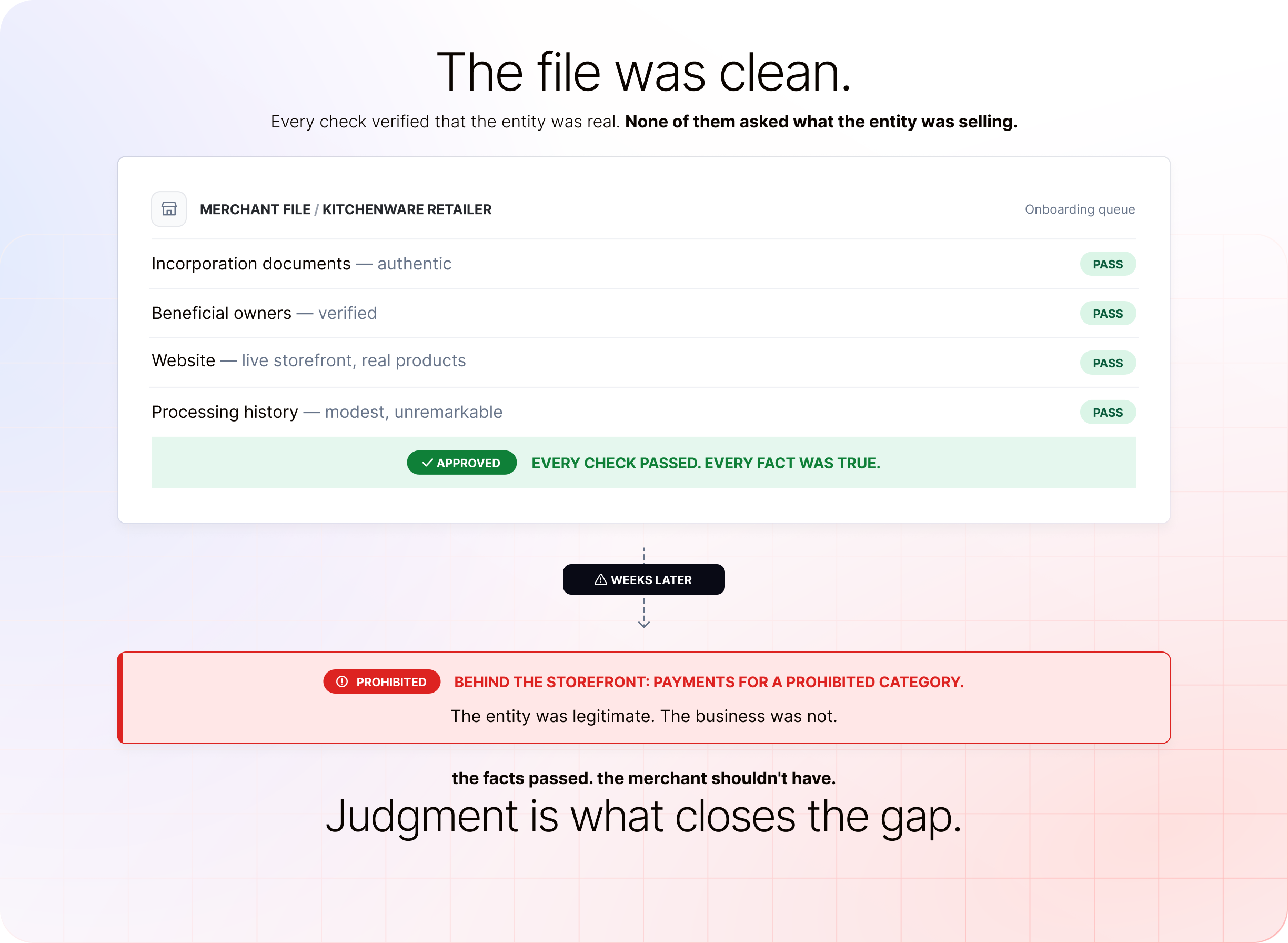
The file was clean. 

A real company with authentic incorporation documents, verified owners, a working website selling kitchen equipment, and a modest processing history. Every check passed, because every check was designed to verify that the entity was real. It was. 

Weeks later, the card scheme flagged the account. The storefront was real but the sales were not. Behind the cookware listings, the merchant was processing payments for something entirely different, in a category the acquirer had explicitly prohibited. The entity was legitimate. The business was not. 

We see a version of this case every month. No individual check failed. The system worked exactly as designed, and it was still wrong. Reading that file did not require more intelligence. It required the judgment to know what to doubt. 

This essay is about the difference. 
1. Intelligence is becoming free. Judgment is not. 

Every few months, the models get smarter. Every few months, someone declares that the application layer is dead. The argument is always the same: if the model can do everything, why would anyone build on top of it? 

This argument confuses two things that sound similar but are not. Intelligence and judgment. 

Intelligence is the ability to reason about a problem. Judgment is the ability to make a decision that an institution can stand behind. The first is becoming a commodity. You can rent it by the token from half a dozen providers, and the price drops every quarter. The second is harder to  commoditize, because judgment is not produced by a model alone. It is produced by a system. 

Consider what a real decision looks like inside a bank or a payments company. Should this

merchant be onboarded? Should this loan be approved? Should this sanctions alert be escalated? Answering these questions requires intelligence, yes. But it also requires the institution’s risk appetite, its regulatory obligations, its card scheme rules, its past decisions on similar cases, the accumulated knowledge of its experienced teams, its documentation standards, and a clear answer to the question of who is accountable if the decision is wrong. 

A model gives you a smart answer. An institution needs a defensible decision. The distance between those two things is where the next decade of enterprise AI will be built. I call it the judgment layer: the institutional infrastructure that turns model intelligence into decisions governed by policy, grounded in evidence, and subject to accountability. 
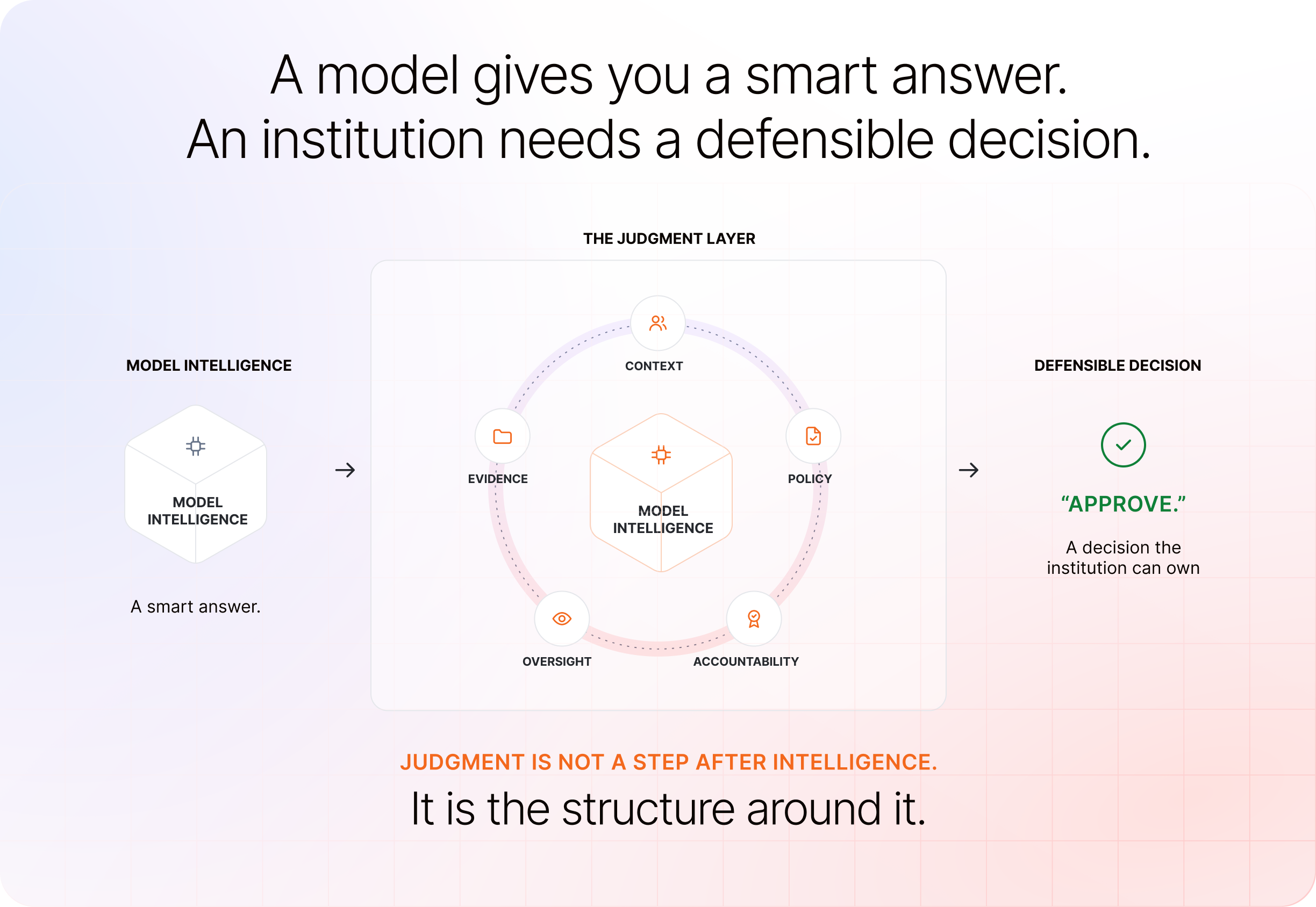
The thesis of this essay is simple. As intelligence gets cheaper, judgment gets more valuable, not less. In regulated industries, advantage will increasingly shift from access to intelligence to the ability to turn that intelligence into decisions institutions can actually deploy.

One note before we start. I will mostly use examples from merchant and payments risk, because that is the world I live in. But swap merchant for borrower, seller, policyholder, or claimant and the argument holds. The judgment layer is not a payments idea. It is a regulated industries idea. 

2. The deployability gap 

Here is something that surprises people outside the enterprise world. The capability of today’s models far exceeds what enterprises actually deploy. Not by a little. By years. 

The frontier models could, in principle, review a merchant portfolio, read every piece of evidence, and reach conclusions that rival a senior analyst. In practice, most financial institutions use AI for summarization and drafting. The gap between what the models can do and what institutions let them do is enormous. That is the deployability gap: the distance between what AI is capable of doing and what an institution can responsibly put into production.
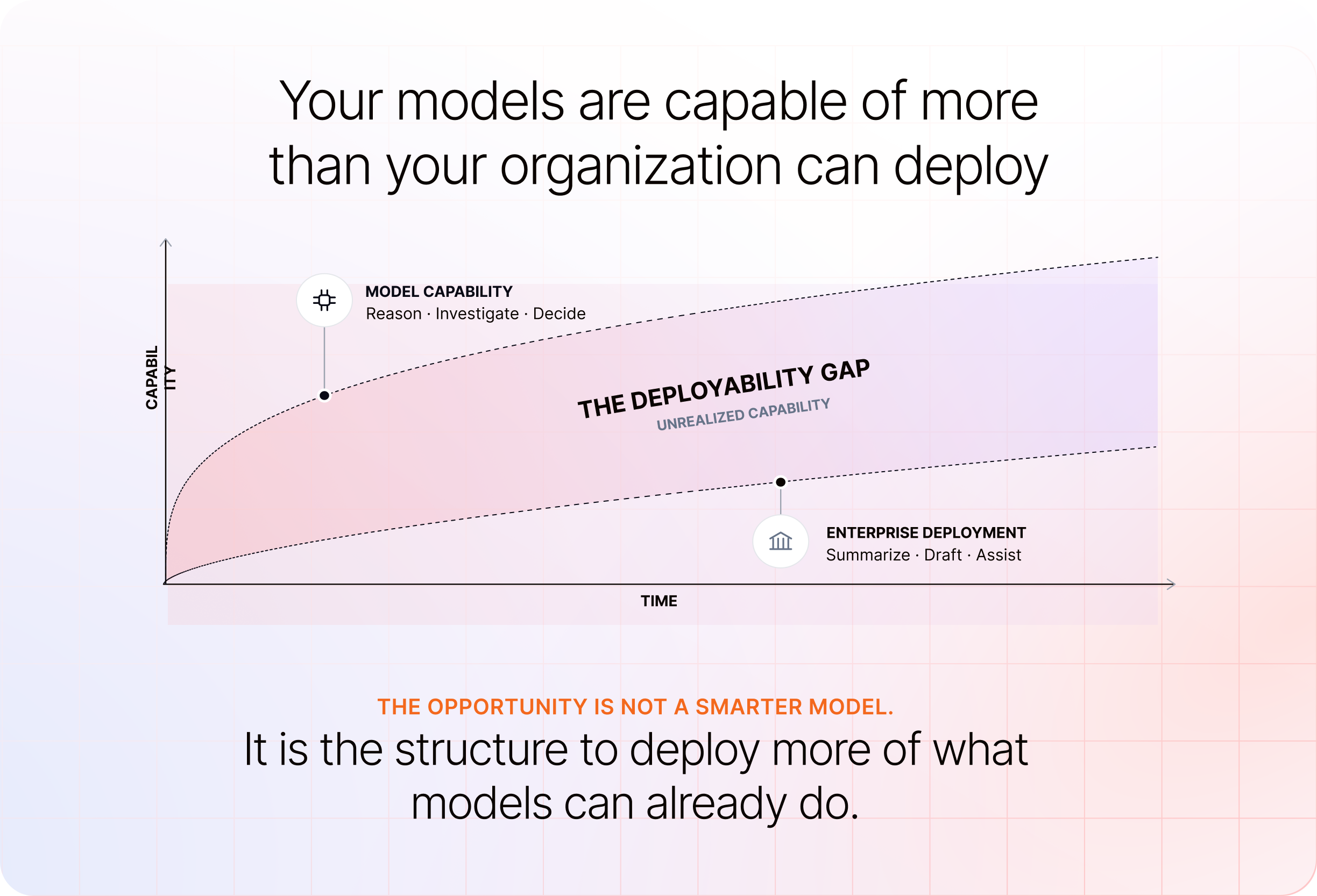
The lazy explanation is that enterprises are slow. The real explanation is more interesting. Enterprises are not resisting intelligence. They are missing the structure that turns intelligence into something deployable. That structure gives institutions the confidence and control to govern AI, navigate the uncertainty that comes with it, and put it to work in consequential decisions.

To deploy an autonomous decision inside a regulated institution, you need to be able to say what the system can and cannot do, and prove it. You need dozens of people across risk, compliance, legal, and operations to shape its behavior without writing code. You need to test it against your policies before it touches a customer. You need to reconstruct any decision it made, months later, for an auditor who was not in the room. And you need to catch it drifting before a regulator does. 

None of this comes from the model. All of it has to be built around the model. That construction is not a thin wrapper or a nice interface. It is the majority of the work, and it is the reason capability alone has not translated into deployment.

The deployability gap is one of the most underestimated forces in enterprise AI. The winners in regulated industries will not be the ones with access to the smartest model. Everyone has access to the smartest model. The winners will be the ones who close the deployability gap first. 

3. Decisions carry liability 

There is a deeper reason the deployability gap exists, and it is worth stating plainly. In regulated industries, decisions carry liability. 

When a merchant is wrongly declined, someone answers for it. When a sanctioned entity slips through screening, someone answers for it. When a monitoring program misses a pattern the regulator later finds, the fines do not go to the model provider. They go to the institution. 

Regulators may examine models, but they hold the institutions accountable. They ask how a decision was made, under which policy, on what evidence, and who approved the process. That is the standard of defensibility. A model, however brilliant, cannot hold liability. It cannot be deposed. It cannot sign an attestation. 

This is why “the model can already do that” is true and irrelevant at the same time. Of course the model can produce the analysis. The question is whether the institution can own the decision. Ownership requires policy, evidence, oversight, and accountability to be wired into the system itself, not bolted on afterward. 

Think of it as decision liability. It changes how you should evaluate any AI system in a regulated context. The right question is not “how accurate is it?” The right question is “when this decision is challenged, can we defend it?” A system that is 95 percent accurate but indefensible is worth less than a system that is 90 percent accurate and fully defensible. Most of the market has not internalized this yet. The institutions that have are moving fastest, because they know exactly what they are buying. 

4. Build versus buy is the wrong question 

Every large enterprise is having the same internal debate right now. The models are capable. We have engineers. Why not build it ourselves? 

This conversation is happening inside almost every enterprise we meet, and the objection deserves to be taken seriously. It’s a fair question. Building on frontier models has never been easier. The demo comes together in a week. The board is impressed. 

Then the second week arrives. 

The team discovers that the demo handled the common case, and the business is made of

uncommon cases. A merchant with a legitimate entity selling a prohibited product. A transaction pattern that is normal in one industry and a red flag in another. A regulation that changed last quarter. Every edge case is an engineering ticket. Every policy change is a code change. The team that built the demo is now maintaining a system, and the system is the easy part. The judgment inside it is the hard part. 

Here is the reframe I offer in those conversations. The build versus buy question assumes you are deciding whether to build software. You are not. You are deciding whether to build judgment. 

Software can be built in a quarter. Judgment is accumulated. It is the residue of thousands of edge cases seen across hundreds of portfolios, encoded into policies, evals, and defaults. A vendor that lives inside one domain amortizes that accumulation across every customer. When one client hits a novel typology, every client is protected the next week. By contrast, an internal team accumulates judgment from a single institutional vantage point.

This is also why the common instinct to fine tune your own model misses the point. The domain knowledge every institution needs should not have to be rebuilt by every institution. Teaching a model to read incorporation documents, spot transaction laundering, or interpret scheme compliance programs is worth doing once, deeply, by someone for whom it is the entire business. The institution can then apply what is uniquely its own: its policies, risk appetite, accumulated experience, and judgment. It is almost never worth rebuilding the domain layer inside a bank whose research budget has better uses. 

Ask yourself honestly: is accumulating judgment in this domain our comparative advantage? Do we have differentiated data and expertise, the engineering depth to operationalize it, and the appetite to keep investing as models, regulations, typologies, and policies change? For a handful of institutions, the answer is yes, and they should build. For everyone else, the honest answer changes the decision. 

5. The retrofit trap 

There is a third option in the build versus buy debate, and it is the one most institutions quietly default to. Keep the systems you have and wait for your existing vendors to add AI. 

It feels safe. The legacy stack is already approved, already integrated, already through procurement. The incumbent shows a roadmap with a copilot on every screen. Why take a risk on new architecture when the old architecture is learning new tricks? 

Here is why. The legacy risk stack was built for a world where judgment was scarce, and that assumption is poured into its foundations. 

The rules engine encodes judgment as thousands of brittle if-then statements, written years ago, maintained by consultants, blind to anything that is not a structured field. The case management system assumes a human will do all the reasoning; its job is to route work and record outcomes. The screening tool floods analysts with alerts, most of them false, because generating alerts was cheap and resolving them was expensive, so the economics

pushed the cost onto the humans downstream. 

Add a language model to this stack and you get real improvements. Cases get summarized. Emails get drafted. Analysts read faster. But the decision still travels through the same pipeline, waits in the same queue, and depends on the same overloaded human at the same bottleneck. You have sprinkled intelligence on top of a workflow. You have not built a judgment layer. 
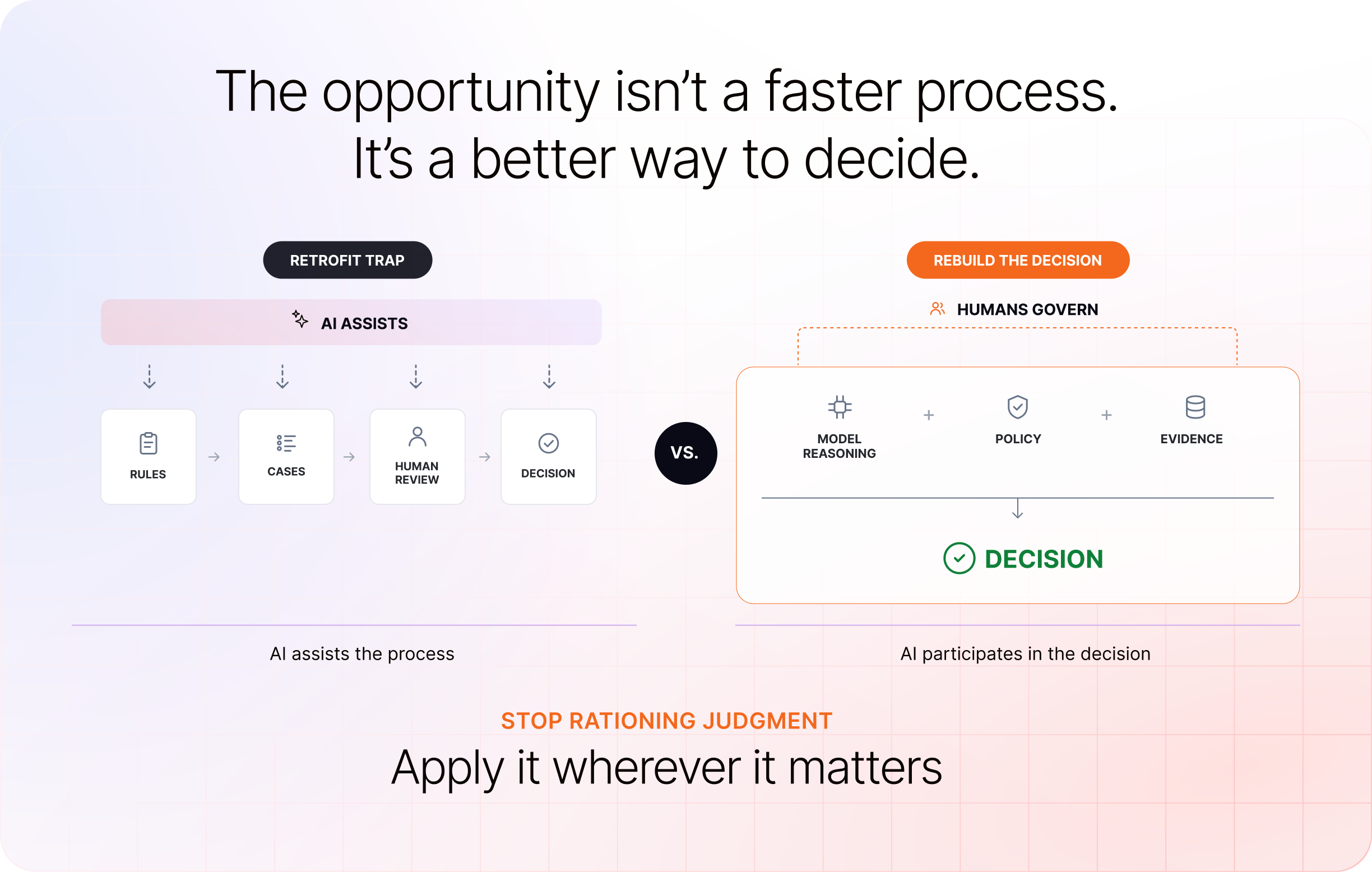
The difference is architectural. A judgment layer puts executable policy at the center, builds evidence into every record by construction, and brings model reasoning to the decision itself, with humans governing rather than processing. A retrofit puts intelligence at the edges of an architecture that still assumes humans are the engine. A rules engine with a copilot is still a rules engine. 

We have seen this movie before. When the cloud arrived, every on-premise vendor added the word to their brochure. Some genuinely rebuilt. Most repainted. The institutions that could tell the difference saved themselves a decade. 

I do not expect legacy vendors to disappear. They have distribution, data, and earned trust, and some will make the transition honestly. But the question to ask any vendor, incumbent or new, is not whether they use AI. Everyone uses AI. The question is whether the decision itself has been rebuilt around policy, evidence, and oversight, or whether an old architecture has learned to talk. 

6. Policy is the interface 

Something quietly important happened as models improved. The breakthrough was not just that models got smarter. It was that they got better at following instructions. 

Three years ago, you had to constrain a model tightly, because given any room, it would wander. Today you can hand a model a broad policy written in plain language and trust it to interpret the policy the way a competent employee would, filling gaps with reasonable sense. 

This changes what a policy is. For decades, a compliance policy was a document. Humans read it, interpreted it inconsistently, and applied it at whatever pace humans work. The policy and the operation were two different things, loosely connected by training sessions and spot checks. 

Now a policy can be executable. The document your compliance team writes can be the thing the system actually runs. Not a translation of it into code, maintained by engineers who do not own the risk. The policy itself, versioned, tested, and enforced in every case. 

The implications are larger than they first appear. The people who own the risk can finally

shape the system directly. A compliance officer becomes, in effect, a programmer, without writing a line of code. When regulation changes, the response time drops from a quarterly engineering cycle to an afternoon. And the perennial audit question, “does your operation actually follow your policy?”, gets an answer it has never had before: yes, provably, because the policy is the operation. 

The interface to enterprise AI in regulated industries will not be a prompt box and it will not be a dashboard. It will be policy. At Ballerine, we are already building this way: working with our customers to translate  the policies they operate under into executable instructions that govern how the system investigates, decides, and escalates, and I doubt we will be the only ones. 

7. Evidence, not answers 

There is a design principle hiding in everything above, and it separates systems that get deployed from systems that stall in procurement. 

Regulated institutions do not buy answers. They buy defensible decisions. An answer says the applicant is a high risk one. A defensible decision says the applicant is high risk because of these three findings, drawn from these sources, evaluated against this section of policy, on this date, with this reviewer accountable, and here is the full trail. 

Most AI systems are answer-native. They optimize for the response and treat justification as an afterthought, something you reconstruct if anyone asks. In a regulated environment this is backwards, because someone will always ask. The auditor asks. The regulator asks. The customer’s lawyer asks. 

The systems that win will be evidence-native. Every conclusion carries its provenance by construction. The reasoning is inspectable while it happens, not reverse engineered afterward. A human can intervene at any step and the intervention itself becomes part of the record. This is not theoretical for us. At Ballerine, evidence and provenance are part of the decision record by construction, not added afterward.

There is a second-order effect here that buyers learn quickly. Opaque systems create dependency. If you cannot see how decisions are made, you cannot improve them yourself, and every change routes through the vendor. Teams that have lived through this once do not repeat it. They choose systems they can understand, steer, and improve themselves. Transparency is not a compliance checkbox. It is what allows the customer to move fast without you. 

8. The trust dividend 

Now the uncomfortable question. If AI can do the work of a risk analyst at a fraction of the cost, does the risk team disappear? 

The honest answer, from watching many real deployments, is that something more interesting

happens. Risk and compliance work has always been rationed. No institution reviews its full portfolio continuously. They sample. They monitor annually what they would prefer to monitor daily. They apply their deepest scrutiny to the largest accounts and hope the long tail behaves. Not because they believe sampling is sufficient, but because judgment has been scarce and expensive, and rationing was the only option. 

When the cost of a review drops by an order of magnitude, institutions do not primarily cut the team. They stop rationing. Annual reviews become continuous monitoring. Sampled oversight becomes full portfolio coverage. Onboarding that took days happens in minutes without loosening a single standard, which means the business says yes faster to good customers, not just no faster to bad ones. The unmet demand for trust turns out to be enormous. It was always there, hidden behind the cost of meeting it. 

This is the trust dividend. Lowering the cost of applying judgment does not shrink trust operations. It expands what trust operations can attempt at scale. 

The people change too, and mostly for the better. The work that disappears is the work nobody would miss: copying data between systems, re-reading the same documents, writing up the same memo for the hundredth time. The work that remains is the work that was always the point: setting the policy, handling the genuinely hard cases, deciding what the institution’s appetite should be. Fewer people processing, more people governing. 

I will not pretend every transition is painless. Some roles will genuinely go away. But the pattern across deployments is consistent enough to say with confidence: AI is taking over individual tasks far faster than it is replacing the people who govern them, and in trust operations, the backlog of undone work is decades deep. 

9. What we do not know 

An argument this confident should also admit what it cannot see. 

I do not know where the line between the model layer and the judgment layer will settle. Model providers are moving up the stack, and they will keep moving. Some of what application companies build today will be absorbed into the models tomorrow. Anyone who claims to know exactly which parts is guessing. 

I do not know whether, in ten years, agents will be capable of assembling their own deployment infrastructure on the fly, which would commoditize part of what I have described. I suspect the constraints that matter most here are institutional rather than technical, and institutions change slower than models. But that is a belief, not a certainty. 

And I do not know how much more directly regulators will scrutinize e AI systems themselves or how that will change the shape of the judgment layer. My bet is that this makes evidence-native architecture more valuable, not less, because it would turn defensibility from best practice into a requirement. But bets are bets. 

What I am confident about is the direction. Intelligence keeps getting cheaper. The institutions that depend on trust keep needing more of it, not less. And the space between raw intelligence and institutional trust does not close on its own. Someone has to build it. 

10. The judgment layer 

Let me compress the argument. 

Models create intelligence. Applications create judgment. Intelligence is reasoning; judgment is reasoning plus context, policy, evidence, and accountability, assembled into decisions an institution can own. 

The deployability gap, not model capability, is the binding constraint on enterprise AI. Decision liability explains why the gap exists and why it will not vanish with the next model release. Build versus buy is really a question about who should accumulate judgment, and for most institutions the answer is not themselves. Retrofitting intelligence onto legacy architecture produces faster paperwork, not different decisions. Policy is becoming executable, which puts the people who own the risk in direct control of the systems that run it. Evidence-native design is what separates deployed systems from stalled pilots. And the trust dividend means all of this expands what institutions do rather than merely shrinking what they spend. 

None of this diminishes the model labs. Their progress is the reason any of this is possible, and every improvement they ship makes the judgment layer more capable. But commoditized intelligence flows to whoever structures it best, the way electricity flowed to whoever built the machines. The value of electricity  was obvious. The bigger opportunity was in what people built with it.. 

In regulated industries, what intelligence must be made to do is earn trust. Trust between a bank and a merchant. Between a marketplace and a seller. Between an institution and its regulator. That is not a model output. It is a system, built deliberately, one defensible decision at a time. 

That system is the judgment layer. It is being built right now, mostly quietly, inside the industries where decisions matter most. The companies building it will not always be the loudest names in AI. But a decade from now, when autonomous decisions move money, approve businesses, or protect customers, it will be the judgment layer that makes them possible.

The merchant with the clean file is out there right now, sitting in someone’s onboarding queue, passing every check. Intelligence will read that file in seconds. Judgment is what doubts it.

Reeza Hendricks

Notes from four years of building AI for banks, payment companies, and marketplaces, on why intelligence is becoming free and judgment is not. 

The file was clean. 

A real company with authentic incorporation documents, verified owners, a working website selling kitchen equipment, and a modest processing history. Every check passed, because every check was designed to verify that the entity was real. It was. 

Weeks later, the card scheme flagged the account. The storefront was real but the sales were not. Behind the cookware listings, the merchant was processing payments for something entirely different, in a category the acquirer had explicitly prohibited. The entity was legitimate. The business was not. 

We see a version of this case every month. No individual check failed. The system worked exactly as designed, and it was still wrong. Reading that file did not require more intelligence. It required the judgment to know what to doubt. 

This essay is about the difference. 

1. Intelligence is becoming free. Judgment is not. 

Every few months, the models get smarter. Every few months, someone declares that the application layer is dead. The argument is always the same: if the model can do everything, why would anyone build on top of it? 

This argument confuses two things that sound similar but are not. Intelligence and judgment. 

Intelligence is the ability to reason about a problem. Judgment is the ability to make a decision that an institution can stand behind. The first is becoming a commodity. You can rent it by the token from half a dozen providers, and the price drops every quarter. The second is harder to  commoditize, because judgment is not produced by a model alone. It is produced by a system. 

Consider what a real decision looks like inside a bank or a payments company. Should this

merchant be onboarded? Should this loan be approved? Should this sanctions alert be escalated? Answering these questions requires intelligence, yes. But it also requires the institution’s risk appetite, its regulatory obligations, its card scheme rules, its past decisions on similar cases, the accumulated knowledge of its experienced teams, its documentation standards, and a clear answer to the question of who is accountable if the decision is wrong. 

A model gives you a smart answer. An institution needs a defensible decision. The distance between those two things is where the next decade of enterprise AI will be built. I call it the judgment layer: the institutional infrastructure that turns model intelligence into decisions governed by policy, grounded in evidence, and subject to accountability. 

The thesis of this essay is simple. As intelligence gets cheaper, judgment gets more valuable, not less. In regulated industries, advantage will increasingly shift from access to intelligence to the ability to turn that intelligence into decisions institutions can actually deploy.

One note before we start. I will mostly use examples from merchant and payments risk, because that is the world I live in. But swap merchant for borrower, seller, policyholder, or claimant and the argument holds. The judgment layer is not a payments idea. It is a regulated industries idea. 

2. The deployability gap 

Here is something that surprises people outside the enterprise world. The capability of today’s models far exceeds what enterprises actually deploy. Not by a little. By years. 

The frontier models could, in principle, review a merchant portfolio, read every piece of evidence, and reach conclusions that rival a senior analyst. In practice, most financial institutions use AI for summarization and drafting. The gap between what the models can do and what institutions let them do is enormous. That is the deployability gap: the distance between what AI is capable of doing and what an institution can responsibly put into production.

The lazy explanation is that enterprises are slow. The real explanation is more interesting. Enterprises are not resisting intelligence. They are missing the structure that turns intelligence into something deployable. That structure gives institutions the confidence and control to govern AI, navigate the uncertainty that comes with it, and put it to work in consequential decisions.

To deploy an autonomous decision inside a regulated institution, you need to be able to say what the system can and cannot do, and prove it. You need dozens of people across risk, compliance, legal, and operations to shape its behavior without writing code. You need to test it against your policies before it touches a customer. You need to reconstruct any decision it made, months later, for an auditor who was not in the room. And you need to catch it drifting before a regulator does. 

None of this comes from the model. All of it has to be built around the model. That construction is not a thin wrapper or a nice interface. It is the majority of the work, and it is the reason capability alone has not translated into deployment.

The deployability gap is one of the most underestimated forces in enterprise AI. The winners in regulated industries will not be the ones with access to the smartest model. Everyone has access to the smartest model. The winners will be the ones who close the deployability gap first. 

3. Decisions carry liability 

There is a deeper reason the deployability gap exists, and it is worth stating plainly. In regulated industries, decisions carry liability. 

When a merchant is wrongly declined, someone answers for it. When a sanctioned entity slips through screening, someone answers for it. When a monitoring program misses a pattern the regulator later finds, the fines do not go to the model provider. They go to the institution. 

Regulators may examine models, but they hold the institutions accountable. They ask how a decision was made, under which policy, on what evidence, and who approved the process. That is the standard of defensibility. A model, however brilliant, cannot hold liability. It cannot be deposed. It cannot sign an attestation. 

This is why “the model can already do that” is true and irrelevant at the same time. Of course the model can produce the analysis. The question is whether the institution can own the decision. Ownership requires policy, evidence, oversight, and accountability to be wired into the system itself, not bolted on afterward. 

Think of it as decision liability. It changes how you should evaluate any AI system in a regulated context. The right question is not “how accurate is it?” The right question is “when this decision is challenged, can we defend it?” A system that is 95 percent accurate but indefensible is worth less than a system that is 90 percent accurate and fully defensible. Most of the market has not internalized this yet. The institutions that have are moving fastest, because they know exactly what they are buying. 

4. Build versus buy is the wrong question 

Every large enterprise is having the same internal debate right now. The models are capable. We have engineers. Why not build it ourselves? 

This conversation is happening inside almost every enterprise we meet, and the objection deserves to be taken seriously. It’s a fair question. Building on frontier models has never been easier. The demo comes together in a week. The board is impressed. 

Then the second week arrives. 

The team discovers that the demo handled the common case, and the business is made of

uncommon cases. A merchant with a legitimate entity selling a prohibited product. A transaction pattern that is normal in one industry and a red flag in another. A regulation that changed last quarter. Every edge case is an engineering ticket. Every policy change is a code change. The team that built the demo is now maintaining a system, and the system is the easy part. The judgment inside it is the hard part. 

Here is the reframe I offer in those conversations. The build versus buy question assumes you are deciding whether to build software. You are not. You are deciding whether to build judgment. 

Software can be built in a quarter. Judgment is accumulated. It is the residue of thousands of edge cases seen across hundreds of portfolios, encoded into policies, evals, and defaults. A vendor that lives inside one domain amortizes that accumulation across every customer. When one client hits a novel typology, every client is protected the next week. By contrast, an internal team accumulates judgment from a single institutional vantage point.

This is also why the common instinct to fine tune your own model misses the point. The domain knowledge every institution needs should not have to be rebuilt by every institution. Teaching a model to read incorporation documents, spot transaction laundering, or interpret scheme compliance programs is worth doing once, deeply, by someone for whom it is the entire business. The institution can then apply what is uniquely its own: its policies, risk appetite, accumulated experience, and judgment. It is almost never worth rebuilding the domain layer inside a bank whose research budget has better uses. 

Ask yourself honestly: is accumulating judgment in this domain our comparative advantage? Do we have differentiated data and expertise, the engineering depth to operationalize it, and the appetite to keep investing as models, regulations, typologies, and policies change? For a handful of institutions, the answer is yes, and they should build. For everyone else, the honest answer changes the decision. 

5. The retrofit trap 

There is a third option in the build versus buy debate, and it is the one most institutions quietly default to. Keep the systems you have and wait for your existing vendors to add AI. 

It feels safe. The legacy stack is already approved, already integrated, already through procurement. The incumbent shows a roadmap with a copilot on every screen. Why take a risk on new architecture when the old architecture is learning new tricks? 

Here is why. The legacy risk stack was built for a world where judgment was scarce, and that assumption is poured into its foundations. 

The rules engine encodes judgment as thousands of brittle if-then statements, written years ago, maintained by consultants, blind to anything that is not a structured field. The case management system assumes a human will do all the reasoning; its job is to route work and record outcomes. The screening tool floods analysts with alerts, most of them false, because generating alerts was cheap and resolving them was expensive, so the economics

pushed the cost onto the humans downstream. 

Add a language model to this stack and you get real improvements. Cases get summarized. Emails get drafted. Analysts read faster. But the decision still travels through the same pipeline, waits in the same queue, and depends on the same overloaded human at the same bottleneck. You have sprinkled intelligence on top of a workflow. You have not built a judgment layer. 

The difference is architectural. A judgment layer puts executable policy at the center, builds evidence into every record by construction, and brings model reasoning to the decision itself, with humans governing rather than processing. A retrofit puts intelligence at the edges of an architecture that still assumes humans are the engine. A rules engine with a copilot is still a rules engine. 

We have seen this movie before. When the cloud arrived, every on-premise vendor added the word to their brochure. Some genuinely rebuilt. Most repainted. The institutions that could tell the difference saved themselves a decade. 

I do not expect legacy vendors to disappear. They have distribution, data, and earned trust, and some will make the transition honestly. But the question to ask any vendor, incumbent or new, is not whether they use AI. Everyone uses AI. The question is whether the decision itself has been rebuilt around policy, evidence, and oversight, or whether an old architecture has learned to talk. 

6. Policy is the interface 

Something quietly important happened as models improved. The breakthrough was not just that models got smarter. It was that they got better at following instructions. 

Three years ago, you had to constrain a model tightly, because given any room, it would wander. Today you can hand a model a broad policy written in plain language and trust it to interpret the policy the way a competent employee would, filling gaps with reasonable sense. 

This changes what a policy is. For decades, a compliance policy was a document. Humans read it, interpreted it inconsistently, and applied it at whatever pace humans work. The policy and the operation were two different things, loosely connected by training sessions and spot checks. 

Now a policy can be executable. The document your compliance team writes can be the thing the system actually runs. Not a translation of it into code, maintained by engineers who do not own the risk. The policy itself, versioned, tested, and enforced in every case. 

The implications are larger than they first appear. The people who own the risk can finally

shape the system directly. A compliance officer becomes, in effect, a programmer, without writing a line of code. When regulation changes, the response time drops from a quarterly engineering cycle to an afternoon. And the perennial audit question, “does your operation actually follow your policy?”, gets an answer it has never had before: yes, provably, because the policy is the operation. 

The interface to enterprise AI in regulated industries will not be a prompt box and it will not be a dashboard. It will be policy. At Ballerine, we are already building this way: working with our customers to translate  the policies they operate under into executable instructions that govern how the system investigates, decides, and escalates, and I doubt we will be the only ones. 

7. Evidence, not answers 

There is a design principle hiding in everything above, and it separates systems that get deployed from systems that stall in procurement. 

Regulated institutions do not buy answers. They buy defensible decisions. An answer says the applicant is a high risk one. A defensible decision says the applicant is high risk because of these three findings, drawn from these sources, evaluated against this section of policy, on this date, with this reviewer accountable, and here is the full trail. 

Most AI systems are answer-native. They optimize for the response and treat justification as an afterthought, something you reconstruct if anyone asks. In a regulated environment this is backwards, because someone will always ask. The auditor asks. The regulator asks. The customer’s lawyer asks. 

The systems that win will be evidence-native. Every conclusion carries its provenance by construction. The reasoning is inspectable while it happens, not reverse engineered afterward. A human can intervene at any step and the intervention itself becomes part of the record. This is not theoretical for us. At Ballerine, evidence and provenance are part of the decision record by construction, not added afterward.

There is a second-order effect here that buyers learn quickly. Opaque systems create dependency. If you cannot see how decisions are made, you cannot improve them yourself, and every change routes through the vendor. Teams that have lived through this once do not repeat it. They choose systems they can understand, steer, and improve themselves. Transparency is not a compliance checkbox. It is what allows the customer to move fast without you. 

8. The trust dividend 

Now the uncomfortable question. If AI can do the work of a risk analyst at a fraction of the cost, does the risk team disappear? 

The honest answer, from watching many real deployments, is that something more interesting

happens. Risk and compliance work has always been rationed. No institution reviews its full portfolio continuously. They sample. They monitor annually what they would prefer to monitor daily. They apply their deepest scrutiny to the largest accounts and hope the long tail behaves. Not because they believe sampling is sufficient, but because judgment has been scarce and expensive, and rationing was the only option. 

When the cost of a review drops by an order of magnitude, institutions do not primarily cut the team. They stop rationing. Annual reviews become continuous monitoring. Sampled oversight becomes full portfolio coverage. Onboarding that took days happens in minutes without loosening a single standard, which means the business says yes faster to good customers, not just no faster to bad ones. The unmet demand for trust turns out to be enormous. It was always there, hidden behind the cost of meeting it. 

This is the trust dividend. Lowering the cost of applying judgment does not shrink trust operations. It expands what trust operations can attempt at scale. 

The people change too, and mostly for the better. The work that disappears is the work nobody would miss: copying data between systems, re-reading the same documents, writing up the same memo for the hundredth time. The work that remains is the work that was always the point: setting the policy, handling the genuinely hard cases, deciding what the institution’s appetite should be. Fewer people processing, more people governing. 

I will not pretend every transition is painless. Some roles will genuinely go away. But the pattern across deployments is consistent enough to say with confidence: AI is taking over individual tasks far faster than it is replacing the people who govern them, and in trust operations, the backlog of undone work is decades deep. 

9. What we do not know 

An argument this confident should also admit what it cannot see. 

I do not know where the line between the model layer and the judgment layer will settle. Model providers are moving up the stack, and they will keep moving. Some of what application companies build today will be absorbed into the models tomorrow. Anyone who claims to know exactly which parts is guessing. 

I do not know whether, in ten years, agents will be capable of assembling their own deployment infrastructure on the fly, which would commoditize part of what I have described. I suspect the constraints that matter most here are institutional rather than technical, and institutions change slower than models. But that is a belief, not a certainty. 

And I do not know how much more directly regulators will scrutinize e AI systems themselves or how that will change the shape of the judgment layer. My bet is that this makes evidence-native architecture more valuable, not less, because it would turn defensibility from best practice into a requirement. But bets are bets. 

What I am confident about is the direction. Intelligence keeps getting cheaper. The institutions that depend on trust keep needing more of it, not less. And the space between raw intelligence and institutional trust does not close on its own. Someone has to build it. 

10. The judgment layer 

Let me compress the argument. 

Models create intelligence. Applications create judgment. Intelligence is reasoning; judgment is reasoning plus context, policy, evidence, and accountability, assembled into decisions an institution can own. 

The deployability gap, not model capability, is the binding constraint on enterprise AI. Decision liability explains why the gap exists and why it will not vanish with the next model release. Build versus buy is really a question about who should accumulate judgment, and for most institutions the answer is not themselves. Retrofitting intelligence onto legacy architecture produces faster paperwork, not different decisions. Policy is becoming executable, which puts the people who own the risk in direct control of the systems that run it. Evidence-native design is what separates deployed systems from stalled pilots. And the trust dividend means all of this expands what institutions do rather than merely shrinking what they spend. 

None of this diminishes the model labs. Their progress is the reason any of this is possible, and every improvement they ship makes the judgment layer more capable. But commoditized intelligence flows to whoever structures it best, the way electricity flowed to whoever built the machines. The value of electricity  was obvious. The bigger opportunity was in what people built with it.. 

In regulated industries, what intelligence must be made to do is earn trust. Trust between a bank and a merchant. Between a marketplace and a seller. Between an institution and its regulator. That is not a model output. It is a system, built deliberately, one defensible decision at a time. 

That system is the judgment layer. It is being built right now, mostly quietly, inside the industries where decisions matter most. The companies building it will not always be the loudest names in AI. But a decade from now, when autonomous decisions move money, approve businesses, or protect customers, it will be the judgment layer that makes them possible.

The merchant with the clean file is out there right now, sitting in someone’s onboarding queue, passing every check. Intelligence will read that file in seconds. Judgment is what doubts it.