

Trusted by








.webp)

.webp)

.webp)
The Acquirer Chargeback Monitoring Program (ACMP) is Mastercard's framework for tracking and enforcing chargeback thresholds at the merchant level, with acquirers bearing responsibility for their merchants' compliance. ACMP encompasses two programs: the Excessive Chargeback Program (ECP), which includes the Excessive Chargeback Merchant (ECM) and High Excessive Chargeback Merchant (HECM) tiers, and the Excessive Fraud Merchant (EFM) program. Mastercard monitors each merchant account ID monthly, measuring first-presentment chargebacks against the prior month's transaction volume. ACMP is scheduled to be replaced by the Global Merchant Audit Program (GMAP) on April 1, 2027, which introduces acquirer-level thresholds and combined fraud-plus-dispute measurement.
Despite its merchant-level thresholds, ACMP places the compliance obligation on acquirers. Acquirers must identify merchants approaching or exceeding chargeback limits, coordinate remediation plans, and report progress to Mastercard. Failure to manage non-compliant merchants exposes acquirers to escalating financial penalties and potential restrictions on their processing license.
ACMP penalties follow a fixed monthly schedule that increases the longer a merchant remains non-compliant. ECM fines start at $1,000 per month and rise to $100,000. HECM fines reach $200,000 per month at 19 months. From month four onward, Mastercard applies an Issuer Recovery Assessment of $5 per chargeback above 300, adding variable cost on top of the fixed assessments.
Merchants that remain in violation without resolution risk placement on the Member Alert to Control High-Risk Merchants (MATCH) list. MATCH listing effectively prevents a merchant from obtaining processing services with any acquirer in the Mastercard network, making it a terminal outcome for the business relationship.
ACMP measures chargebacks at the individual merchant account ID. Calculate the ratio monthly: first-presentment chargebacks in the current month divided by total Mastercard transactions in the prior month, multiplied by 10,000 to express in basis points. Track both the count and the ratio, since both must be exceeded to trigger enrollment.
Merchants enter ECM at 150 basis points with 100 chargebacks. Set internal alerts at 100 basis points and 75 chargebacks to create a remediation window before Mastercard flags the account. This buffer gives acquirers time to intervene before penalties begin.
Chargeback volume increases stem from specific operational failures: unclear billing descriptors, delayed fulfillment, insufficient customer service, or fraud exposure. Identify the source before applying generic remediation. A merchant with descriptor confusion needs a different intervention than one with a fraud vulnerability.
Merchants exit ACMP only after three consecutive months below the threshold. Design remediation plans that sustain chargeback reductions over a full quarter, not one-time corrections that revert the following month.
Acquirers must demonstrate active management of non-compliant merchants. Maintain records of merchant notifications, remediation plan agreements, progress reviews, and outcomes. Incomplete documentation weakens an acquirer's position during Mastercard reviews.
A payment facilitator with 200 sub-merchants identifies three merchants that crossed 150 basis points in consecutive months, triggering ECM status. Investigation reveals two merchants have billing descriptor issues causing customers to initiate chargebacks because they don't recognize the charge. The third merchant has a fulfillment backlog resulting in delivery complaints.
The acquirer implements descriptor corrections for the first two merchants and works with the third on fulfillment timeline guarantees. Two merchants drop below threshold within two months. The third requires four months, accumulating $11,000 in assessments before achieving three consecutive compliant months and exiting the program.
A single non-compliant merchant in HECM status costs the acquirer up to $200,000 per month at the 19-month mark, plus variable Issuer Recovery Assessment charges. For acquirers with large portfolios, even a small percentage of non-compliant merchants creates material financial risk that compounds over time.
ACMP's replacement by GMAP in April 2027 changes the measurement methodology from chargebacks-only to combined fraud-plus-disputes. Acquirers currently managing ACMP compliance need to re-baseline their portfolios against the new combined metric. Merchants that are compliant under ACMP may breach GMAP thresholds when fraud reports from Mastercard's Fraud and Loss Database are included.
Manual chargeback tracking across hundreds or thousands of merchants is operationally unsustainable. Acquirers that rely on spreadsheet-based monitoring or monthly batch reviews risk missing threshold breaches until penalties have already begun. Automated, continuous monitoring at the merchant ID level is a structural requirement for ACMP compliance.
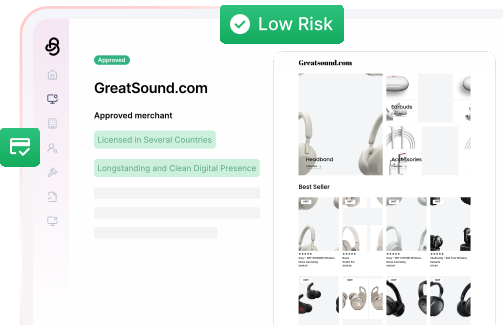
Ballerine's merchant monitoring platform tracks chargeback ratios at the merchant ID level continuously, flagging accounts approaching ACMP thresholds before they trigger program enrollment. The system supports automated remediation workflows, maintains audit-ready documentation of all compliance actions, and provides portfolio-level visibility across the full merchant base. As one of five solutions globally certified under Mastercard's MMSP, Ballerine helps acquirers reduce scheme fines by up to 75% while managing the transition from ACMP to GMAP.



Reduced manual efforts
Improved review resolution time
Increase in detected fraud
.webp)

.webp)
.png)
.svg)


.webp)