

Trusted by








.webp)

.webp)

.webp)
The High Dispute Acquirer (HDA) is a new acquirer-level monitoring category introduced under Mastercard's Global Merchant Audit Program (GMAP), effective April 1, 2027. HDA applies directly to acquirers rather than individual merchants, marking a structural shift in how Mastercard enforces dispute compliance.
An acquirer enters HDA status when three conditions are met: 1,500 or more cleared transactions, 1,500 or more combined fraud and dispute transactions, and a combined fraud-plus-dispute ratio of 0.5% (50 basis points) or higher. HDA sits below the Excessive Dispute Acquirer (EDA) threshold of 0.7% and is the first Mastercard program to impose financial penalties and compliance obligations at the portfolio level rather than the merchant level.
Under the current Acquirer Chargeback Monitoring Program (ACMP), Mastercard monitors chargebacks at the merchant level and holds acquirers responsible for managing non-compliant merchants. HDA changes this dynamic. Acquirers are now measured on the aggregate dispute performance of their entire portfolio. An acquirer can have zero merchants in ECM or HECM and still breach HDA if the portfolio-wide combined fraud-plus-dispute ratio exceeds 0.5%.
HDA measures combined fraud reports (from Mastercard's Fraud and Loss Database) and non-fraud chargebacks against total cleared transactions. This is broader than previous programs that measured chargebacks alone. Fraud reports that never resulted in a chargeback now count toward the acquirer's threshold. An acquirer with low chargeback rates but elevated fraud reporting volume could breach HDA under this expanded measurement.
HDA assessments follow a deferred penalty structure: $0 in months one through eleven, $25,000 per month in months twelve through eighteen, and $10,000 per month from month 19 onward. However, the financial penalties are secondary to the structural risk. An acquirer in non-compliance for 12 or more months faces a mandatory franchisee review conducted at the acquirer's expense. At 19 months, Mastercard may restrict or terminate the acquirer's processing license. The financial assessments are a warning signal; the license risk is the material consequence.
Current monitoring systems likely track chargeback ratios only. To assess HDA exposure, acquirers need to incorporate fraud reports from Mastercard's Fraud and Loss Database into their ratio calculations. Run this combined metric across the full portfolio to establish your current position relative to the 0.5% threshold.
HDA is a portfolio-level metric, but the levers are merchant-level. Identify which merchants contribute disproportionately to the combined fraud-plus-dispute ratio. A small number of high-dispute merchants can push an otherwise healthy portfolio above the 0.5% threshold. Rank merchants by their individual contribution to the aggregate ratio.
Under ACMP, acquirers could manage compliance by tracking chargebacks alone. HDA requires monitoring fraud reports that may not generate chargebacks. Build data pipelines that incorporate Mastercard's Fraud and Loss Database outputs into existing merchant monitoring dashboards alongside chargeback data.
New merchant onboarding changes the portfolio denominator (total cleared transactions) and potentially the numerator (dispute volume). A high-risk merchant addition can shift the portfolio ratio. Similarly, offboarding a high-volume, low-dispute merchant reduces the denominator and may push the ratio higher. Model both effects before making portfolio composition changes.
Set internal alert thresholds at 0.35% to 0.40% to create a remediation buffer before reaching the 0.5% HDA trigger. The 12-month deferred penalty structure provides time to correct, but the compliance clock starts immediately upon breach. Earlier intervention preserves more runway.
A mid-market acquirer processes transactions for 500 merchants with a portfolio-wide chargeback ratio of 0.30%, well below previous ACMP concerns. When the acquirer models the GMAP combined metric by adding fraud reports from Mastercard's Fraud and Loss Database, the ratio rises to 0.47%, just below the HDA threshold.
Analysis reveals that 12 merchants in high-risk verticals account for 60% of the fraud report volume despite representing only 8% of transaction volume. Three of these merchants were never flagged under ACMP because their individual chargeback counts fell below ECM minimums.
The acquirer implements enhanced monitoring for the 12 merchants, including monthly fraud report reviews and remediation requirements. Two merchants are terminated after failing to reduce fraud indicators. The portfolio ratio drops to 0.32% under the combined metric, providing a buffer against HDA enrollment when GMAP takes effect.
HDA makes the overall mix of merchants a compliance factor. An acquirer specializing in high-risk verticals faces structural HDA exposure that cannot be managed by remediating individual merchants alone. Underwriting decisions, vertical concentration limits, and portfolio diversification become compliance levers in addition to risk management tools.
Acquirers that rely on ISOs or payment facilitators to manage sub-merchants face HDA exposure from portfolios they do not directly control. Dispute volume generated by ISO-managed merchants contributes to the acquirer's aggregate ratio. Contractual monitoring requirements and real-time visibility into partner portfolios become necessary to manage HDA risk.
Unlike merchant-level programs where penalties are the primary consequence, HDA's most significant risk is license restriction or termination at month 19. The financial assessments ($25,000 per month starting at month 12) are manageable for most acquirers. The franchise review and potential license action are not. Compliance strategy should prioritize staying below the threshold entirely rather than managing the cost of being in the program.
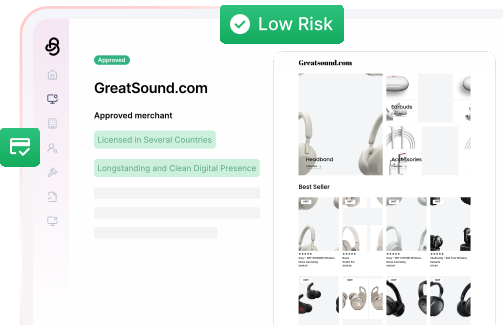
Ballerine's merchant monitoring platform provides portfolio-level visibility into combined fraud and dispute metrics, tracking both chargeback data and fraud report volumes at the sub-merchant level. The system identifies which merchants drive the highest share of portfolio-level dispute ratios, supports acquirer-level threshold alerting, and maintains audit-ready documentation for Mastercard's franchisee review process. As one of five solutions globally certified under Mastercard's MMSP, Ballerine helps acquirers reduce scheme fines by up to 75% while managing portfolio-level compliance under GMAP's new acquirer-focused categories.



Reduced manual efforts
Improved review resolution time
Increase in detected fraud
.webp)

.webp)
.png)
.svg)


.webp)