

Trusted by









.webp)

.webp)

.webp)
A Merchant Monitoring Service Provider (MMSP) is an organization that Mastercard has formally approved to perform merchant monitoring on behalf of acquiring banks, payment service providers (PSPs), and payment facilitators (PayFacs). MMSPs carry out the continuous scanning, content review, and risk detection that acquirers are required to maintain under Mastercard's Merchant Monitoring Program (MMP). The MMSP designation is granted directly by Mastercard, and only approved providers may fulfill this function on behalf of regulated entities in the Mastercard ecosystem.
Mastercard cannot directly monitor every merchant across every acquirer's portfolio. Instead, it delegates this responsibility to acquirers, who must either develop internal MMSP capabilities that satisfy Mastercard's approval criteria, or engage a certified third-party MMSP to perform monitoring on their behalf.
The driver behind this structure is BRAM - Mastercard's Business Risk Assessment and Mitigation program. BRAM places direct financial liability on acquirers when merchants in their portfolio engage in illegal, brand-damaging, or prohibited activity. Fines for individual BRAM violations have historically reached $150,000 or more. The MMSP framework is Mastercard's mechanism for ensuring that acquirers have a credible, auditable detection infrastructure in place - not just a policy on paper.
An approved MMSP performs a defined set of monitoring functions on behalf of the acquirer. These functions are not discretionary - they reflect Mastercard's Security Rules and Procedures and the updated MMP standards effective January 1, 2026.
Core MMSP responsibilities include:
These two terms are frequently confused, and the distinction is operationally significant.
| Term | What It Is |
|---|---|
| MMP (Merchant Monitoring Program) | The compliance framework - the rules Mastercard requires acquirers to follow |
| MMSP (Merchant Monitoring Service Provider) | The approved entity - the organization that executes the monitoring on the acquirer's behalf |

MMP is the mandate. MMSP is the fulfillment mechanism. An acquirer subject to MMP requirements must either become an approved MMSP themselves or contract with one. Using an unapproved third party does not satisfy the requirement, regardless of what that provider monitors.
The MMSP requirement flows through the acquiring chain. Different entities interact with it differently:
Acquirers (direct acquiring banks)
Acquirers bear primary responsibility under MMP. They must either obtain MMSP approval from Mastercard to conduct monitoring internally, or formally engage an approved third-party MMSP. Acquirers are the party fined by Mastercard when violations are detected and compliance cannot be demonstrated.
PSPs and PayFacs
Payment service providers and payment facilitators operating sub-merchant portfolios are typically required by their acquiring bank to submit complete merchant data - including legal names, DBAs, all operational URLs, and required MMSP data fields - to ensure monitoring coverage. PSPs and PayFacs that fail to maintain data quality undermine the accuracy of the monitoring their upstream MMSP performs.
ISOs and Processors
Independent Sales Organizations and processors should confirm that the acquirers they work with have verified MMSP coverage in place. Gaps in the acquiring chain create compliance exposure that can affect merchant relationships and program standing.
Mastercard's Service Provider Categories and PCI documentation defines MMSP as a formally recognized service provider category. Approval requires demonstrating specific technical and operational capabilities to Mastercard's satisfaction.
Providers seeking MMSP designation must typically demonstrate:
The approval process is governed by Mastercard directly. Not all merchant monitoring vendors hold approved MMSP status, and acquirers should verify provider status before relying on a third party to fulfill this compliance obligation.
An effective MMSP monitors across several risk dimensions simultaneously:
Website and content monitoring
Business ecosystem mapping
MCC and category validation
Documentation and evidence
MMSP sits within a wider set of card scheme compliance obligations that acquirers and PSPs must navigate simultaneously.
Related programs and frameworks:
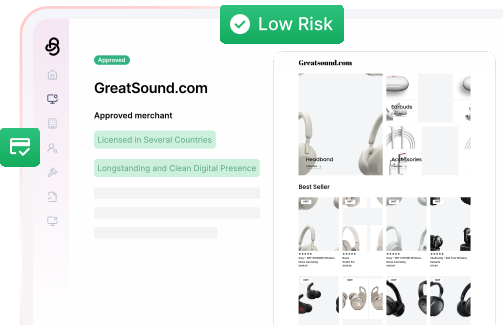
Ballerine is a Mastercard-approved Merchant Monitoring Service Provider (MMSP), certified to perform merchant scans on behalf of acquirers operating within the Mastercard ecosystem.
The platform combines AI-native web intelligence with gated content access capabilities - allowing risk teams to monitor merchant websites beyond the login wall, where prohibited content is most often concealed. Automated initial scans complete before the first transaction is processed, satisfying the pre-transaction mandate without adding friction to merchant onboarding. Ongoing monitoring runs continuously, generating the audit-ready documentation Mastercard requires and surfacing violations within the 15-day remediation window.
Acquirers, PSPs, and PayFacs working toward Mastercard MMP compliance can use Ballerine's MMSP infrastructure instead of building monitoring capabilities internally.
Can an acquirer act as its own MMSP?
Yes. Mastercard permits acquirers to obtain direct MMSP approval, allowing them to conduct monitoring internally rather than relying on a third-party provider. This path requires demonstrating to Mastercard that internal capabilities meet all MMSP standards. Most acquirers choose to engage an approved third-party MMSP given the technical investment required to build and maintain compliant scanning infrastructure.
Does every merchant need to be covered by an MMSP?
The January 2026 MMP updates apply to all merchants onboarded on or after January 1, 2026. These merchants must undergo an initial pre-transaction scan conducted by an approved MMSP. Ongoing monitoring requirements apply throughout the lifecycle of the merchant relationship.
What happens if an acquirer uses an unapproved monitoring vendor?
Using a monitoring vendor that lacks Mastercard MMSP approval does not satisfy the MMP requirement. Acquirers that cannot demonstrate coverage by an approved MMSP are exposed to BRAM enforcement actions, including financial penalties and potential program restrictions.
How long does the MMSP have to resolve a detected violation?
Mastercard mandates a 15-day window from detection to investigation and resolution. The MMSP provides the detection and evidence; the acquirer is responsible for executing remediation and documenting the outcome within this timeframe.
Is MMSP a Mastercard-specific requirement?
Yes. The MMSP designation is specific to Mastercard's MMP framework. Visa operates separate compliance programs, including VAMP and VIRP, which have different structures and approval mechanisms. Acquirers working across both card schemes need to ensure their monitoring infrastructure satisfies the distinct requirements of each program.
Reduced manual efforts
Improved review resolution time
Increase in detected fraud
.webp)




.webp)
.png)
.svg)


.webp)